
For millions of smallholder farmers and aquaculturists in Indonesia, agriculture serves as the backbone of household livelihoods and food security. In 2023, the sector contributed $170 billion to GDP and employed nearly 29% of the population. Approximately 17.2 million farmers in Indonesia are smallholder farmers who rely on traditional agricultural practices that can be labour intensive and low in productivity. They also face challenges such as market volatility, climate shocks, and rising input costs. Many lack access to capital, technology, and markets, making it difficult to build resilient livelihoods.
This is where Agritech can play a role to boost productivity and resilience. Over the past decade, nearly 270 Agritech companies in Indonesia have raised over $270 million, aiming to address smallholder challenges through digital solutions. Early tools included SMS alerts, basic apps, and online marketplaces. Now, with growing access to AI, startups in Indonesia are exploring how emerging technologies can deliver more adaptive, predictive, and locally relevant support across the agricultural value chain. The GSMA M4D Central Insights Unit, in collaboration with the UK-FCDO, has launched a project to explore how AI can improve the livelihoods of smallholder farmers and aquaculturists in Indonesia. This work builds on the learnings from the GSMA’s long-standing Agritech programme, which has supported the launch and scaling of digital solutions for smallholder farmers across LMICs, reaching over 220 million people.
AI for smallholder farmers in Indonesia
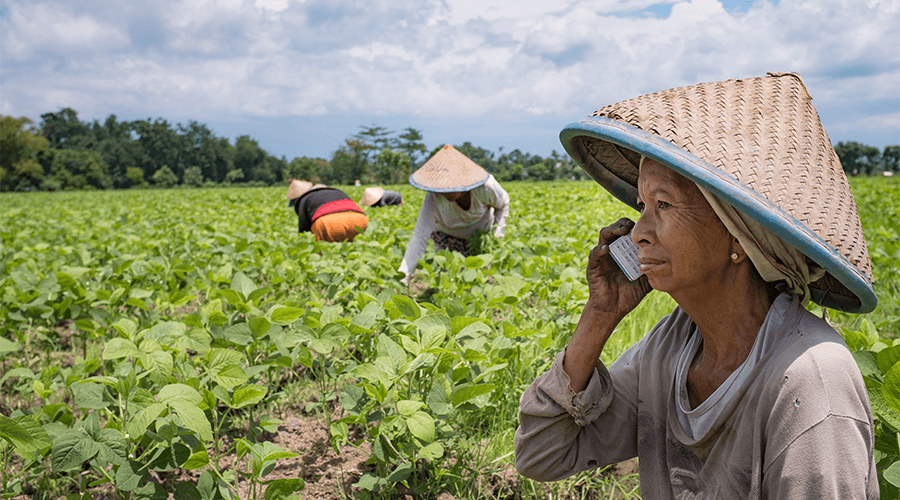
Agritech refers to the array of digital tools aimed at smallholder farmers including digital advisories, digital financial services for the rural sector, agri e-commerce platforms connecting farmers to markets, smart farming tools enabling automation and monitoring of farming activities and digital procurement solutions. Many of these tools are designed to work on basic phones or in low-connectivity environments, though some require internet or smartphone access. For smallholder farmers and aquaculturists in Indonesia, AI-enabled Agritech presents a powerful opportunity to address such challenges.
Indonesia is comprised of over 17,500 unique islands and therefore geographically diverse. The agricultural economy is highly fragmented. Smallholder farmers and aquaculturists in the country face multiple challenges throughout the value chain, the most prominent of which are as follows:
- Inefficient and fragmented distribution chains with lots of middlemen, resulting in profit losses
- Lack of real-time price transparency due to price fluctuations resulting from weather, pest outbreaks, and harvest uncertainty
- Limited reliability in buyer demand due to unmet quality standards, often resulting in post-harvest losses for farmers
- Lack of access to financial solutions and capital to invest in productivity improvements, limiting farmers’ income stability
- High post-harvest waste due to perishable goods and poor storage infrastructure
- Limited access to quality and affordable inputs (fertiliser, seeds, equipment)
The GSMA Connectivity Index indicates that Indonesia has high digital readiness, with 91% smartphone penetration, and widespread mobile internet access. Interestingly, the GSMA Mobile Gender Gap Report 2024 found that women in Indonesia adopted mobile internet at a faster rate and for more diverse use cases than men, further highlighting the country’s potential for inclusive innovation that is primed for AI adoption.
Challenges in Indonesia’s Agritech Startup Ecosystem

Indonesia has spent the past decade laying the groundwork for digital agriculture. Since 2013, initiatives like the National Movement of 1000 Digital Startups and Making Indonesia 4.0’s Agriculture 4.0 have accelerated innovation. The Ministry of Agriculture’s e-agriculture roadmap (2023-2027), developed with the UN FAO, aims to deepen digital integration. The National AI Strategy (2020-2045) also identifies food security as a priority.
Despite this momentum, several persistent challenges limit the reach and impact of AI-enabled Agritech. Funding gaps and fragile business models persist, often due to mismatches between investor expectations and agricultural realities. While venture capital often prioritises rapid growth and quick exits, which can clash with the longer timelines typical of agricultural innovation, there is growing potential for more patient capital and blended finance models that better align with the Agritech ecosystem’s needs.
Adoption of Agritech solutions by smallholder farmers and aquaculturists can also be challenging. Farmers may be risk-averse, given the volatility and seasonality of their livelihoods, and may be reluctant to invest in unfamiliar technologies especially when there is limited evidence of impact. Without clear demonstration of value, digital tools may seem irrelevant in solving pain points. New technologies may also be met with mistrust and scepticism by older and less digitally literate farmer cohorts. In cases where solutions are not designed with farmer needs in mind, uptake is further stalled. This underscores the importance of inclusive user-centred design to promote uptake of the services, ensuring that digital tools are relevant to local needs.
Emerging Opportunities

To overcome these barriers, AI-enabled Agritech must demonstrate immediate, tangible value while building on Indonesia’s existing digital infrastructure. By further localising the five main Agritech use cases identified by the GSMA M4D Agritech program, AI has begun to demonstrate tangible value for Indonesian smallholders and shows strong potential to further enhance impact across key agricultural domains.
1. Supply Chain Management
AI is beginning to untangle Indonesia’s complex archipelago logistics. For example, GSMA Innovation Fund grantee Koltiva, an Indonesian Agritech startup founded in 2013, is already providing seed-to-table traceability for smallholder farmers and is using AI to conduct household level profiling of farms, greenhouse gas emissions, and geo-reference mapping that helps ensure smallholder farmers’ compliance with the EUDR and other regulatory frameworks. Another Indonesian end-to-end cold solutions startup founded in 2022, Coldspace, is providing smart cold storage systems and uses AI to manage inventory and transport timing, helping to curb post-harvest losses resulting from poor supply chain management.
2. Agri DFS (Digital Financial Services)
Access to credit and insurance remains a barrier for many smallholders without formal banking records. AI-driven credit scoring and risk assessment provided by platforms such as CROWDE, an Indonesian fintech startup founded in 2015, and Semaai, an Indonesian Agritech startup founded in 2021, are opening doors to inclusive financing by analysing alternative data such as transaction histories, weather patterns, and farm activities. These systems allow farmers to secure loans for investment and obtain insurance to protect against climate risks and market volatility, thereby improving the resilience of their livelihoods.
3. Digital Advisory
Through widely used chat apps like WhatsApp, Indonesian Agritech startups are beginning to use AI to deliver personalised, real-time advice on key practices in agriculture. Neurafarm’s “Dokter Tania”, an AI powered chatbot app created in 2018, helps farmers identify pests and diseases, and has included features such as a crop cultivation guide and an “ask an expert” feature that links them to an agronomist. In 2023, the Indonesia Rice Research Institute, in partnership with Viamo, launched IVR Infoline, a voice-enabled service in rice farmers’ local language that provided advisory services catering to different literacy levels. Despite this, there is a lack of real-time voice interaction or conversational voice bots that provide agricultural advisory services in local languages in Indonesia.
4. Market Linkages
Traditionally, smallholders rely on layers of middlemen to sell their produce, often at low prices. Indonesian Agritech startups like Sayurbox, Jiva, and Aruna are using AI platforms to enable demand forecasting and allow for real-time price transparency, increasing farmers’ bargaining power and helping them to secure higher profits. These models also connect farmers directly with buyers such as exporters, processors, and domestic retailers, and can be expanded into further difficult-to-reach areas to ensure all farmers are linked to markets.
5. Smart Farming
AI-enabled precision agriculture providers based in Indonesia such as Precision Agriculture Indonesia, founded in 2018, and HabibiGarden, founded in 2016, allows farmers to apply fertiliser more efficiently and better manage scarce water resources. For shrimp farmers, the end-to-end aquaculture startup JALA, founded in 2015, offers IoT sensors and AI analytics that enable constant water condition monitoring. These early successes signal a growing opportunity to scale sustainable, productivity-enhancing technologies that can transform how smallholders manage Indonesia’s land and marine resources.
| Feature/Function | Non-AI Agritech | AI-Enabled Agritech |
| Productivity | Incremental yield improvements | Higher yields via predictive analytics and automation |
| Resilience | Limited early warning, slow response to shocks | AI-powered weather/pest forecasting, rapid adaptation |
| Supply Chain Management | Manual logistics, basic tracking | AI-optimised routing, predictive storage/transport |
| Financial Services | Mobile wallets, digital payments, basic credit | AI-driven credit scoring, tailored insurance products |
| Advisory Services | Generic SMS/app alerts, static recommendations | Personalised, real-time advice based on local data |
| Market Linkages | Basic online marketplaces, listings | AI-matched buyers/sellers, demand forecasting |
| Smart Farming | Scheduled irrigation/fertiliser, remote sensors | Automated, data-driven input optimisation, pest alerts |
When it comes to AI-enabled Agritech in Indonesia, our upcoming research seeks to identify the ways in which trust with farmers can be built and maintained, inclusive user design established, and sustainable financing models created so that smallholders, as opposed to just agribusinesses, see the benefits.
Our upcoming research, which will be published in early 2026, will identify how trust with farmers can be built and sustained, how interoperability between services can be achieved, how inclusive user design can be embedded, and how sustainable financing models can be developed, ensuring that smallholder farmers’ and small-scale aquaculturists’ livelihoods are enhanced with AI-based solutions.
The Central Insights Unit is currently funded by the UK Foreign, Commonwealth & Development Office and supported by the GSMA and its members. The views expressed do not necessarily reflect the UK government’s official policies.