
For many humanitarian innovators, grant funding is only the beginning. The harder question is often what happens next: how to strengthen the systems, products, evidence and partnerships that allow a promising solution to reach more people and last beyond the grant period.
This was a central lesson from the GSMA Innovation Fund for Humanitarian Challenges, launched in November 2024 to support for-profit small and growing enterprises, start-ups and local innovators using mobile and digital technology to respond to protracted crises. Across the cohort, grantees were already deeply familiar with the humanitarian challenges they were addressing. What they needed most was targeted support to build the foundations around their solutions — from stronger financial systems and product design to evidence generation, market positioning and technical documentation.
Throughout 2025, GSMA designed and delivered a tailored technical assistance programme for ten grantees working across eight countries, and all of them used mobile and digital technology to address some of the humanitarian issues perpetuated by protracted crisis. These organisations are achieving remarkable results with limited resources, whether they’re using IoT water quality sensors in flood-prone areas of Pakistan, deploying AI-driven early warning systems in Somalia, or providing microfinance loans to refugee women in Uganda.
What technical assistance looked like in practice
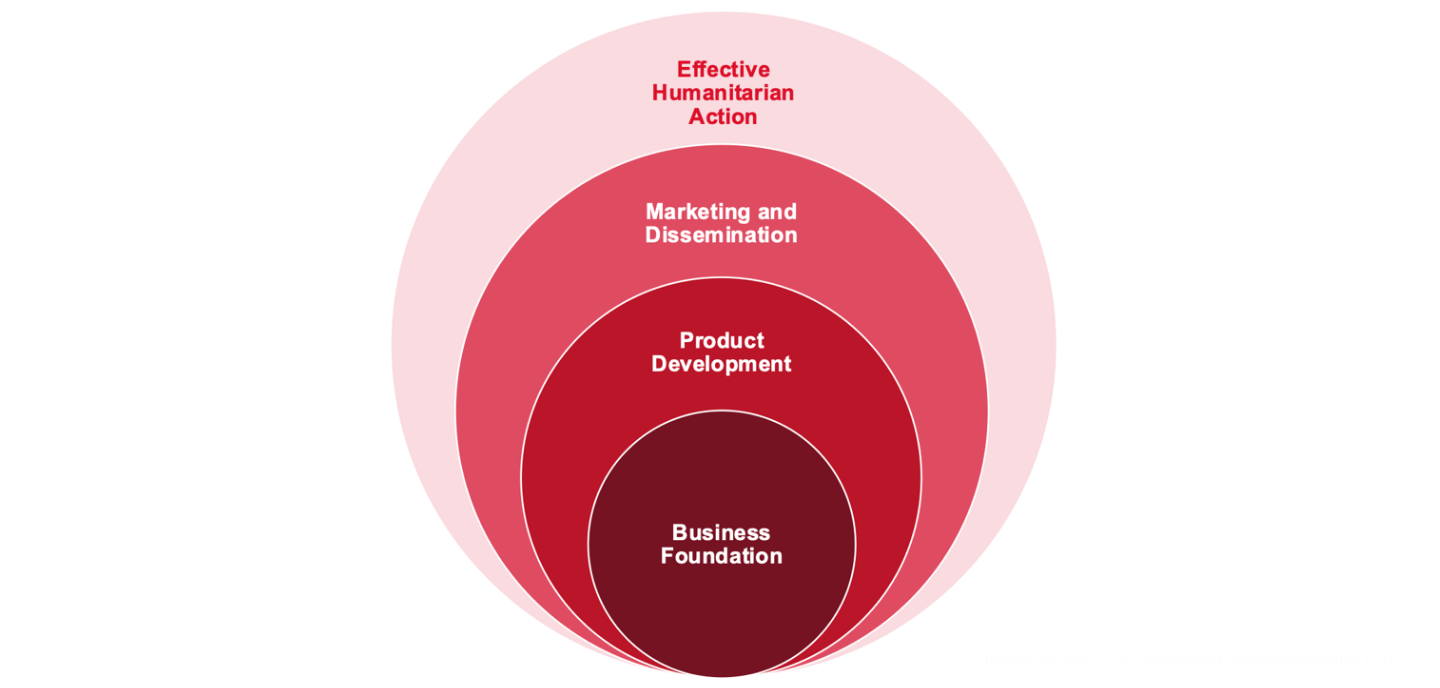
Technical assistance was designed around the specific needs of each grantee. Rather than applying a standard package of support, GSMA helped grantees identify the most important barriers to scale. To guide this process, we used a flexible four-pillar framework covering: business foundations, product development, marketing and dissemination, and effective humanitarian action. These pillars provided structure while leaving room for flexibility, ensuring the support remained closely aligned with each grantee’s context and priorities.
The resulting engagements varied widely. Some grantees focused on strengthening product functionality, such as GIS mapping, AI-enabled data collection, UX design or automation. Others used support to improve internal systems, prepare for certification, refine financial processes or sharpen their market positioning.
One striking insight emerged: although all grantees were addressing humanitarian challenges, none chose to use their technical assistance under the humanitarian action pillar. Instead, most prioritised product development, business foundations and marketing. This suggests that many innovators already had strong knowledge of the humanitarian problems they were solving, but needed support to build the infrastructure around their solutions so they could scale sustainably.
What technical assistance made possible
One of the clearest successes of technical assistance was its ability to translate the targeted investment into practical assets that grantees could continue using beyond the grant period. The TA engagements did not simply produce reports; they delivered tools, systems, documentation, training materials, strategies and evidence that strengthened each organisation’s ability to operate, scale and attract future support.
1) Strengthening internal systems and operational readiness
For several grantees, technical assistance helped build the operational backbone needed to manage growth. Patapia, for example, had been using two separate financial systems for operations and reporting. Through TA, the organisation was supported to design and implement a process for synchronising data between its microfinance software and QuickBooks, alongside staff training to ensure the new mechanism could be used independently going forward.
ConnectHear also used TA to strengthen its internal foundations. Support included ISO process documentation and technical documentation for its AI-powered and mobile app systems. This helped the team organise policies, standard operating procedures, architecture documentation, model pipeline guidance, debugging guides and deployment processes, reducing dependency on external support and improving readiness for future certification and scale.
2) Improving products so they are easier to use, maintain and scale
Product development emerged as the dominant area of support across the cohort. SmartWTI used TA to improve the user experience of its web dashboard and mobile app, including UX audits, stakeholder research, personas, journey maps, wireframes, high-fidelity prototypes and usability testing. This helped turn user feedback into clearer, more intuitive digital interfaces.
Somleng’s TA supported the development of a native Android SMS Gateway application connected to the Somleng platform. The resulting open-source application, source code, documentation, automated testing and CI/CD pipeline strengthened the organisation’s ability to demonstrate its OpenEWS system without relying on direct mobile network operator integration for SMS delivery.
For CIS PvT, technical assistance focused on automating microbial contamination analysis for drinking water. The work progressed from requirements analysis and system design to module automation, laboratory validation, on-site deployment and training. This helped reduce manual intervention, speed up response times and reduce the risk of human error in water quality testing
3) Turning data into better humanitarian decision-making
Several grantees used TA to strengthen how data is collected, interpreted and applied in humanitarian contexts. Helium Health integrated geospatial mapping into the HeliumDoc platform to support healthcare access in disaster-prone regions of Nigeria. The assistance supported geolocation data collection, a geospatial database of healthcare facilities, flood-risk mapping and a user-friendly interface for emergency response teams.
RAAGSAN’s TA combined GIS and AI support. The GIS component built internal capacity to collect, analyse and visualise spatial data, while the AI component helped the team use open-source data scraping tools, translation scripts and dashboards to gather weather information, alerts, river forecasts, humanitarian updates and social media reports. Together, these interventions strengthened RAAGSAN’s ability to triangulate field data and improve early warning services beyond the grant period.
4) Building market positioning and routes to sustainability
Technical assistance also helped grantees sharpen how they communicate, sell and position their solutions. Drop Access received support to develop a comprehensive sales and marketing strategy, including situational analysis, go-to-market design, product-level marketing and sales strategies, a branding handbook and a sales organisation structure. This gave the team a clearer pathway to market growth.
Exuus used TA across both communications and product design. The communications support produced a strategic marketing and branding plan, stakeholder and audience mapping, a communications toolkit, draft assets, staff training materials and success story guidance. The product support focused on UX research with refugee and low-literacy users, generating personas, journey maps, advisory notes and design recommendations. Together, these outputs positioned Exuus to communicate more clearly with users, partners and future funders.
5) Generating evidence for learning, adaptation and influence
For Viamo, technical assistance supported an evaluation of ‘Ask an Expert’, a voice-first generative AI tool designed to deliver life-saving disaster preparedness and response information in Urdu language through the Viamo platform in Pakistan. The evaluation examined accessibility and engagement, knowledge change and behaviour change, producing analysis, an evaluation report, a slide deck and a manuscript for academic submission. This kind of evidence is valuable beyond a single project. It helps innovators understand what works, refine their products and communicate impact more credibly to partners, donors and policymakers.
Why targeted support matters
Across the GSMA Innovation Fund portfolio, a consistent lesson is emerging: grant funding delivers more lasting value when it is paired with the right support at the right time. For early-stage innovators, this support can turn promising solutions into stronger organisations, better products and clearer routes to scale.
Evidence from other funding rounds reinforces this point. In the GSMA Innovation Fund for Climate Resilience and Adaptation, nearly three-quarters of technical assistance engagements helped reduce barriers to scale, showing how targeted support can strengthen both individual enterprises and the wider portfolio.
Flexibility is central to this. The most effective engagements respond to each grantee’s most pressing bottleneck, whether that means improving a product, strengthening internal systems, refining market positioning or building technical capacity.
The value comes from practical, usable outcomes that are closely linked to the grantee’s pathway to scale. When support is well designed, it can improve efficiency, strengthen investment readiness, open up new revenue models and build capabilities that last beyond the grant period.
Key takeaways from the cohort
- 1. The most valuable support is specific, not generic. Each grantee used TA differently because each faced a different barrier to scale. The strongest results came from matching support to a clearly defined operational, product, evidence or market need.
- 2. Product support dominated, but the need was broader than technology. Many grantees focused on product development, but the work often included documentation, user research, training, process design, deployment support and operational handover. This shows that technology-focused TA is most effective when it also strengthens the systems around the product.
- 3. Humanitarian innovators often know the problem; they need support to scale the solution. Across the cohort, grantees demonstrated deep knowledge of the humanitarian challenges they were addressing. TA was most useful where it helped them build the infrastructure, evidence, usability, governance or market readiness needed to reach more people sustainably.
- 4. Capacity transfer matters as much as the final deliverable. Several engagements included training, manuals, SOPs, editable templates, technical documentation and user guides. These outputs are important because they allow teams to maintain and build on the work without relying indefinitely on external consultants.
- 5. TA can improve value for money by extending the life of grant-funded impact. By addressing bottlenecks early, technical assistance helped grantees strengthen capabilities that will continue to generate value after the grant period ends. This is especially important in a constrained humanitarian funding environment.
Looking ahead
As humanitarian needs increase and funding becomes more constrained, funders will need to think carefully about how their funding support can create lasting value. The experience of this cohort shows that relatively small, well-targeted investments in technical assistance can make a meaningful difference when they address the bottlenecks that matter most.
For the GSMA Innovation Fund, the lesson is clear: backing innovation is not only about supporting promising ideas. It is about helping innovators build the capabilities, evidence and systems that allow those ideas to grow, adapt and reach more people over time.
This blog draws on close-out feedback from grantees of the GSMA Innovation Fund for Humanitarian Challenges, a fund supported by UK International Development and the GSMA and its members.
This initiative is funded by the UK government’s Foreign, Commonwealth & Development Office (FCDO) through its Global Research and Technology Development portfolio and is supported by the GSMA and its members.