


Other blogs in this series: Trusted digital ecosystems and Governing DPI in the age of AI
The long-term success of DPI depends on institutions, trust and continuous stewardship

The hard part starts after launch
The real test of digital public infrastructure sustainability is not launch, but legacy: whether the extraordinary can become ordinary.
That does not mean DPI will become a commodity. It means expectations rise. Technologies become ordinary when people no longer experience them as innovation, but as part of how things should work: reliable, trusted and available when needed.
As established in part one, the most transformative infrastructure is rarely the most visible. Few people think about the electricity grid when they switch on a light; they simply expect it to work. DPI should aspire to the same level of reliability and trust: enabling people to prove who they are, make payments and access services seamlessly, without needing to understand the systems behind them. Launch may prove that DPI can be built, whereas legacy proves whether it was built to last.
Launch is the offensive game: building momentum, mobilising resources and proving that change is possible. It may be the crescendo, but it is not the climax, which is normalisation: when DPI stops being a project and becomes part of how people, businesses and institutions get things done.
Legacy is the defensive game that follows: protecting trust, maintaining standards, adapting to risks and keeping the ecosystem working when political attention, funding cycles and launch momentum have moved on.
DPI’s forthcoming challenge is not to scale systems but to normalise them: to make trust routine, accountability visible, participation worthwhile and improvement continuous. That is how DPI moves from launch to legacy: from ambition to endurance.
Scaling means more than growth
As countries scale DPI, success is often measured in visible numbers: more users, more credentials, more transactions and more connected services.
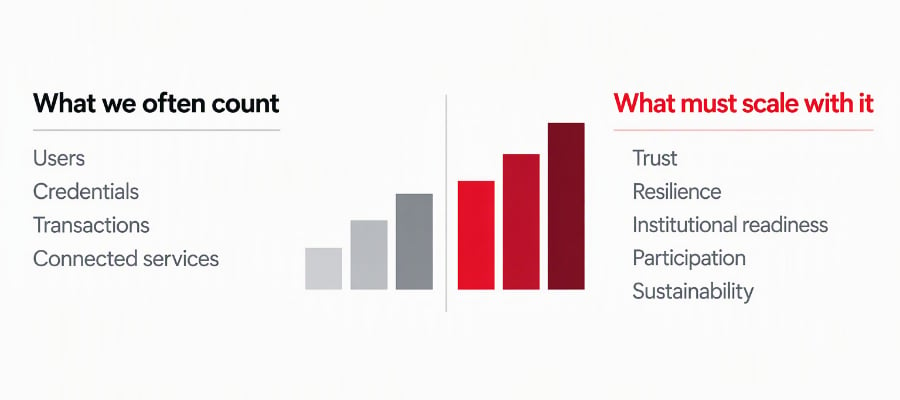
Those indicators matter, but they capture only one dimension of scale. The harder question is whether trust, governance and resilience grow at the same pace. Scale without confidence is not maturity: it is exposure.
Reuse is one of the clearest signs of real scale. A digital identity that is used once to open a bank account has done its job. One that is also recognised and trusted to access health records, claim benefits and sign contracts has become infrastructure. The same is true of payments and data exchange. Each new use should be cheaper, faster and safer than the last, because the foundations already exist.
DPI measurement should therefore evolve beyond activity and reach. Enrolments, transactions and integrations remain important, but they should be complemented by indicators of trust, adoption quality, institutional readiness, ecosystem participation, resilience and long-term sustainability. Without these, countries may scale what is visible while missing whether DPI is becoming useful, trusted and durable.
This means asking more honest questions. Are services reliable when demand rises? Are failed transactions monitored and resolved? Do users know how to complain, correct errors or challenge decisions? Are harder-to-reach groups actually using the system with confidence? Are private-sector actors, civil society and public institutions still willing to participate? Are incidents handled transparently? These are not secondary indicators. They show whether scale is deepening trust or merely increasing exposure.
As new actors join, the system itself becomes harder to hold together. Governance must evolve, standards must adapt, institutions must coordinate, cybersecurity must improve, incentives must remain aligned and innovation must continue without fragmenting interoperability.
This is where many systems face their second test. What worked in a controlled launch environment may not work once more institutions, service providers and users depend on the same foundations. Rules need to be clarified, responsibilities shared and feedback from real use built into how systems are refined over time.
Scaling is therefore not just about connecting more systems; it is about ensuring that confidence in those systems scales with them.

Stewardship is more than governance
Governance is essential to DPI, but it is not the same as stewardship. Governance sets the rules: who has authority, how decisions are made, what standards apply, how risks are managed and how accountability is enforced. Stewardship is the ongoing responsibility to keep the ecosystem healthy once those rules are in place.
In practice, stewardship means maintaining systems, monitoring performance, updating standards, coordinating institutions, responding to user feedback, managing cybersecurity risks and ensuring that incentives remain aligned as new actors join. It is less about a one-time compliance framework and more about continuous care.
That responsibility cannot sit with one actor alone. Governments remain central because they set direction, uphold public interest and provide legitimacy. But stewardship also depends on regulators, technology providers, mobile operators, financial institutions, innovators, civil society, academia and users themselves. Each sees different risks. Each brings different capabilities. Each has a role in keeping the ecosystem useful, trusted and responsive over time.
“Governance gives DPI legitimacy, but stewardship gives it durability.”
This distinction matters because many DPI systems are launched with strong governance frameworks but weaker arrangements for what happens next. Without stewardship, even well-governed systems can drift: standards become outdated, responsibilities become unclear, user trust weakens and the ecosystem starts to fragment.
Governance gives DPI legitimacy, but stewardship gives it durability. It is where compliance becomes care, and where institutional wisdom turns digital infrastructure into something that can be trusted, adapted and sustained over time.

From launch to legacy
Across this series, the message has been clear: DPI is not only about building the rails. It is about the journeys those rails enable, the actors they must bring in, the trust they must sustain and the value they must keep creating over time.
Part one reframed DPI as an ecosystem, not just an infrastructure project. Part two showed why artificial intelligence makes trust more operational, more urgent and harder to retrofit. Part three brings those arguments together around endurance. A DPI ecosystem only becomes a legacy when it can keep adapting without losing trust, keep expanding without excluding people and keep innovating without fragmenting the foundations on which others depend.
Launch is when DPI proves it can be built. Legacy is when it proves it can last. That happens less through headline numbers than through the quieter work of maintenance, adaptation and stewardship: institutions coordinating beyond political cycles, businesses and innovators continuing to participate, safeguards evolving with new risks, and people relying on digital services without needing to think about the infrastructure behind them.
That is the real test of DPI. Not whether it is celebrated as innovation, but whether it quietly becomes the standard people expect: trusted enough to rely on, open enough to evolve and valuable enough to last. DPI should be built to leave a legacy, not to become a legacy system.