


Access to electricity and reliable transport remains a key challenge to economic growth; telecommunications presents strong growth opportunities
The future economic growth of Malawi will predominantly be affected by the development of its key infrastructure sectors including power, transport and ICT (Information and Communication Technology). Strong policy support will be required to bring in the necessary investments to these sectors. Malawi faces acute problems with shortages in foreign exchange reserves resulting in fuel shortages and higher cost of imports.
Malawi’s economy predominantly depends on agricultural produce and productivity, which employs the majority of the country’s workforce. Agricultural export contributes to more than 80% of the country’s GDP. The agriculture sector faces key challenges in productivity and cost efficiency due to lack of infrastructural and policy support. Malawi’s conservative investment policies, trade barriers and an unsupportive investment environment continue to hinder foreign investment, which will remain a major obstacle to industrial growth and infrastructure development.
Transportation
Poor roads, underdeveloped freight and rail access, limited air links and poor access to ports represent Malawi’s transport infrastructure. Malawi is a landlocked country and heavily depends on the road infrastructure to support its economic activities. The rail infrastructure is far below standards and needs a significant boost in order to develop any sort of competitiveness to production activities. The cost of transportation also needs to be reduced. The domestic road infrastructure holds a major role in supporting and improving efficiencies in the key economic activities which include agriculture and allied services.
Power
The power sector holds the most potential for significant contribution to future growth and sustainability of Malawi’s economy. The power sector needs significant improvements reliability and access, in order to boost and sustain the economy of the country. The power supply situation in Malawi has limitation; reduced production capacity followed by poor transmission and distribution infrastructure.
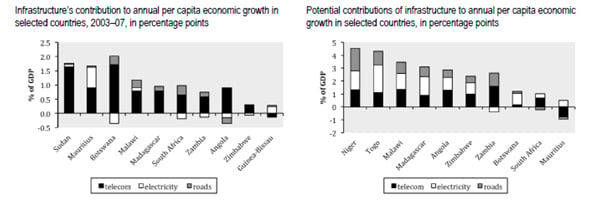
Source: World Bank, AICD Country Report
Communication
The ICT sector has been key contributor to economic growth in Malawi and has seen significant growth over the last decade due to major private participation in increasing the access to telecom services, predominantly the GSM services. However, affordability and cost of services are the key challenges to taking mobile communications to the next level and providing wide spread access and connectivity. The power and transport sectors hold key contributions to the cost of telecom services as the telecom operations are heavily dependent on these services in order to improve access and growth.
The lower penetration levels of key telecoms services such as broadband access, present good opportunities for investment and the overall growth of the sector.