




Mission 300 is a major new framework for accelerating electricity access across sub-Saharan Africa, with the goal of connecting 300 million people by 2030. Its importance lies not only in the scale of the ambition, but in the way it positions electrification as a broader system transformation challenge rather than a narrow infrastructure rollout. Led by the World Bank Group and African Development Bank, it aims to raise over USD 230 billion in public and private investment to achieve its goal.
Across the initiative, countries are setting out plans that combine grid expansion, distributed renewable energy, utility reform, regional power integration and private capital mobilisation. This creates a strong opportunity for digital and mobile-enabled solutions to act as cross-cutting enablers of delivery. From improving utility efficiency and revenue collection, to supporting PAYG energy models, customer engagement, productive use, data-driven planning and more effective service delivery in underserved areas, digitalisation has the potential to strengthen how electrification strategies are implemented in practice.
In this blog we will first look at the universal approaches that emerge from the published NECs to achieve M300 goals, then examine the role of digitisation across these approaches. Subsequent blogs in this series will deep-dive on country-specific NECs, and take a critical look at the state of play in the most prominent areas of digitisation.
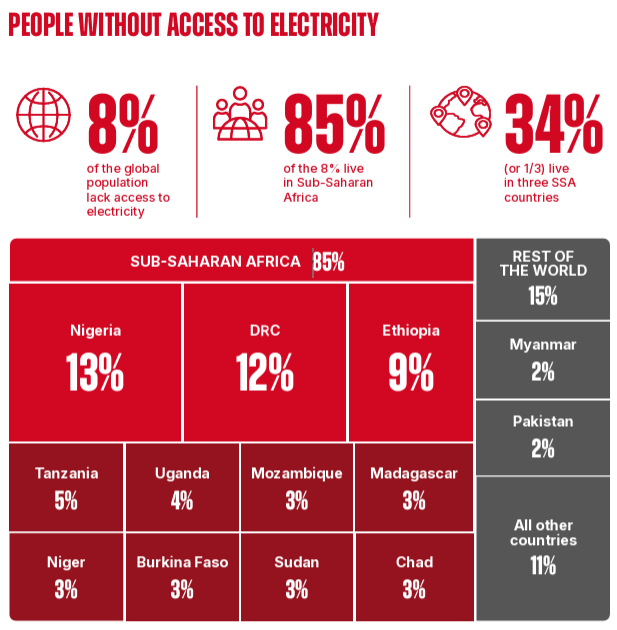
Mission 300 National Energy Compacts
A central and unique mechanism for Mission 300 is the development of head-of-state endorsed National Energy Compacts, which translate Mission 300’s continental ambition into country-level reform and investment plans. The compacts set out practical targets, reform priorities and implementation timelines across generation, transmission, last-mile access, utility performance, regional integration and private sector participation. So far, 35 countries have finalised and published their National Energy Compacts (NECs) under Mission 300. In doing so, they provide a common national framework that can align government, utilities, regulators, financiers and private-sector providers around shared priorities, clearer roles and coordinated delivery pathways.
Taken together, NECs offer one of the clearest available signals of the direction of travel for the sub-Saharan African energy sector over the next five years and beyond. This makes them especially important – not only as statements of political intent, but as practical frameworks for understanding how different parts of the energy system are being aligned to close energy access gaps. In this blog series, we use them as a window on how Mission 300 countries are leveraging digital solutions to support delivery, improve utility performance and help close implementation gaps in practice.
National energy compact archetypes
To extract more generalisable approaches from the 30 NECs published before June 2026, we clustered the energy transformation strategies set out across the compacts and identify the factors that most clearly shape national pathways. While the NECs differ in emphasis and context, four variables consistently emerge as the main differentiators:
- the maturity and reach of the grid,
- the degree of fiscal space and utility financial health,
- the strength of a country’s resource endowment and planning capacity, and
- the nature of the primary constraint to faster electrification.
Looking across the compacts through this lens helps move beyond country-by-country description and towards a more strategic understanding of how governments are approaching power sector transformation. On that basis, four overarching archetypes emerge that represent distinct approaches to energy access. While all of these approaches are represented within a given NEC, the degree to which these are emphasised varies based on the specific country context.
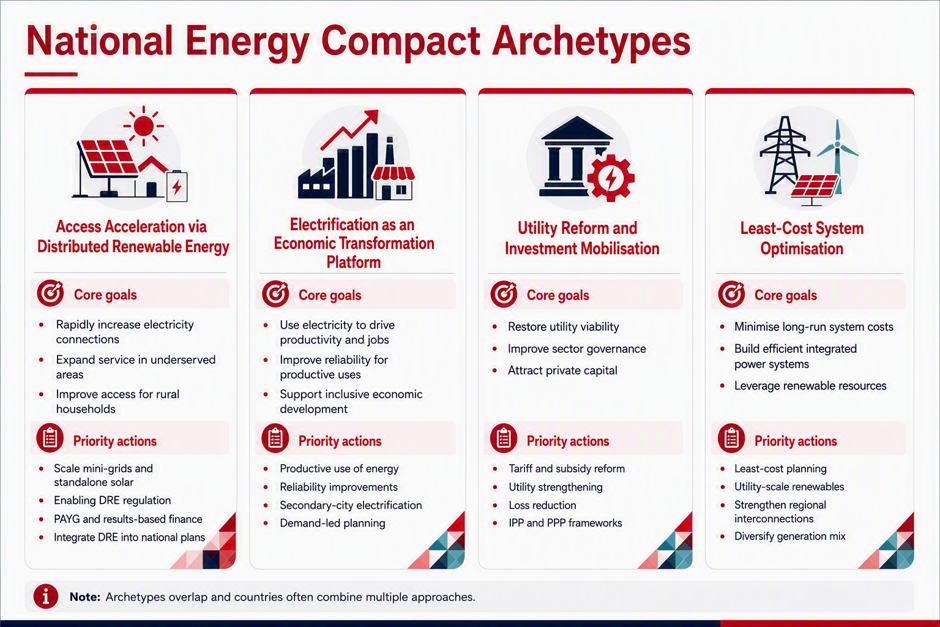
Many NECs in low-income countries with low grid reach emphasise an access-first strategy focused on closing the basic electrification gap as quickly as possible. These NECs prioritise rapid connection growth through minigrids and standalone solar, alongside enabling mechanisms such as PAYG, results-based financing, off-grid regulation and accelerated rollout in remote and underserved communities. Countries such as Malawi, Sierra Leone, Benin and Lesotho broadly illustrate this approach. Sierra Leone is a particularly clear example: with electricity access reaching only 36% of the population, its compact is strongly focused on expanding access, including a target to raise access to 80% through the deployment of 200 minigrids in remote communities.
In higher access contexts, the emphasis shifts to using electricity as a driver of productivity, jobs and economic development. NECs in this cluster place greater emphasis on improving the reliability of supply for MSMEs and industry, strengthening electrification in urban and secondary city contexts, and linking power expansion more directly to productive use and industrial growth. Countries such as Tanzania, Mozambique, Côte d’Ivoire, Botswana and Namibia broadly reflect this approach. Tanzania is a particularly clear example, with initiatives such as TREEP focused on bringing grid and off-grid power to rural homes, shops and local industries, while also developing industrial corridors and urban growth zones to deliver reliable power for SMEs, agro-processing and manufacturing.
In large or mid-sized power systems with more extensive grid infrastructure, the emphasis shifts to restoring the financial viability of the power sector and crowding in investment,though access and economic transformation remain important. NECs in this cluster prioritise tariff and subsidy reform, stronger utility governance, and measures to de-risk independent power producers and public-private partnerships, alongside improved planning and project preparation. Countries such as Nigeria, Zimbabwe, Republic of Congo, Zambia, Ghana, Cameroon and DRC broadly reflect this approach. Nigeria is a particularly clear example, where the Government aims to crowd in $1bn of private investment through the DARES programme by using public financing to reduce project risks, bridge commercial viability gaps, and support blended finance structures.
In countries with strong resource endowments and higher planning capacity, the focus shifts from basic access expansion to system optimisation and the integration of renewables at scale. NECs in this cluster tend to prioritise least-cost planning, utility-scale renewable generation, regional power trade and grid optimisation, reflecting systems that are better positioned to manage more complex transitions. Countries such as Kenya, Senegal, Ethiopia and Mauritania broadly illustrate this approach. Kenya is a particularly clear example: its NEC sets out an ambition to transition to a fully clean power system by 2030, building on a foundation in which renewables already account for 82% of installed capacity. Key initiatives include expanding the Olkaria geothermal field and hybrid projects such as the Siruai Wind and Storage project.
Digitisation’s place in NEC delivery
Having established a general sense of direction in strategies countries have put forward in their NECs, we next scanned for digitisation themes to understand where and how they play a role in countries’ action plans. Overall, we identified five clusters of digitally-related topics that featured in at least one third of NECs, summarised in the table below.

The most prevalent cluster focuses on the use of digital as core operational infrastructure to improve utility performance. In many countries, grids lose large shares of generated power through transmission and distribution losses, as well as inefficiencies in billing and revenue collection; in sub-Saharan Africa transmission and distribution losses alone are estimated at 26%. IoT-enabled smart grid approaches can help address these challenges by monitoring key indicators across the network, improving grid efficiency and reducing losses. This becomes especially important as grids integrate larger shares of variable renewable energy. Because utility performance is a priority across most NECs, even where it is not the primary focus, this theme appears in around 80% of published compacts.
Related to this, smart metering and mobile money integration provide an additional functional layer for both grids and minigrids. Together, they enable two-way communication between meters and utilities, supporting better load balancing and more efficient network management, while also allowing more accurate and automated billing that can reduce administrative costs. They also facilitate prepaid electricity provision, helping improve accessibility for low-income users, and support demand management through variable tariffs that can improve affordability. In turn, these tools can strengthen revenue collection, improve energy affordability and make tariff reform more feasible. Because of this broad relevance, the theme appears in a clear majority of NECs.
A third cluster focuses on the use of digital technologies to enable last-mile electrification through solar home systems, clean cooking, productive use assets and minigrids. In practice, these models depend on mobile money platforms, mini- and micro-grid monitoring systems, and remote asset tracking enabled by data and IoT networks. These capabilities are key enablers of pay-as-you-go and energy-as-a-service business models, which have significantly increased the accessibility of energy assets, as well as innovative financing approaches that further improve the affordability of both assets and energy provision. This theme is most relevant in countries where accelerating access remains the core priority.
A fourth cluster relates to the use of digital tools to strengthen planning, data and transparency across the power sector. In many NECs, better data is treated as a prerequisite for more effective investment decisions, stronger coordination and improved accountability. Data-driven tools such as those catalogued by the International Energy Agency include datasets for geospatial planning, demand forecasting and asset mapping, helping countries prioritise scarce resources, reduce planning uncertainty and improve visibility over implementation progress. In Ghana, the regulator is integrating datasets to monitor and manage utilities more actively, shape regulatory reform and improve delivery of its Mission 300 goals. This theme is especially relevant where weak data and limited transparency constrain reform and investment mobilisation.
The final cluster focuses on the use of digital technologies to enable impact-linked financing streams for private sector energy providers. Institutional investors seeking measurable impact, as well as voluntary carbon markets, increasingly require robust data to validate outcomes and reduce perceived risk. This is driving greater interest in real-time digital measurement, reporting and verification (dMRV), alongside digitally enabled results-based financing, where finance is closely linked to verified delivery outcomes. In turn, these models can help channel the concessional capital needed to make energy provision commercially viable for private sector providers operating in underserved markets.
Implications
Overall, NECs focus on areas where digitisation can deliver near-term gains in planning, grid optimisation and access expansion. Given the compressed five-year timelines, frontier technologies such as AI and blockchain do not feature explicitly in most compacts, though they may emerge in narrower applications linked to optimisation and results-based financing. Taken together, the NECs suggest several implications for implementation feasibility.
- The emphasis on grid optimisation and smart metering implies a need to strengthen the mobile and IoT ecosystem, including co-investment where needed, to support smart grid functionality.
- Digitising utilities remains a major challenge in its own right: these are often large legacy organisations, and both internal capacity-building and outsourcing to private partners come with trade-offs.
- More integrated and hybrid energy systems, alongside rising use of decentralised renewables for production, as advocated for in most NECs, increase the need for system-level coordination, including active load management with mechanisms such as virtual wheeling and energy trading.
- Expanding the productive use of energy depends on progress across the wider system – from digital planning and network optimisation to tailored customer management – but maximising impact will require a more explicit productive-use lens.
In the next blog in this series, we will explore these implications in more detail, reviewing the main challenges and emerging best practices. The final blog will then examine how these issues play out in specific country contexts.
The questions explored in this blog form part of a broader conversation about the future of energy access. Our latest report, Productive use of Energy Across Energy Systems, examines how digital solutions are shaping the adoption and scaling of productive use of energy (PUE) across India, Kenya, Uganda, and Nigeria.
Read the report here