
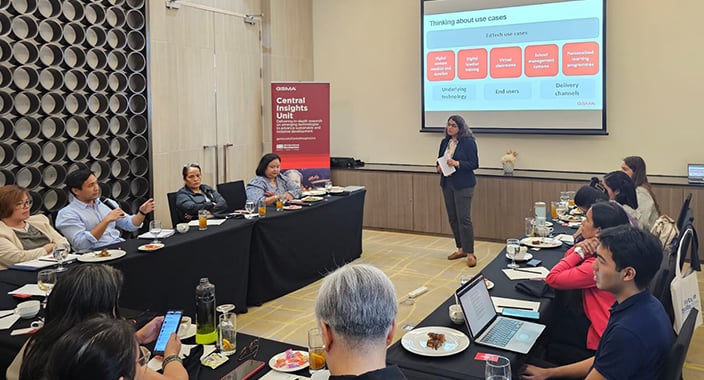
Last month, GSMA Mobile for Development and UK-FCDO brought together regional educational technology (EdTech) experts including EdTech providers, research institutions, civil society organisations, academic institutions, NGOs and telecommunications companies to discuss key challenges to implementing EdTech interventions in the Philippines.
This blog reflects on the importance of EdTech in the Philippines, examines three key insights generated from the roundtable and lays out the steps needed to scale the impact of EdTech in the country.
Why are Edtech solutions so vital in the Philippines?
The Philippines is among the lowest performing countries in education outcomes due to factors including high levels of poverty, extreme weather events, insufficient resources and public infrastructure and domestic issues such as ongoing armed conflicts.
Poor performance in the education sector is holding back the future workforce, affecting its global competitiveness and impacting the country’s socio-economic development.
Digital and mobile technologies offer the opportunity to drastically improve learning outcomes, however several barriers, discussed below, need to be addressed to increase the adoption of EdTech solutions in the country.
What the experts said
The Covid-19 global pandemic accelerated the use of digital tools for education in the Philippines. Popular use cases of EdTech include audio-visual tools, such as radio and TV, smartboards, virtual classrooms, and learning management systems. In addition, social media platforms such as YouTube, Facebook Messenger, and WhatsApp have also emerged as popular delivery channels for online learning.
There are several EdTech interventions deployed by international development agencies including ADB and UNICEF, as well as international EdTech providers like Khan Academy, who have partnered with the Philippines Department of Education for remedial learning programmes.
Stakeholders also observed that while there is considerable potential for emerging technologies like AI and AR/VR to be deployed, investment in public infrastructure is vital to enable tasks like assessment and grading, online tutoring, vocational and technical courses and teacher training. In practice this means providing smartphones and tablets, VR headsets, and computer labs in schools and ensuring there are enough devices for all students. Lack of access to devices has been flagged as a key barrier to EdTech implementation.
The Philippines is an archipelago, comprising more than 7000 islands with diverse geographies. This means that EdTech solutions must be adapted to work for different levels of digital connectivity and mobile phone access. In addition, electricity supply and internet connectivity also vary across different regions, especially on some of the outer islands, where mobile connectivity is poor.
Given this diversity, it is important to balance EdTech solutions that demand higher digital and technical requirements with Edtech solutions that can operate on feature phones and TVs. This will also ensure that the solutions are cost-effective and inclusive for all schools to implement.
Teacher training and digital readiness were highlighted as key barriers to the adoption of EdTech. While EdTech solutions may have the potential to make learning processes more effective and efficient, current deployments of EdTech are perceived as time-consuming and inefficient by teachers. Teachers are reluctant to adopt new platforms and tools that add to the already overscheduled workdays.
Furthermore, there is a lack of guiding strategy from the government at the national and regional level on the use of EdTech tools; as a result, teachers undergo trainings on several different EdTech platforms (e.g. Adobe, Canva, tools by Google or Microsoft, etc.) without enough time to become accustomed to using them.
For EdTech solutions to be successfully implemented, there has to be demonstrable impact linked to them. It is crucial to develop incentives for teachers to use EdTech in their teaching, and teacher training courses should account for the existing digital skills of teachers to make sure that they address actual gaps in classroom learning.
Actions needed to scale EdTech adoption
Robust monitoring and evaluation (M&E) processes, region-specific educational content and policy frameworks to guide the implementation of EdTech were some of the key next steps highlighted by roundtable attendees. While there are several pilot projects and short-term EdTech interventions in place, there is a need to conduct comprehensive M&E to determine their impact on students’ learning outcomes.

Anecdotally, EdTech solutions that used gamified content were linked to increased attendance in school as well as engagement with learning. Customising content and material to the regional context of the learners, such as providing examples from their daily life and in local languages is another way of ensuring learner engagement. The importance of reviewing learning material to assess its appeal to students and teachers and its relevance to a variety of geographical contexts was emphasised.
Additionally, in the absence of a national guiding framework for EdTech use in the country, there are considerable silos among government agencies as well as other key players in their efforts to introduce EdTech in the Philippines. To identify and scale effective and sustainable EdTech solutions, some key measures include:
- Presenting a national and regional strategy for EdTech
- Facilitating increased collaboration among stakeholders
- Conducting needs-based capacity building of teachers
- Increasing M&E efforts
- Digitising existing school records and learning content to enable the use of emerging technologies like AI in education.
Want more? Read our other blogs detailing the potential of Emerging Technology for impact or keep your eyes peeled for our upcoming report on EdTech in the Philippines later this year.
The Central Insights Unit is currently funded by the UK Foreign, Commonwealth & Development Office and supported by the GSMA and its members.