Nigeria’s agriculture sector involves over 40 million households and is vital to its economy and global food production. However, smallholder farmers face significant challenges accessing market and capital, preventing them from achieving self-sufficiency and improving their livelihoods.
This blog explores how the Nigerian agritech company Winich Farms (“Winich”) addresses these challenges by creating market linkages between producers, input dealers, and buyers, and providing innovative financial solutions that help farmers access much-needed capital.
The challenges facing Nigerian agricultural value chains
Nigeria, Africa’s most populous country and one of its biggest economies, relies heavily on agriculture. Agriculture contributes 23% to its Gross Domestic Product (GDP) and provides a livelihood for over 70% of households. Yet, systemic challenges limit its full potential.
Market access is a key issue. High transportation costs, distant markets, limited price transparency, and post-harvest losses force farmers into inefficient value chains dominated by intermediaries, reducing their earnings. Poor rural infrastructure further exacerbates these challenges, increasing waste and restricting access to markets, inputs, and technologies.
Access to finance is another hurdle for producers. Only 34% of rural residents, mostly in farming households, hold an account with a formal financial service provider (FSP), compared to 45% nationally. With 95% of agricultural land lacking titles, farmers struggle to provide collateral to secure credit to invest in farm improvements. Informal predatory lending for inputs further exacerbates the problem, creating cycles of debt that are hard to escape.
On the produce buyers’ side, limited access to quality data, inadequate tracking and traceability systems hinder informed decision-making, inventory management and quality assurance, making it harder to align supply with demand.
Addressing these issues through innovative solutions can empower Nigerian agricultural value chains, enhance livelihoods for farmers and drive agricultural trade and broader economic growth.
Winich connects Nigeria’s smallholder farmers to market
Founded in 2020, Winich aims to improve efficiency and streamline operations within agricultural supply chains. Driven by the ambition to increase earnings for food producers and ensure a steady supply of produce for most small processors, the company operates as a digital marketplace connecting Nigerian smallholder farmers with market off-takers.
The unique value proposition of its platform relies on its inventory management and tracking feature, allowing off-takers to oversee stock and orders in real-time. Its fulfilment centres also simplify processing and distribution.
Central to the agritech’s operations is its dual-app solution, which includes:
- An agent functionality, enabling farmer registration, produce aggregation, and payment facilitation at the community level, empowering agents to bulk produce for processors.
- An off-taker functionality, allowing small-scale processors to order remotely, complete payments, and receive produce directly at their premises, eliminating concerns over product quality or logistics.
In February 2024, with the support of the GSMA Agritech Accelerator and our UX partner Bopinc, the company enhanced the user experience of the app, focusing on registration and procurement processes to boost adoption and regular usage. This led to a reduction in drop-off by 83%, an increase in sign-ups by 71%, and a 52% rise in orders.
By the end of 2024, Winich had served over 180,000 users, including farmers, small processors, and agents, facilitating over $30 million in gross merchandise value that year, and reducing farmers’ reliance on intermediaries for a stable supply of produce.
Building on its foundation of market access facilitation, Winich also aims to facilitate input financing, mechanisation, and market information access, which may further enhance farmer productivity and livelihoods.
Embedding financial services to market aggregation to further improve farmer livelihoods
Since 2023, Winich has been working on embedding digital financial services into its platform to address the challenges of cash-based transactions while empowering farmers with the financial tools they need to grow their businesses. Recognising that financial services for agriculture requires well-structured partnerships, Winich has launched several initiatives aimed at enhancing farmers’ financial inclusion and access to tailored financial solutions.
Digital payments
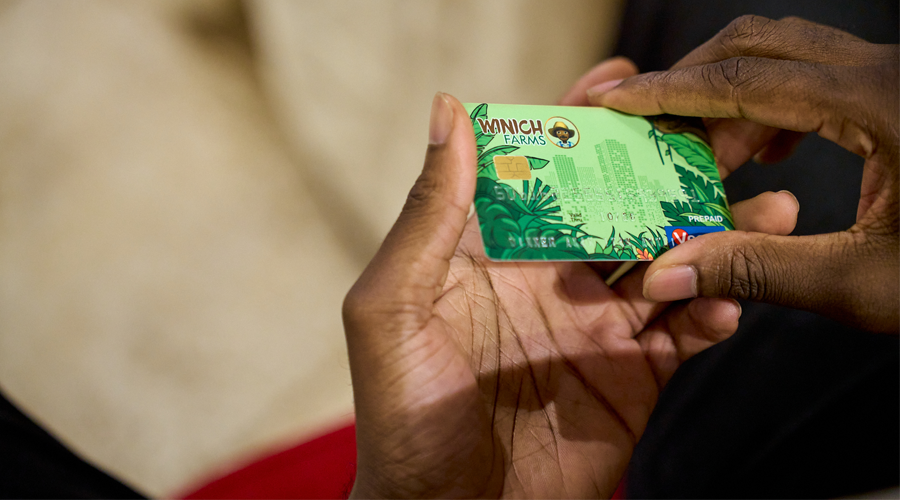
In partnership with Sterling Bank and Providus Bank, the company introduced automated digital payments. Farmers now receive payments digitally via branded debit cards, enabling them to access immediate compensation upon delivering their produce. The cards function as savings accounts, allowing farmers to set aside funds for future farming seasons or personal needs.
Credit: Mouhamdou M. Camara (MMC)
To incentivise adoption, the banks and Winich agreed to provide the cards free of charge to farmers. The applicable cost of ₦2,400 (approximately $1.62) per card is shared between the partners, with the expectation of recovering it over time through transaction fees generated by the farmers’ usage.
Farmers’ willingness to accept cards largely depends on their access to convenient cash withdrawal points, should they choose not to store funds on their cards. To address this, Winich intends to provide POS terminals (incorporating Winich app’s agent functionality) to agents at aggregation points. These terminals will facilitate both the onboarding of farmers’ produce and the cashing out of payments, with cash management being the sole responsibility of the agent.
In parallel, partner banks offer financial literacy training to farmers as part of the card rollout, helping them effectively use the cards and access ongoing customer support. Over 25,000 cards have been distributed so far, with a target of reaching 195,000 by September 2025.

Credit: Winich Farms
Access to credit
To facilitate access to finance for producers, Winich has established a partnership with SeedFi, a Nigerian fintech company, to roll-out produce-collateralised loans. Interested farmers can leverage their crops stored in Winich’s warehouses as collateral, eliminating the need for traditional asset-based guarantees. The funds from these loans can be used at the farmers’ discretion. The pilot, set to launch on April 1, 2025, will initially target 700 farmers.
The agritech has also created an Application Programming Interface (API) to share (upon request) analysis of farmers transaction records and produce sales data on Winich’s system with FSPs. This helps FSPs in assessing farmers’ creditworthiness and informs their lending decisions.
In addition to smallholder farmers financing, Winich, in collaboration with a bank, offers a “Buy Now, Pay Later” facility for their off takers. Winich’s off-takers can obtain financing at any of the bank’s branch. This option facilitates more consistent produce deliveries and deferred payments, thereby supporting supply chains and business operations. However, the current interest rate of 35% per annum is somewhat limiting the attractiveness of this offer.
Looking forward
Through these targeted initiatives, Winich is promoting financial empowerment for smallholder farmers and fostering inclusive growth within Nigeria’s agricultural value chains. In 2025, the company intends to onboard 400,000 new farmers and diversify their list of partner FSPs to enhance their offerings. Establishing themselves as a gateway for agricultural financing will remain a top priority. To sustain their financial inclusion efforts and scale operations, Winich will actively pursue investment opportunities, with a Series A fundraising round planned for 2025.
The GSMA AgriTech Accelerator is funded by the German Federal Ministry for Economic Cooperation and Development (BMZ) and supported by the GSMA and its members.