


Despite the transformational benefits of mobile internet and near universal broadband network coverage1 in India, roughly 423 million people still do not have an internet-enabled device. Women and rural populations are significantly less likely than men and urban populations to own such devices. For example, the GSMA estimates that around 53% of women in India, approximately 258 million women, do not own an internet-enabled device, compared with 32% of men, around 165 million men.2
Handset affordability remains one of the most persistent barriers to mobile internet adoption in India, particularly for low-income individuals and the underserved. This challenge goes beyond the ability to pay and includes a lack of willingness to invest in a device. As a result, addressing affordability requires more than incremental price cuts; it demands a holistic approach that rethinks device pricing, consumer financing, design, distribution and consumer education. In particular, targeted consumer education initiatives are essential to increase understanding of the practical benefits of mobile internet, while also building trust in their safety and relevance for everyday activities.
Reliance Jio has pursued such initiatives to lower barriers to mobile internet use, combining ultra-low-cost 4G devices, affordable service plans, and complementary interventions for underserved users. Jio’s handset portfolio has evolved over time, offering ultra-low-cost 4G devices with a clear pathway to smartphones:
- 2017-2018: JioPhone smart feature phones ranging in price from ₹1,500 (~$18) to ₹2,999 (~$36)
- 2019-2020: JioPhone prices revised to ₹699 (~$8.5)
- 2021: JioPhone Next entry-level smartphone (~$80 at launch; later ~$40)
- 2023-2024: JioBharat ultra-low-cost 4G feature phones priced between ₹699–₹1,799 (~$8.5–21.7)
Since the launch of JioPhone and JioBharat 4G phones, Jio has sold over 175 million devices. Of these, 70% were upgrades from 2G devices, representing new mobile internet users, and 30% were first-time Jio customers with many likely being first-time internet-enabled device owners. JioBharat 4G phone users also show higher representation of women and rural populations compared with Jio’s historical network customer base, underscoring the strong digital inclusion impact of Jio’s efforts.
Key learnings from Jio’s handset affordability strategy
1. Ultra-low-cost 4G devices drive adoption, while affordable data plans boost retention and mobile internet use
About 24% of India’s population live below the low- and middle-income country poverty line of $4.20 per day according to the World Bank. GSMA analysis suggests that a handset is generally considered affordable if it costs no more than 20% of average monthly income3. At entry-level prices as low as ₹699 (approximately $8), JioBharat 4G phones are more affordable than most entry-level 4G devices. At this price point, a JioBharat 4G phone represents roughly 6–7% of average monthly income for lower-income segments, making it accessible to a relatively large share of underserved users.
Crucially, greater affordability is reinforced by low-cost, JioBharat 4G-exclusive data plans. A standard prepaid plan costs ₹123 per month (~$1.50) for 14 GB of data, unlimited voice, and Jio services such as JioPay mobile payment application, encouraging sustained engagement among first-time users. Even after upgrading to smartphones, users can access plans around $4 per month (with unlimited 5G data), helping reduce churn and maintain long-term mobile internet use.4
2. Local manufacturing at scale, design-to-cost, and strategic price matching are key strategies for reducing cost
Jio’s ability to sustain ultra-low prices rests on three structural levers:
- Local manufacturing and economies of scale: Devices are manufactured in local Indian factories, thus leveraging local low-cost manufacturing procured in very high volumes, allowing lower per-unit costs that are passed on to consumers.
- Design-to-cost principles: Devices exclude expensive features such as touchscreens, high-resolution cameras, large storage, or costly operating systems, focusing instead on basic functionality including cloud capability which enables the device to provide Jio’s application ecosystem with limited memory footprint, optimal screen size for usage and simple keypads. These design choices, combined with OEM negotiations, enabled substantial cost efficiencies in device production.
- Strategic price-matching: As part of its mission to ‘connect over 1.3 billion Indians to a digital life‘, Jio is supporting the onboarding of new mobile internet users to its network while focusing on longer-term ARPU. Crucially, JioBharat 4G phones are priced roughly on par with 2G devices, giving an incentive for 2G users to purchase internet-enabled 4G devices; effectively throttling demand for 2G devices.
This combination of measures ensures that JioBharat 4G devices are both affordable and strategically positioned to onboard first-time mobile internet users.
3. Smart feature phones provide a commercially viable stepping stone
In the medium to long term, many users upgrade from a JioBharat 4G phone to a smartphone. Of roughly 175 million smart feature phone users on Jio’s network since 2017 (including 35 million JioBharat 4G phone customers), around 140 million (~80%) have transitioned to smartphones, typically after 3 years of usage.
4. Embedding digital skills and inclusive design supports low-literacy users
Low-income and first-time users of internet-enabled devices often face challenges with literacy, digital confidence and skills, particularly women and rural populations. Jio addresses this barrier by embedding digital education into the device journey. Jio delivers instructional videos directly to users using content from the GSMA Mobile Internet Skills Training Toolkit (MISTT), which it has translated into eight additional Indian languages5 and tailored to better reflect the needs of women6. JioBharat 4G devices operating KaiOS also include in-device “skills cards”, which push relevant tutorials based on individual usage behaviours. To further support low-literacy and underserved users to access mobile internet confidently, devices and services are available in 23 Indian languages and include voice-based features.
5. Bundled services can significantly increase perceived value
JioBharat 4G devices come preloaded with a broad suite of free services, including JioPay, JioTV (over 500 local channels), JioHotstar sports content (including cricket), and the JioChat messaging service. This bundling significantly enhances the perceived value of inexpensive devices, boosting willingness to pay and driving strong demand for Jio services. For example, around 80% of digital payments on smart feature phone UPI7 (the national feature phone payment platform) are made via JioBharat 4G phones, while the majority8 of JioBharat 4G users consume content on Jio streaming platforms on any given day. By embedding these use cases into daily life, the devices foster habitual usage while delivering consistent, tangible value to consumers.
6. Sales and distribution innovation ensures last-mile reach
Lastly, affordable devices must be easy to access for underserved users, and Jio is trialling several innovative approaches to improve this:
- Expanding last-mile retail outlet network: 2G customers are notoriously hard to reach due to relatively low exposure to TV, print, or social media. Jio finds the most effective way to reach them is through last-mile retail outlets, which 2G customers typically visit monthly to recharge airtime. These customers often do not carry much cash, and small retailers struggle to hold device stock due to limited capital, space, and security. Jio’s advance-booking model allows customers to reserve a JioBharat 4G handset with a ₹100 (~$1.20) down payment and complete payment of ₹599 (~$6.60) on collection. Through partnerships, Jio has expanded its JioBharat 4G-stocking retail network to over 600,000 outlets.
- Jio distributor network and pop-up kiosks: Jio distributors carry stock in backpacks, sometimes on credit, and set up mobile kiosks with branded umbrellas and signage. They position these kiosks at high-traffic confluence points such as railway stations, markets, factories, and other areas where underserved and typically unconnected customers naturally gather. This approach captures commuters and daily shoppers, making JioBharat 4G devices visible and accessible in locations where traditional retail may not reach.

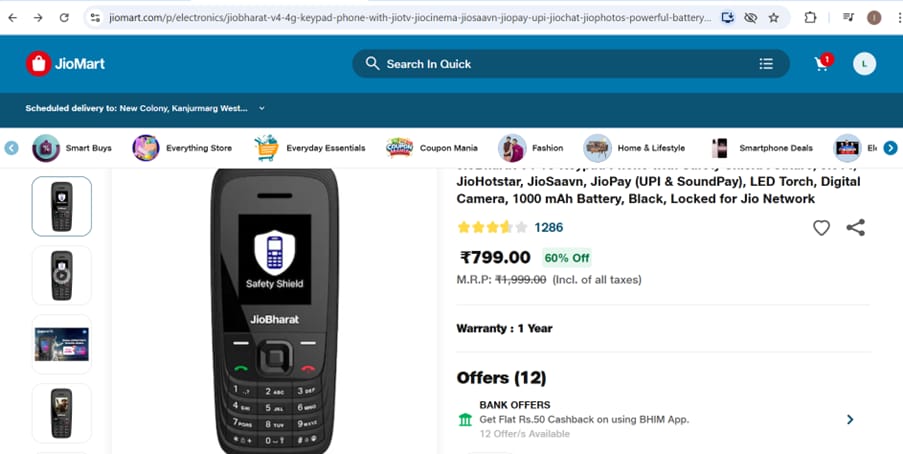
- Selling JioBharat 4G devices through e-commerce and quick-commerce9 platforms to enable third-party delivery: Jio has made the JioBharat 4G range available on widely adopted platforms including JioMart, Amazon and Swiggy Instamart, which, according to Jio, cover around 80% of the country. These platforms enable existing internet users to purchase JioBharat 4G devices online and have them delivered to family members or employees in other locations who do not yet own one.
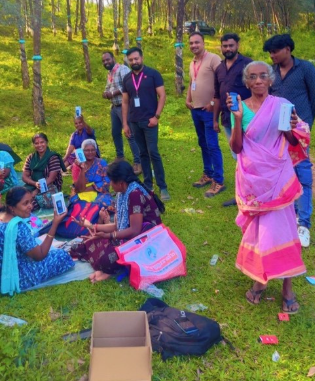
- Self-help groups (SHGs) to reach women: Jio shared that most SHG female leaders own smartphones to access government schemes and digital payments. They are supported by Jio to promote and earn commission through selling JioBharat 4G phones, with messaging focused on practical benefits rather than technical features. For example, communications emphasise that JioBharat 4G phones allow women, who often lack autonomous access to entertainment, to watch JioTV, us JioPay to securely check bank balances, manage small business transactions, and save money securely, increasing both convenience and financial control.
- Targeting smartphone users through CVM/in-app notifications to purchase JioBharat 4G phones for their family and employees: Through its digital products and services, Jio reaches over 500 million smartphone users, including many not yet on Jio’s network. It uses customer value management (CVM) tools and in-app notifications to encourage these users to purchase JioBharat 4G phones for family members or employees who do not yet own an internet-enabled device.
Looking ahead
Jio is expanding its efforts for underserved users across several fronts:
- Expanded distribution: Through additional partnerships, Jio aims to expand its JioBharat 4G device retail network from 600,000 to 1 million outlets. It is also piloting last-mile delivery via money-transfer chains, which cover urban–rural remittances, enabling people in one location, such as cities, to purchase JioBharat 4G devices for family members in rural areas and have them delivered.
- Enhanced safety for women and vulnerable customers: Jio is launching JioBharat Safety Shield, featuring call whitelisting which allows users to restrict incoming calls to only approved contacts, aiming to reduce exposure to fraud and, particularly for women, reduce exposure to unsolicited harassing or threatening contact. Jio’s safety feature also includes location sharing, allowing users to share their location with trusted contacts when they choose. This feature can also serve as a practical safety tool for families with children or dependent adults. To use this feature, a family member must download the JioThings app on their smartphone and pair it with the user’s JioBharat 4G phone.
- Gender-intentional marketing: Jio is optimising JioBharat 4G device promotions to better resonate with women, using imagery of diverse women and messaging that highlights relevant and socially acceptable benefits and use cases for women and their families.
Conclusion
Jio is helping bridge the 2G-to-4G divide by offering ultra-low-cost JioBharat 4G devices at a sub-$10 price point. Its compelling value proposition combines affordable data plans, embedded digital services and the innovative Safety Shield feature, which enhances consumer trust and fraud protection for more vulnerable users.
Through a multi-channel go-to-market strategy, these devices have reached diverse user groups across both urban and rural areas, as well as male and female populations across India, enabling broad-based access for underserved users. With more than 35 million JioBharat 4G phones sold and smartphone migration rates of up to 80%, Jio’s approach reflects a longer-term view of commercial sustainability.
The Jio model offers practical strategies for mobile operators and other organisations seeking to expand digital inclusion among underserved populations.
[1] 99% of Indian population are covered by 4G while 82% are covered by 5G.
[2] Source: GSMA (2026), Mobile Gender Gap Report 2026, in publication. Based on nationally representative survey data.
[3] Analysis to Improve Handset Affordability
[4] As of December 2025
[5] The Mobile Internet Skills Training Toolkit (MISTT) is available in ten Indian languages. Originally developed in Hindi and Tamil, it has since been translated into Marathi, Oriya, Telugu, Malayalam, Bengali, Gujarati, Punjabi and Kannada.
[6] Report: Understanding people’s mobile digital skills needs Insights from India and Ghana | MISTT modules: Learning and discovering for your family | Connecting with family
[7] National Payments Corporation of India’s Unified Payments Interface (UPI) is a real-time digital payment system in India that enables instant bank-to-bank money transfers through mobile devices.
[8] More than two-thirds of JioBharat 4G users access content on Jio’s streaming platforms on most days, highlighting the strong demand for digital content among users of affordable internet-enabled devices. During special occasions such as election periods, engagement increases further, with around 80% of users accessing content on these platforms.
[9] Quick-commerce (q-commerce) refers to ultra-fast online delivery services that bring groceries and everyday essentials including phones to customers within minutes, typically through local fulfilment hubs.
The Connected Society programme is funded by the UK Foreign, Commonwealth & Development Office (FCDO), the Swedish International Development Cooperation Agency (SIDA), and is supported by the GSMA and its members.