In early 2024, the GSMA Innovation Fund, supported by the UK’s Foreign, Commonwealth and Development Office, launched its Accelerated Growth round to help high-potential digital startups overcome critical barriers to scale. This initiative built upon earlier rounds of the Fund, focusing on alumni enterprises that had already developed impactful, innovative mobile solutions in areas such as livelihoods, clean energy, water, finance, recycling, accessibility, and education in low- and middle-income countries.
Over a ten-month period, seven ventures from Africa and Asia received up to £100,000 in grant funding, supplemented by tailored technical assistance and professional coaching. Their collective journeys offer valuable insights into what “scale” truly means for early-stage innovators in emerging markets and what it takes to achieve it.
Evidence of growth and resilience
Across the portfolio, every enterprise recorded increases in both users and revenue, ranging from modest double-digit improvements to several-fold growth. Four secured external investment amounting to over £4 million collectively, while total revenue surpassed £4 million and the combined user base exceeded 200,000. Together, these companies employ nearly 500 people.
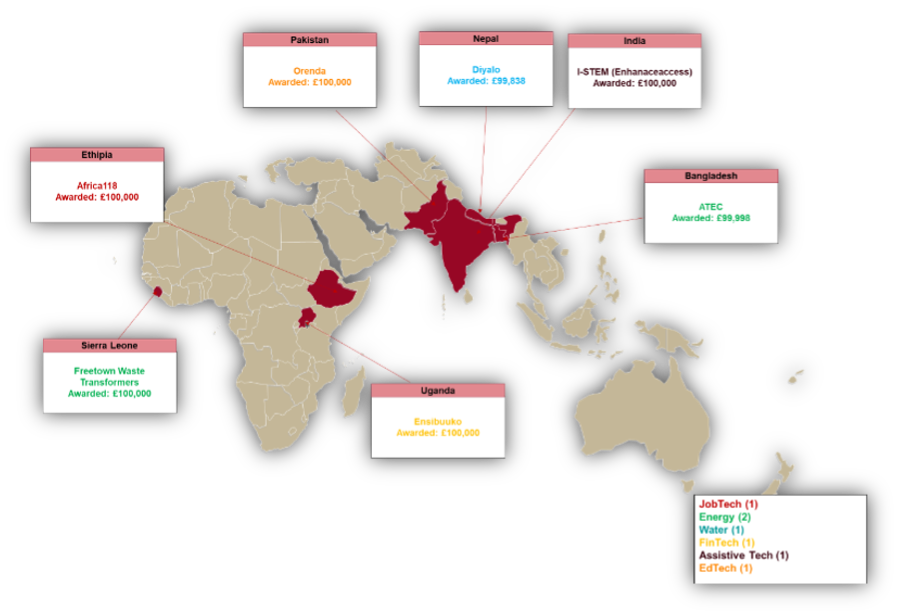
Collectively, the participating startups demonstrate the transformative potential of inclusive digital innovation. From improving access to clean energy and safe water to enabling financial inclusion, education, and accessible technology, the Accelerated Growth round exemplifies how early-stage solutions can evolve into scalable, sustainable models that advance the Sustainable Development Goals.
Defining scale beyond numbers
The GSMA Innovation Fund approaches scale not simply as growth in size but as the process of achieving sustainability and market maturity. Drawing on frameworks from the Wheeler Institute, four indicators were used to measure progress in this round: user acquisition, revenue generation, follow-on funding and employment growth. Yet, we found that these markers should be interpreted flexibly.
For example, an increase in users is meaningful only when accompanied by consistent, active engagement. Similarly, greater revenue matters most when it coincides with efficiency gains, not higher costs. And, not all ventures required additional funding or staff. Some reached financial self-sufficiency through organic growth and several achieved expansions without enlarging their workforce, particularly those with software-as-a-service (SaaS) models.
This nuanced interpretation reflects a growing understanding within the development innovation community: scale is multidimensional. It is as much about deepening impact and operational resilience as it is about headline numbers.
Common themes on the journey to scale
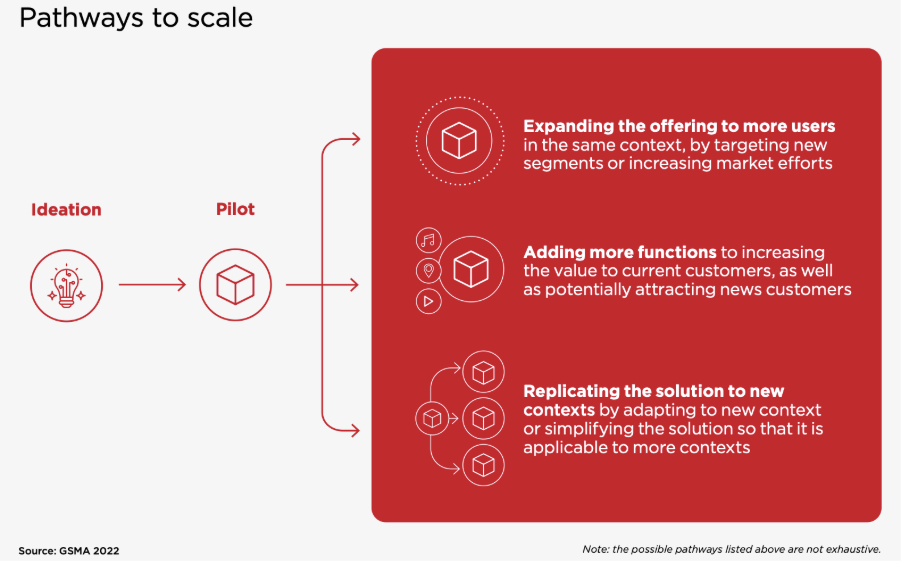
Most grantees in this round chose to utilise the funding to enhance their existing solutions. This focus on “adding more functions” yielded substantial benefits. Several companies developed new mobile applications, incorporated offline or low-tech access channels such as USSD or voice response systems, and integrated artificial intelligence to reduce costs and improve user experience. These developments often blurred the boundary between scaling and right-sizing – the process of refining a product to ensure market fit before rapid expansion. For many, addressing usability, accessibility, and affordability was the critical next step on the path to sustainable growth.
Additionally, we found the technical assistance offered by the GSMA during the grant to be more impactful to this cohort than in previous rounds. The support was highly tailored: some enterprises used it to conduct market assessments, refine financial management systems, or develop AI capabilities unavailable locally. This bespoke approach enabled organisations to address structural barriers that had previously hindered their ability to scale. Participants cited the combination of capital, technical assistance, and mentorship as pivotal to overcoming their unique barriers to growth.
However, external challenges such as economic volatility, regulatory constraints, and political instability continued to affect progress in certain markets. These contextual factors underscore the importance of ecosystem partnerships and adaptive business models.
Insights for future learning
The GSMA Innovation Fund for Accelerated Growth offers several lessons for future innovation funding:
1. Redefine success metrics. Measuring scale should account for quality of user engagement and impact, operational efficiency and long-term sustainability – not just user or revenue growth.
2. External environments matter. Partnerships with governments, financial institutions and research organisations are crucial to sustain momentum beyond grant cycles.
3. Targeted technical support is key. Bespoke assistance, aligned with a venture’s maturity and context, often yields higher returns.
As the GSMA continues refining its methodology for assessing scale, the Accelerated Growth round provides clear evidence to how catalytic funding, targeted expertise, and adaptive learning accelerates the growth of digital innovations serving low-income and marginalised populations. The next challenge will be to leverage this momentum, ensuring that promising and impactful startups can sustain scale in complex and rapidly changing markets.
This initiative has been funded by the UK Government’s Foreign Commonwealth & Development Office (FCDO) through its Global Research and Technology Development Portfolio and is supported by the GSMA and its members.