As climate-related disasters grow more frequent and severe, acting before crises occur is increasingly important. Anticipatory action – steps taken before a hazard hits – helps to save lives and protect livelihoods.
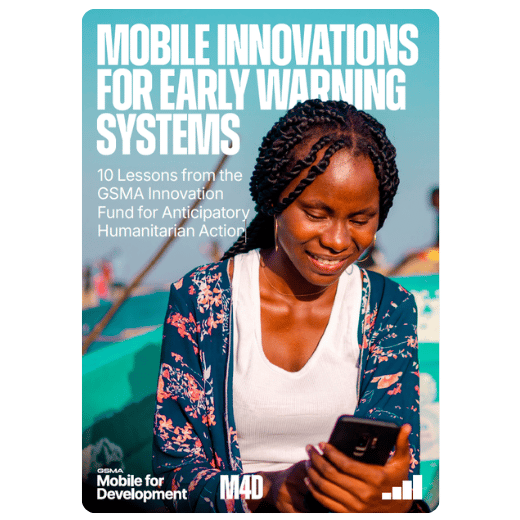
Through the GSMA Innovation Fund for Anticipatory Humanitarian Action, we worked with eight organisations to test how mobile and digital tools can strengthen preparedness. Their experiences are captured in our new synthesis report which distils lessons from the innovators working directly with communities and governments.
Here’s what we learned:
1. Mobile tools strengthen anticipatory action
Across the cohort, mobile and digital solutions improved the speed and coordination of anticipatory action. In Pakistan, Buraq’s rainfall sensors and landslide monitoring stations provided an extra 30 minutes of warning before flash floods occurred – critical time that traditional forecasts could not offer. In Nepal, NAXA’s impact-based forecasting reframed hazard data around likely human consequences, allowing local governments to plan evacuations and deploy resources more effectively. The projects provided clear evidence on how mobile and digital technologies can strengthen the link between forecasting, decision-making and early response.
2. Trust is the hardest element to build – and the most decisive
Technical solutions only work when people trust them. Building trust took time and consistent effort – often far more than grantees had anticipated. Communities were more likely to act on warnings when they had been involved in shaping the system and saw their feedback reflected in improvements. Co-design, transparency and partnerships with trusted local actors helped strengthen this credibility. Our takeaway is that future funding models should budget as seriously for community engagement and trust-building as they do for technical design.
3. Skills matter as much as access
The cohort showed that digital and financial literacy training was not an optional add-on for early warning systems – it was a core condition for uptake. Training helped people understand and act on the information they received, reduced digital risks and gave response teams the confidence to manage new systems.
For example, in Nepal, Rumsan’s workshops on digital wallets and fraud prevention helped households to use mobile cash transfers securely and avoid fraud. In Ethiopia, Tearfund strengthened digital and financial capabilities through women’s self-help groups, enabling communities to more confidently engage with insurance and savings mechanisms.
4. Designing for those most at risk improves systems for everyone
Digital innovation risks excluding those with the least access – women, persons with disabilities, minority-language speakers or people with lower literacy. Designing for these users first created better systems for everyone. In Cambodia, ActionAid combined mobile alerts with radio broadcasts and community outreach to ensure warnings reached people with varying levels of connectivity and literacy. Interactive voice calls in local languages proved especially powerful across the projects, reaching people who would otherwise have been missed.
We saw that inclusion – when treated as a design principle rather than a box-ticking exercise – improved reach and engagement, as well as reducing dependence on any single channel or user group for mobilising communities.
5. Cash enables people to act on early warnings
Early warning systems can raise awareness but without resources, households struggle to act. Where cash or insurance was built into solutions in the cohort, households prepared earlier and recovered faster. In Nepal, Rumsan used blockchain-enabled mechanisms to trigger anticipatory cash transfers rapidly once risk thresholds were met, allowing households to take protective measures before flooding occurred. NAXA linked geospatial risk profiling with mobile-enabled cash transfers issued ahead of a cloudburst, helping communities to act swiftly.
6. Partnerships make or break innovation
Every project relied on partnerships that bridged technical, social and institutional gaps. Startups brought innovative tech solutions, local NGOs offered community access and trust, while governments and the mobile industry gave legitimacy and a path to scale. In Kenya, Synnefa partnered with agricultural networks and local actors to deliver climate advisory services through accessible mobile channels, demonstrating how collaboration helps solutions to reach end users effectively. Creating these strategic relationships took time and effort for the cohort, but it has proved critical.
7. Government engagement gives solutions legitimacy and sustainability
Governments determine whether early warning systems solutions remain pilots or become part of national disaster management frameworks. The cohort found that local authorities were often their strongest champions, able to integrate tools into everyday response. National endorsement, though harder to secure, was essential for legitimacy and scale. The most effective models bridged these two levels – local champions driving uptake, with national agencies providing policy anchors. In Cambodia, ActionAid formalised its solution through a Memorandum of Understanding with the Ministry of Rural Development and the National Committee for Disaster Management, ensuring that activities aligned with government priorities and could be embedded in official plans.
8. Mobile operators hold unique levers for scale
Mobile operators can provide early warning system infrastructure, reach and credibility that few actors can match. For example, in the Philippines, People in Need partnered with Smart to ensure early warning messages reached at-risk communities. In Ghana, TAHMO collaborated with AT Ghana to use commercial microwave link data to strengthen rainfall modelling and flood forecasting. Both direct and indirect engagement models proved viable pathways to strengthening early warning innovations.
9. Scaling looks different for every innovation
The cohort showed there’s no single path from pilot to scale. Some of the grantees expanded their solutions across regions, while others focused on embedding deeply in one national system. Several grantees adapted their tools beyond a single hazard or country, tailoring them to new risks and sectors. What mattered most was alignment – between the innovation and the incentives of governments, donors and communities. To address this gap, the GSMA Innovation Fund for Humanitarian Replication and Scale was launched in 2025 to support the catalysts and conditions needed for growth.
10. Sustainable financing remains the biggest challenge – but demand is growing

Securing suitable investment for anticipatory action can be a challenge. Early warning systems are often treated as public goods, leaving them more dependent on grants.
Despite this, the cohort secured more than $4 million in follow-on funding during the project period, showing growing appetite for anticipatory solutions. NAXA raised $454,000 to expand its platform beyond Nepal; Rumsan attracted $688,000 to scale its blockchain-enabled cash system; and TAHMO secured $2.5 million from the Gates Foundation to extend its weather station network across Ghana, Kenya and Rwanda
Several grantees also explored new business models to reduce their dependence on grants. The cohort’s experiences show that achieving financial sustainability for early warning systems is difficult but progress is being made, even if full commercial viability remains a long-term goal.
Looking ahead
The GSMA Innovation Fund for Anticipatory Humanitarian Action cohort has shown that mobile-enabled anticipatory action works – demonstrating clear impact across diverse and complex contexts. The next step is to build on this progress by embedding successful models in government systems and addressing the funding gaps that can limit growth.
As the humanitarian sector continues to face rising climate risks and constrained resources, these lessons offer a roadmap for scaling what works. Explore the report to read recommendations for building systems that turn mobile solutions into life-saving anticipatory action.
Read the full report, which draws on evidence and case studies from all eight grantees:
Meet the GSMA Innovation Fund for Anticipatory Humanitarian Action cohort:
Discover more about the GSMA Innovation Fund for Humanitarian Replication and Scale:
Explore our programme of work that enables the development of efficient and inclusive early warning systems.
This initiative is currently funded by UK International Development from the UK government and is supported by the GSMA and its members.