Recent years have seen significant growth in humanitarian needs. New and protracted conflicts alongside the increasing prevalence and severity of disasters mean there are now over 400 million people in need of humanitarian assistance and protection. Tightening humanitarian budgets have forced humanitarian agencies to prioritise who and where they will be able to deliver.
Connectivity and digital services are utilised and requested by crisis affected populations and are increasingly prioritised by humanitarian agencies. The crucial role of private sector partners and local innovators, both due to their role in the local community and ability to deploy innovation and digital services, is a vital contribution in today’s humanitarian landscape. Further, in a sector-wide study, it was found that only 9% of humanitarian funding is targeted at scaling, opposed to 87% for pilots.
Over the last 10 years, the GSMA Innovation Fund has supported 167 grantees in 45+ countries, reaching over 100 million users across themes such as anticipatory action, disaster response, complex emergencies, and forced displacement. These grantees have shown how mobile-enabled solutions- from early warning systems to digital cash assistance and inclusive agricultural services – can deliver faster, more targeted, and more dignified humanitarian outcomes. Seeing the impact of this portfolio of grantees, it became clear that some of the strongest opportunities for scale already existed within our own network. By supporting proven innovators to replicate or expand their solutions into new humanitarian contexts, we can accelerate learning, strengthen cross-market collaboration, and ensure that tested, effective models reach more people in need.
Against this backdrop, in February 2025, the GSMA launched the GSMA Innovation Fund for Humanitarian Replication and Scale, aimed at GSMA Innovation Fund alumni who had an existing innovative digital solution that could be either scaled or replicated to further meeting humanitarian needs. This could be approached by:
- Scaling an existing humanitarian innovation
- Replicating an existing innovation into a new country
- Adaptation an existing innovation for specific unreached user groups (e.g. forcibly displaced persons or persons with disabilities)
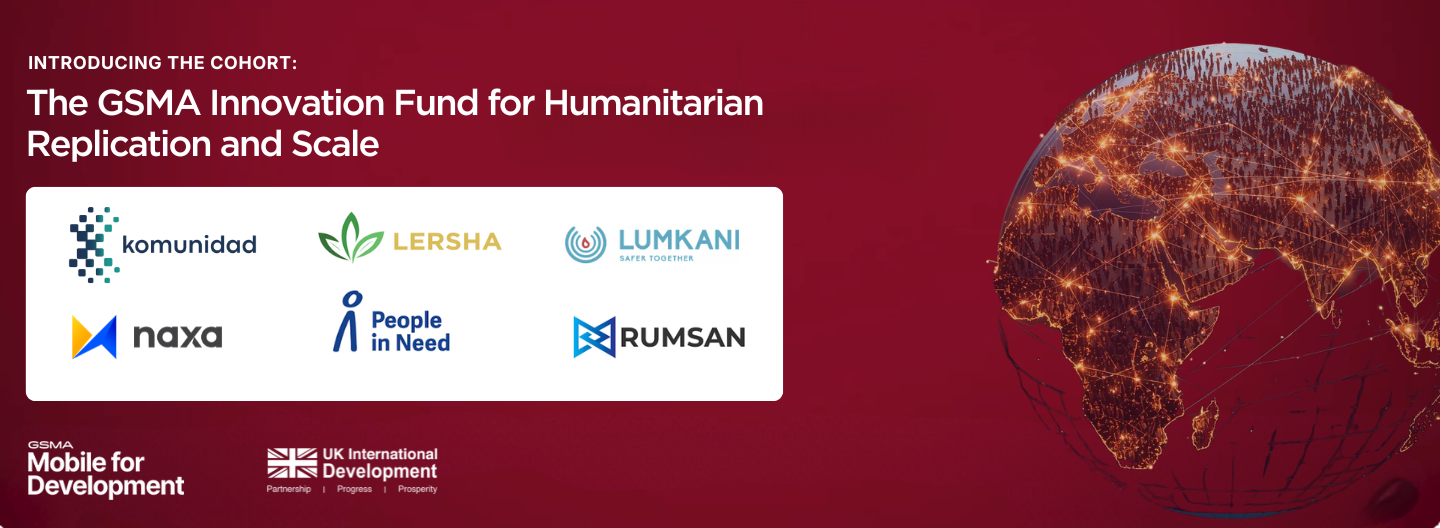
Meet the cohort:
Komunidad – Philippines

Building on the success in Siargao Island and the traction across Metro Manila, this project will scale Komunidad’s centralised multi-hazard EWS to Mandaue city and Claver city. Designed for local governments with varying capacities, the platform offers a cost-effective, web-based dashboard and alerting system that automates forecasting, localises risk insights, and delivers early warnings through SMS and Facebook auto-posts. It enhances local government unit capacity for anticipatory action and strengthens community protection against climate-related hazards.
For more information from their previous GSMA Innovation Fund project, click here.
Lersha – Green Agro Solutions – Ethiopia

Green Agro solutions will continue to scale their platform, Lersha, by integrating inclusive finance, climate-smart advisory, and value chain services into conflict-affected regions of Amhara and Tigray. The initiative will empower smallholder farmers, especially women, youth, and displaced populations, to boost productivity, resilience, and economic recovery. They will expand their service coverage, deploy field agent networks and conduct onboarding and training activities for smallholder farmers in these regions.
For more information from their previous GSMA Innovation Fund project, click here.
Lumkani – South Africa
Lumkani provides IoT-powered fire prevention devices to homes within informal settlements in South Africa. The grant will be used to scale Lumkani’s patented RF mesh network mobile technology and IoT early warning fire sensors. By integrating customised microinsurance, they aim to increase access to early warning and financial protection services among high-risk, low-income households and micro-businesses in informal settlements in South Africa. Central to this project is the installation and expansion of the gateway alert infrastructure from the current 2G enabled to 4G enabled gateways.
For more information from their previous GSMA Innovation Fund project, click here.
NAXA – Nepal and Malawi
Naxa‘s digital platform, DASTAA, is an all-in-one solution designed to strengthen disaster preparedness at both the household and community level. Available as both a mobile and web app, DASTAA combines data technology and local insights to support evidence-based decisions throughout a disaster. The project will enhance risk assessments of critical infrastructure in Nepal and extend its application to flood-prone regions in Malawi for household risk assessments. It will focus on key sectors such as health, education, agriculture, and drinking water, integrating AI-driven modelling and citizen science (involvement of public participants in research) to generate accurate and real-time data. This approach strengthens disaster preparedness and resilience by enabling timely warnings and the development of targeted, sector-specific response plans.
For more information from their previous GSMA Innovation Fund project, click here.
People in Need – Philippines

Following the successful scaling of People in Need‘s STREAM Phase 1 project, STREAM EWS (Early Warning Systems) Phase 2 focuses on scaling up a mobile-enabled early warning system that delivers anticipatory flood alerts to vulnerable, flood-prone communities in Luzon, Visayas and Mindanao. By using IoT sensors, SMS dissemination, integrating updated forecast tools and engaging local stakeholders, this project will deploy to eight high-risk municipalities across the Philippines. They will also update contingency plans with inclusive SOPs and will also disseminate hyperlocal alerts via SMS, Facebook, Messenger, and community radio.
For more information from their previous GSMA Innovation Fund project, click here.
Rumsan – Nepal
Rumsan’s decentralised platform Rahat provides immediate access to finance with transparent and inclusive aid distribution and builds resilience through microinsurance for smallholder farmers. The scale-up funding will support the expansion and commercialization of the Rahat platform by extending its use across the operational areas of the Nepal Red Cross Society, focusing on women and people with non-communicable diseases. It will also enable adaptation to multi-hazard contexts such as floods, heatwaves, and cold waves through smart contract-enabled, multi-channel disbursements, positioning Rahat as a replicable, low-tech, and interoperable solution.
For more information from their previous GSMA Innovation Fund project, click here.
Each grantee has already demonstrated impactful results in an existing humanitarian setting. During the implementation of this grant, the GSMA Innovation Fund will also offer a range of non-financial technical assistance to help the innovators deliver impact. This will include networking opportunities and investor readiness support, a platform to profile the solutions at GSMA global events, partnership facilitation with mobile network operators and humanitarian organisations, and monitoring, evaluation and learning support to demonstrate the impact of their solutions.
This initiative is currently funded by UK International Development from the UK government and is supported by the GSMA and its members.