
In Indonesia, more than 27 million smallholder farmers in agriculture and aquaculture face persistent challenges in earning livelihoods, from low productivity to limited access to capital to invest in their farms, insufficient extension services for much-needed agronomic advice and weak bargaining power in markets dominated by intermediaries. In May 2026, the GSMA Mobile for Development’s Central Insights Unit (CIU) published a research study that examines key AI use cases, products and services tailored to smallholder crop farmers and small-scale aquaculture farmers in Indonesia. As part of the study, a subset of AI-led solutions were tested with farmers in the field across Jakarta, Bali, Yogyakarta and Aceh. In total, the research consulted with about 85 organisations and 200 stakeholders.
On the completion of the research, we held an online webinar where key stakeholders including local government officials, policymakers, start-ups and innovators discussed key findings and reflections, as well as ways to move forward with the research.
5 key findings
- 1. AI use cases are emerging across the agricultural value chain
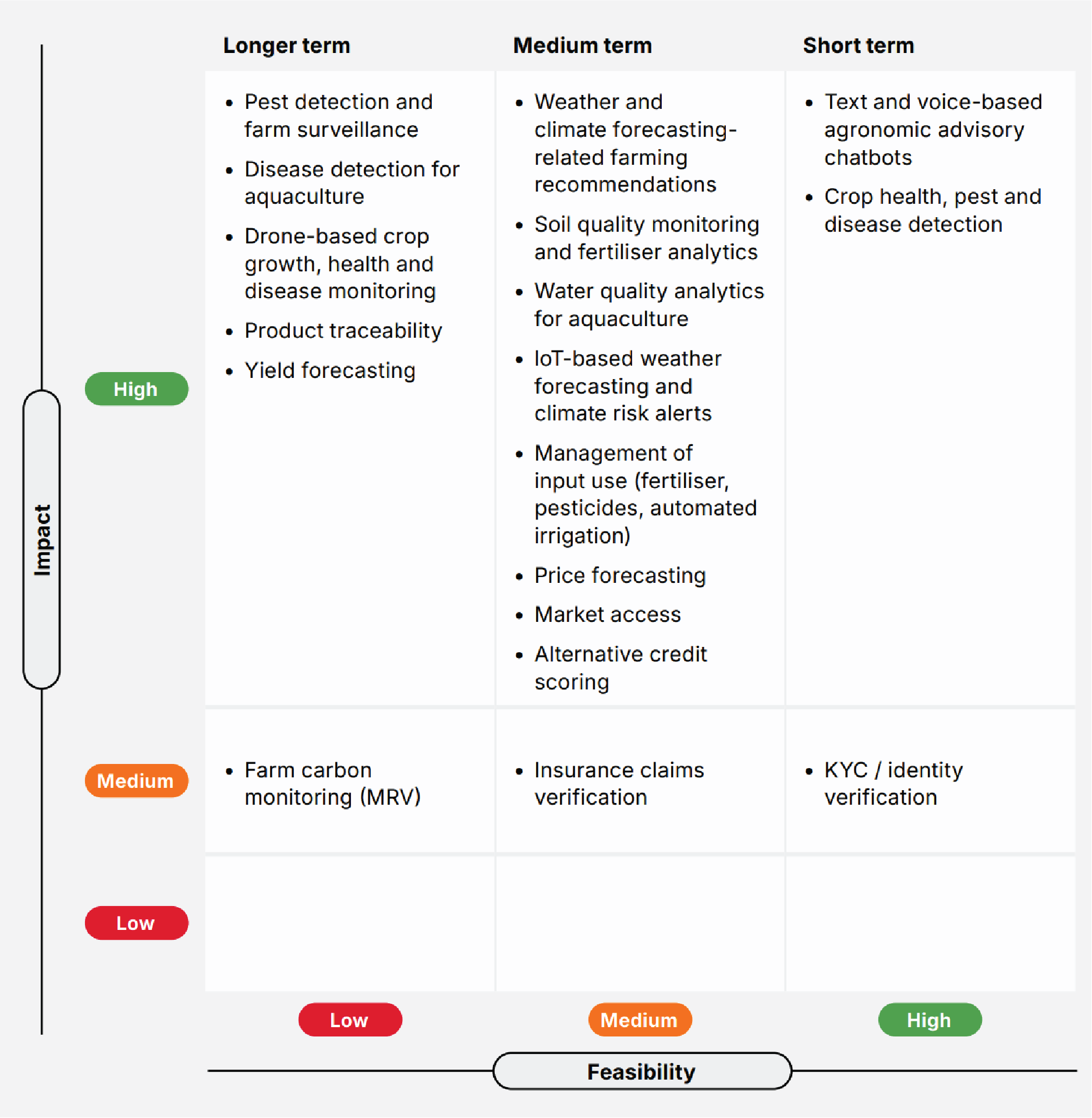
Distinct AI sub-use cases with a high potential for impact were identified under the broad categories of:- Agricultural advisory and farm management
- Markets, distribution and logistics
- Inclusive finance and risk mitigation
- 2. Three AI use cases stand out as both high impact and ready to scale now: conversational agricultural advisory; alternative credit scoring; and price prediction and market information
- Conversational agricultural advisory via WhatsApp offers the greatest opportunity in terms of impact, reach and feasibility. In Indonesia, Pak Dayat, a locally built, AI-enabled agronomist delivered via WhatsApp, is free for farmers to access and embedded within a broader support programme, providing a template for a replicable and impactful model.
- AI-enabled alternative credit scoring for rural women, as offered by the fintech Amartha, provides a path to financial inclusion. Amartha has disbursed more than IDR 35 trillion (approximately USD 2.1 billion) to 3.3 million women in Indonesia. Its borrowers have consistently demonstrated strong repayment discipline, and the model has enabled access to working capital for a population previously excluded from access to formal finance.
- AI-enabled price prediction and market information is a high-impact use case that helps farmers optimise planting and sales decisions. By providing insights into crop prices across regions and time horizons, farmers can select higher-value crops, time market entry more effectively and reduce exposure to price volatility. However, there are only a few organisations providing this service in Indonesia.
- 3. Precision agriculture, market access and farm management use cases show promise but face greater barriers to scale
AI-enabled precision agriculture holds significant impact potential but remains constrained by hardware costs and technical complexity. Farming-as-a-Service models, such as those offered by Tani Bersama Estate, point towards a path to affordability by aggregating smallholder landholdings into managed blocks. Meanwhile, cooperative-owned platforms like FarmerApps, developed by the Petani Muda Keren cooperative in rural Bali, demonstrate that even modest AI capability, embedded within trusted community structures, can improve planning, market access and incomes.
- 4. Adoption barriers remain significant for both providers and farmers
For AI investors, suppliers and developers, three challenges consistently limit their ability to scale existing solutions and develop more advanced ones: sustainable business models; access to high-quality, locally grounded data; and technical capacity, particularly data science skills, to build and continuously improve models in local contexts.
Meanwhile, farmers face barriers such as unreliable or no digital connectivity in rural areas; devices that lack the storage and processing capacity to run dedicated apps; and low awareness of, and trust in, digital tools. We identify several risks across social, technical and policy dimensions in our report. One point to highlight is that digitally excluded farmers that are older, less connected and have lower literacy risk being further marginalised as better-connected peers gain informational and market advantages. - 5. Partnerships and inclusive design are critical for scale
Blended finance models aligning commercial and development imperatives are essential for early-stage innovation. NGOs, cooperatives and development partners play a critical role in supporting adoption of AI-enabled solutions. Design matters as much as innovation: tools built for platforms farmers already use, in local languages, calibrated for low literacy and low bandwidth, are far more likely to be adopted. Women were consistently among the most digitally engaged farmers in our research — targeted efforts to include them in AI adoption offer a promising pathway to household-level impact.
Looking ahead
Indonesia’s AI agritech landscape is growing, and the three use cases that our research identified as ready to scale now serve as a strong starting point to ensure the benefits of AI reach the last mile to improve smallholder livelihoods. Stakeholders in the AI-enabled agritech ecosystem should consider looking ahead to address the impact assessment gap. While early adopters of conversational advisory tools reported improved decision-making as a clear benefit, robust impact evaluations that trace the full pathway from AI tool adoption to yield improvement and household income change are largely absent from the Indonesian agritech evidence base.
Realising the potential for AI-enabled agritech for the 27 million smallholder farmers in Indonesia will require patient capital, inclusive design and cross-sector coordination that no single actor can deliver alone.
For detailed insights, click here to read the full report. For further information, you can reach out to us at centralinsights@gsma.com
The Central Insights Unit is currently funded by UK International Development from the UK government and is supported by the GSMA and its members. The views expressed do not necessarily reflect the UK government’s official policies.