This blog is part of the ‘GSMA AgriTech AI Blog Series,’ which highlights AI innovations in agriculture. Throughout the series, we will explore various use cases where AI is transforming agritech operations and farming practices.
Smallholder farmers in low- and middle-income countries (LMICs) often struggle to access formal credit due to a lack of collateral or economic identities. Without reliable ways to assess their creditworthiness, financial service providers (FSPs) perceive lending to these farmers as too risky. As a result, many farmers struggle to secure the financing needed to invest in high-quality inputs like seeds and fertilizers, ultimately limiting their ability to improve yields and enhance their livelihoods.
Addressing this situation, Apollo Agriculture (“Apollo”), an agri-fintech company operating in Kenya and Zambia, leverages data and Artificial Intelligence (AI) to assess smallholder farmers’ creditworthiness. This blog explores how Apollo’s AI-driven approach contributes to closing the agricultural financing gap while ensuring commercial viability.
The financing challenge faced by smallholder farmers
Smallholder farmers, who account for 450 to 500 million globally, play a critical role in food production. However, they face significant challenges in obtaining the financing needed to invest in their farms, improve productivity, and increase incomes. In LMICs, only one-third of the $238 billion annual credit demand from smallholder farmers is met.
Several factors influence access to formal financing options by smallholder farmers. The lack of traditional collateral, such as land titles or other assets, typically required to secure loans, leaves FSPs with limited options if a farmer defaults on their loan, and makes lending to smallholders appear too risky.
Beyond collateral issues, smallholder farmers often lack economic identities that could provide insights into their operations and cash flows. Many rely on irregular or seasonal earnings, often made in cash, and have limited credit history or formal transaction records. Agriculture itself is an inherently risky sector. Farmers are highly susceptible to climatic events like droughts and floods, as well as market risks like fluctuating commodity prices. These uncertainties make it difficult for FSPs to predict farmers’ ability to repay loans.
Without access to formal loans, farmers are unable to purchase necessary inputs—such as seeds, fertilizer, and equipment — needed to increase their yields. As a result, they are often forced to rely on informal lenders who charge predatory interest rates, driving up production costs and ultimately reducing their net income. This situation perpetuates cycles of low productivity and poverty.
Digital solutions in agriculture present a promising future. They generate valuable data that provide insights into farm productivity helping to assess creditworthiness and reduce lending risks, thereby advancing the financial inclusion of smallholder farmers.
Leveraging AI to evaluate the creditworthiness of smallholders and mitigate credit risk
Apollo Agriculture (“Apollo”) provides a comprehensive package of services, including credit, high-quality inputs, agricultural advice, and risk mitigation solutions such as crop insurance to help smallholder farmers in Kenya and Zambia transition from subsistence farming to more commercial farming practices.
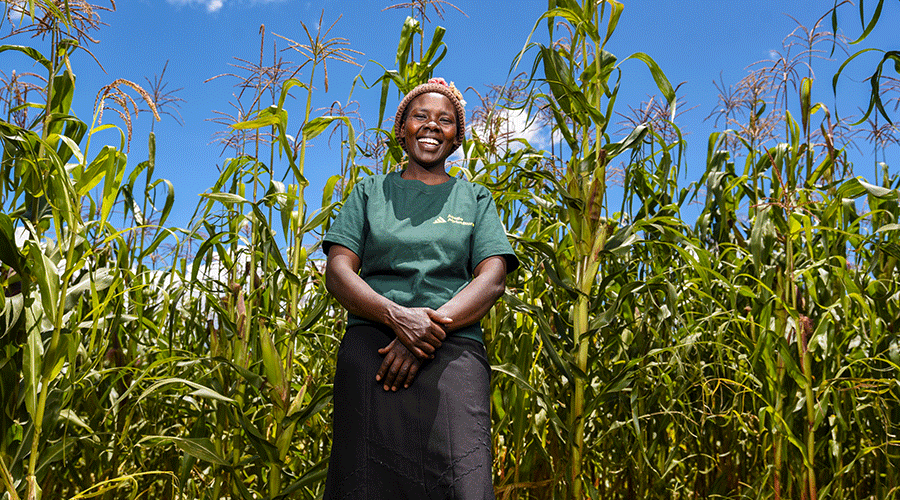
Access to credit is a critical component of Apollo’s support. Farmers who secure loans from Apollo are able to purchase high-quality inputs such as seeds and fertilizers designed to optimise their chances of a successful harvest. Apollo’s maize loans, for example, typically range between 15,000 and 24,000 Kenyan shillings (approximately $115 and $180), allowing to cover input expenses for landholding of up to one hectare. They come with an eight-month repayment schedule that is aligned to the agricultural season, and a large and final payment due after harvest.
Copyright: Apollo
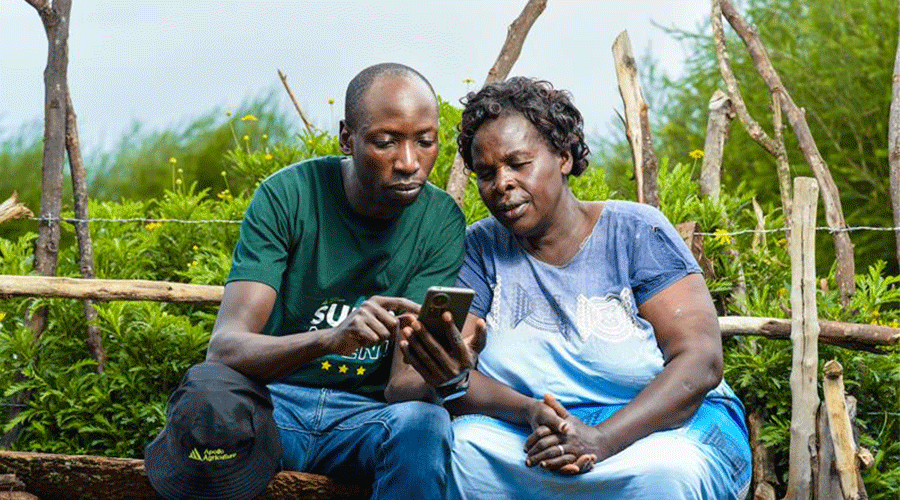
To facilitate these loans, Apollo has developed an AI-driven credit assessment engine that enables automated, data-driven lending decisions for farmers who are often excluded from formal financial services. Instead of relying on collateral, Apollo evaluates a farmer’s creditworthiness using a diverse array of data points. Apollo’s field officers are integral to this process. They collect farm and farmer data through Apollo’s mobile app, including farm size, crop types, household information, and farming behaviours, among others. This data is then validated by a dedicated Data Verification team to ensure accuracy before it is fed into the automated system. This manual validation step is critical as it ensures that only high-quality, verified information is used by the AI models. The information, combined with satellite imagery and credit bureau records (when available), is used to develop detailed credit scoring profiles of the farmers. While the data collection and validation processes are handled manually, the final credit decisioning is entirely automated through Apollo’s AI models.
Apollo spent a few years developing its AI-driven credit assessment models, starting with the crucial task of gathering repayment data. Initially, the company adopted a “lend-to-learn” approach, relying on non-automated, uninformed decision-making to offer loans to a wide range of farmers, including high-risk borrowers, to generate repayment data to feed into its predictive algorithms. Over time, Apollo incorporated machine learning algorithms capable of analysing patterns in farm data, repayment behaviour and alternative data sources. These algorithms aim to emulate and enhance human decision-making by identifying correlations and risk factors to calculate credit risk.
Applying AI to fight lending fraud
As Apollo scaled its operations to serve more smallholder farmers in Kenya and Zambia, the issue of fraud became increasingly visible. Fraud commonly occurred when individuals applied for loans with no intention of repayment, subsequently collecting agricultural inputs and reselling them at discounted prices. Field agents, too, occasionally engaged in fraudulent activities by providing incorrect information during the registration process or by encouraging ill-intentioned farmers to avail of loans.
Copyright: Apollo
To address this challenge, Apollo uses machine learning to analyse behavioural patterns and data points to identify potentially fraudulent activities. For field officers, the system monitors how and when they use their mobile devices, including connectivity patterns and responsiveness. This provides valuable insights into whether their behaviours align with legitimate practices or indicate potential issues. For loan applicants, the models analyse payment histories and any discrepancies in submitted documents to detect signs of fraud.
This AI-powered fraud prevention system is crucial for ensuring that financing reaches legitimate, creditworthy farmers while minimizing risks associated with fraudulent applications.
Key benefits of using AI for agri DFS
The use of AI by Apollo greatly enhances the efficiency of its credit assessment process, and overall impact of its lending services. It has also allowed Apollo to offer these services in a scalable and cost-effective way.
Scalable operations: Automation enables Apollo to implement uniform lending criteria across its customer base, thereby reducing human biases and errors. Additionally, it reduces the dependence on manual processes traditionally used by banks, such as in-person verification visits. Consequently, operational costs are significantly lowered, making it feasible to offer small loans at scale.
Tailored interest rates: AI enables Apollo to offer smart pricing based on a farmer’s risk profile, providing more competitive interest rates to those with a strong repayment history. In the past, all borrowers were offered a uniform interest rate, regardless of their risk level. Currently, risk-based pricing allows lower-risk farmers to benefit from reduced rates. “We could automate processes without AI, but only AI allows us to create the sophisticated and dynamic profiling that we achieve today”, shared Leandro Sales Holanda Pinto, VP of Technology at Apollo.
Better conversion rates: A significant advantage of AI integration is the substantial reduction in loan approval times. Previously, smallholder farmers had to wait two to three days for approval and pricing details, as agents gathered information and call centres conducted follow-ups. Currently, Apollo’s AI-driven models provide instant feedback on loan eligibility and terms, while the field officer is still with the farmer. This allows farmers to make informed decisions quickly, avoiding lengthy processes that could lead to service attrition. According to Akshay Chandrasekhar, Head of Capital Markets and Sustainability at Apollo, the company “would not be able to achieve that kind of a significant reduction in turnaround times without AI”.
Enhanced customer and field officer experience: The provision of immediate loan eligibility and terms significantly enhances farmer experience. Farmers are now able to receive a provisional price upfront, allowing them to promptly decide if the terms are acceptable, thus reducing drop-off rates during the application process. Field officers benefit too since they are less likely to spend time on tasks that do not lead to sales, boosting their productivity and morale.
Considerations for using AI to assess creditworthiness and combat fraud
Apollo Agriculture’s use of AI in smallholder lending in Africa has been marked by challenges such as extended feedback loops, data collection issues, and infrastructure limitations.
Feedback loops: In contrast to consumer lending, which involves relatively quick repayment cycles, agricultural lending is tied to growing seasons, typically around four to eight months depending on the crop. This longer cycle results in extended feedback loops for model refinement. Additionally, the highly dynamic nature of farmer profiles, influenced by environmental factors such as droughts and floods, as well as socio-economic conditions like fluctuating market prices, presents challenges in isolating variables and accurately assessing model performance. Nonetheless, Apollo continues to explore model improvement. Through its “lend-to-learn” approach, it deliberately extends credit to high-risk farmers to gather diverse repayment data and enhance predictive accuracy of its credit assessment model. After harvest, Apollo compares predicted repayment risks with actual outcomes, to fine-tune its algorithms and improve risk management.
Data collection: Operating in rural Africa entails technological challenges such as limited smartphone usage, unreliable connectivity, and low-resolution satellite imagery, which hinder data collection for credit assessments. Although free satellite imagery provides some insights, its resolution is inadequate for farms of less than two acres which constitute the majority of Apollo’s portfolio. Procuring high-resolution satellite data would be prohibitively expensive for a startup that offers loans averaging less than $150.
Absence of benchmark models specific to Africa: In developed regions like Europe and North America, financial institutions benefit from well-established credit scoring frameworks based on borrower data accumulated over decades. These models serve as a foundation for algorithm development, allowing companies to refine existing models to their needs. In Africa, however, smallholder farmers often lack formal credit histories, and there are no benchmark models for agricultural lending. Consequently, Apollo had to build its credit scoring model from scratch and consider innovative data sources like seasonal productivity and mobile money usage, to strengthen its models.
Talent and resources: Sourcing skilled AI and machine learning professionals locally remains a challenge. Although Apollo is expanding its presence in Kenya, its main engineering team is in the Netherlands, where technical expertise is more accessible.
Outlook
Since launch in 2016, Apollo has assisted nearly 400,000 farmers, about half of whom are women, in achieving yields 2-2.5 times higher than Kenya’s national average. To further bolster its support for smallholder farmers beyond financial services, Apollo Agriculture is investigating how generative AI can deliver real-time, personalised agronomic advice. The company envisions to integrate an AI-powered companion into its field officer app, to address the challenges associated with serving farmers who predominantly use feature phones rather than smartphones. Field agents could utilise tools such as photo-based disease and pest identification, personalised crop management recommendations, and interactive, real-time farming guidance. This suite of services could also encompass features like comparing a farmer’s crop stage to ideal growth conditions based on planting dates.
Although Apollo is not the first to explore generative AI for agricultural advisory, its emphasis on leveraging its existing data and portfolio to develop these tools underscores its commitment to innovation. With the integration of generative AI, Apollo aims to enhance its financial inclusion efforts, and boost both knowledge and productivity of smallholder farmers.
Read the previous blogs from our AI series:
- ‘Harnessing machine learning to power weather forecasts: Insights from Ignitia’.
- ‘Detecting and managing crop pests and diseases with AI: Insights from Plantix’.
Stay tuned for more insights into how AI is shaping the future of agriculture.
The GSMA AgriTech Accelerator is funded by the German Federal Ministry for Economic Cooperation and Development (BMZ) and supported by the GSMA and its members.