This blog is part of the ‘GSMA AgriTech AI Blog Series,’ which highlights AI innovations in agriculture. Throughout the series, we will explore various use cases where AI is transforming agritech operations and farming practices.
Smallholder farmers play a crucial role in creating more resilient food systems, yet they frequently struggle with poor yields and low incomes. This is often due to limited access to agronomic advice that could help mitigate against pests and diseases, leaving farmers vulnerable to severe crop losses and financial instability.
To address this issue, agritech company Plantix has developed an AI-powered mobile app that provides farmers with diagnosis and management options for pests and diseases. Using deep learning – a subset of AI – to recognise and classify images of symptomatic crops, Plantix can accurately identify 800 symptoms across 60 crop types.
This blog explores how Plantix leverages AI for pest and disease detection, the benefits and considerations associated with this approach, and the company’s outlook.
Lack of accessible pest and disease diagnosis for smallholders
Back in 2013, while conducting their PhD research in soil science in Brazil, Simone and Rob Strey were frequently approached by local farmers seeking help with crop disease diagnosis. A common issue affecting crops at that time was a condition locally known as “morto subito” (sudden death), though neither of them initially knew what caused it. Investigations led to the discovery of a fungus that was also responsible for historical agricultural crises like the one in Ireland in mid-1800s that caused the Great Famine.
For the two agricultural researchers, this experience highlighted the profound vulnerability of smallholder farmers in tackling crop health challenges—not just in Brazil, but across low- and middle-income countries (LMICs) worldwide. They identified two key gaps in smallholders’ access to information on pests and diseases.
First, farmers often lack access to resources or specialists they can consult. Traditionally, they depend on guidance from agricultural extension officers – professionals deployed by local governments to provide technical assistance and education to farmers. However, departments of agricultural extension are often understaffed due to inadequate funding. In Kenya, there is only one extension officer for every 1,093 farms, while in India, this ratio is even higher at 1:1,162 farms. By contrast, the Food and Agriculture Organization (FAO) recommends a ratio of one officer for every 400 farms, a standard that most LMICs fail to achieve.
Second, even with access to pest and disease resources, smallholder farmers in LMICs would struggle to use this information, as they often use local terms to describe crop symptoms, when most scientific resources are available in English.
Without accessible diagnostics tools, smallholder farmers are vulnerable to preventable crop losses that could exacerbate food insecurity and economic instability.
Leveraging deep learning to detect pests and diseases
To tackle this issue, Simone and Rob Strey founded Plantix, a mobile app-based digital agriculture solution that helps farmers easily identify crop pests and diseases while providing access to management options in their native language.
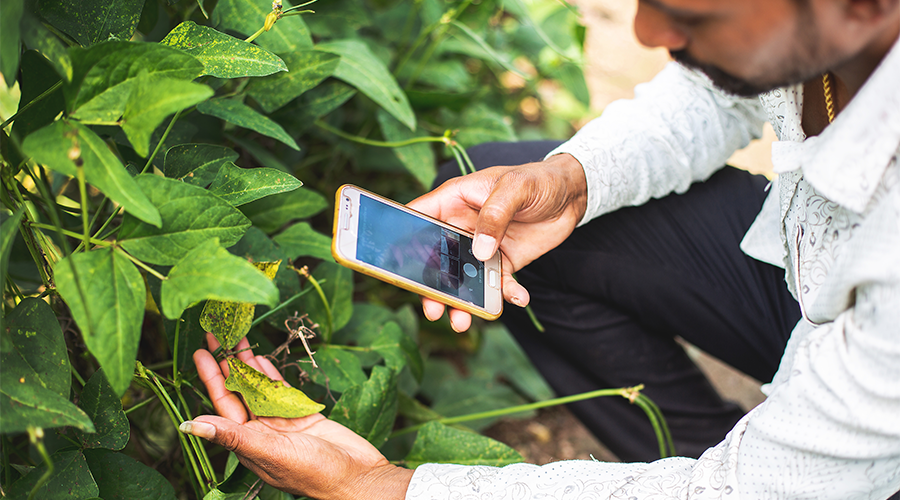
The app allows farmers to capture and upload photos of their symptomatic crops, which are then analysed in real-time using deep-learning algorithms. These algorithms identify visual patterns and compare them against an extensive database of labelled images to generate a diagnosis. The app also suggests targeted management recommendations in the farmer’s local language, based on research and data from the International Crops Research Institute for the Semi-Arid Tropics (ICRISAT).
At the core of the company’s diagnostics capabilities is a robust database of over 120 million images of symptomatic crops, contributed by farmers worldwide. To train the models, image samples are meticulously labelled by Plantix’s crop scientists with key details such as crop type and specific pest or disease names. This labelling enables the deep learning models to learn the unique features of hundreds of symptoms across different crops. The models are continually updated through validation and testing datasets to refine their accuracy. Over time, Plantix has expanded its coverage from an initial 30 crop pests and disease combinations to nearly 800 now.
Copyright: Plantix
Although the app is available for download worldwide, Plantix has focused on India as a priority market due to the country’s increasing smartphone adoption and rapidly declining mobile data costs. To cater to India’s diverse population, the app is available in 20 local languages, including English.
AI-driven outbreak tracking
Plantix uses its deep learning models not only to analyse images and detect infections but also to track outbreaks up to district level. It achieves this by leveraging anonymised metadata like GPS coordinates and timestamps collected when using the app. Thanks to the additional analysis of metadata, Plantix has for example been able to identify pink bollworm as the top cotton pest in Maharashtra, India, and brown plant hopper as a major problem in rice cultivation in Telangana, India.
The analysis provides Plantix with unique insights into crop health trends at the district level, enabling the company to deliver automated disease alert notifications to farmers.
Figure 1: Fall Army Worm occurrence in India using more than 100k data points from Plantix.
Copyright: Plantix
Key benefits of using AI for pest and disease recognition
The use of AI by Plantix greatly enhances the accuracy, efficiency and overall impact of its advisory service. It has also allowed the company to offer these services in a scalable and cost-efficient way.
Efficiency: The app can process up to 250,000 images per day, a task that would otherwise require hundreds of full-time agronomists. AI also facilitates content translation into 20 languages, ensuring farmers receive pest and disease diagnoses and managementrecommendations in their local languages, thereby enhancing the solution’s reach.
Accuracy: AI systems are faster and more accurate than human experts, significantly reducing the risk of misdiagnosis while improving the chances of timely control of the pest or disease. “Plantix’s AI algorithms boast an accuracy rate exceeding 90%, while human experts typically achieve 60-70%”, according to Rob Strey.
Real-time disease tracking: AI allows real-time analysis of metadata, including GPS coordinates and timestamps, collected when using the app. This capability enables real-time tracking of outbreaks and helps other local farmers take preventive measures to minimise crop loss. Such analysis would be slower if done manually and would require collaboration with local government and department of agriculture experts.
Considerations for using AI for crop pest and disease detection
While AI can improve the impact of digital advisory to farmers, its implementation can be challenging. Like many other agritech companies leveraging AI, Plantix faced difficulties laying the foundations to fully leverage AI’s capabilities.
Data collection: Training deep learning models requires massive amounts of data, which can be difficult to gather. Instead of relying on costly third-party data, Plantix invested in building its own database, initially limiting algorithm accuracy. However, as a pioneer in digital pest and disease advisory, the company rapidly expanded its dataset, benefiting from thousands of images contributed by early-adopter farmers. To address early challenges, Plantix established proactive measures, such as direct communication channels, to enhance disease identification accuracy while steadily growing its data repository.
Skilled labour to label data properly: Finding specialists with the expertise to accurately analyse and label images has been challenging. Pests and diseases affecting crops are complex, and distinguishing between similar agents of infection requires highly specialised knowledge of diverse crops, and pests and diseases from around the world. Such skillset is rare and hard to find and acquire.
Resource-intensive operations: Running deep learning models that can deal with hundreds of thousands of farmer-generated images daily demands significant computational power and cloud infrastructure, that drives up costs. In the past few years, cloud-based machine learning models have become more mainstream, simplifying infrastructure needs. However, in the early days, Plantix had to employ a team of engineers to develop customised solutions.
Outlook
The next major frontier for Plantix is pest and disease forecasting. The company aims to further optimise its deep learning models to predict outbreaks weeks before they spread. By using prediction models similar to those used in weather forecasting, Plantix’s vision is to alert farmers about potential risks in their area and give them the opportunity to act before a crisis unfolds. This proactive approach to pest and disease detection and management will help minimise crop losses and reduce unnecessary pesticide applications.
Plantix has been downloaded 135 million times worldwide and is serving nearly 10 million farmers annually. While India has been the primary focus, Plantix is planning to expand further into African and Southeast Asian markets by making the app available in key languages spoken in the two regions to support scale and deliver benefits to more farmers.
As the company continues to refine its AI capabilities and expand into new markets, Plantix can play an even bigger role in tackling crop pests and diseases. By leveraging the growing availability of data and combining it with AI’s capabilities to understand language, solve problems, recognise pictures and learn by analysing patterns in large sets of data, Plantix aspires to provide a lifeline for millions of farmers worldwide.
Read the previous blog from our AI series ‘Harnessing machine learning to power weather forecasts: Insights from Ignitia’.
Stay tuned for more insights into how AI is shaping the future of agriculture.
The GSMA AgriTech Accelerator is funded by the German Federal Ministry for Economic Cooperation and Development (BMZ) and supported by the GSMA and its members.