


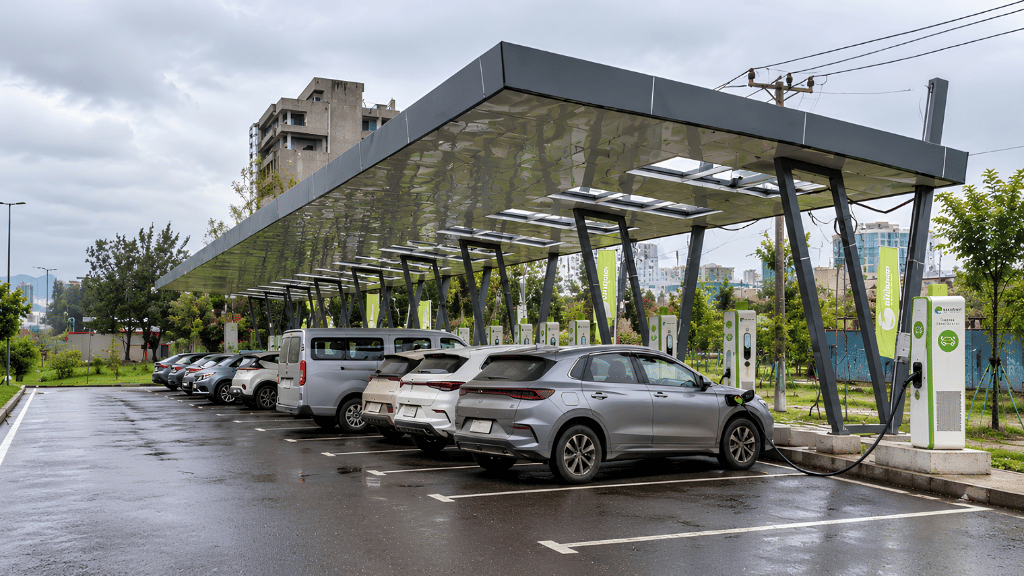
Ethiopia’s transition to electric mobility is changing the economics of transport for people who depend on vehicles to earn an income. For taxi drivers, delivery riders and fleet operators, electric vehicles offer the potential to reduce operating costs, but realising those benefits depends on more than the vehicle itself. Reliable charging, affordable pricing and services that make charging accessible and convenient are equally important.
This is where Ethio Telecom, one of Ethiopia’s mobile network operators, is taking on a new role. Beyond operating its own charging stations, the company has developed a National EV Charging Platform that brings together charging information, digital payments and operational data, with the ability to integrate infrastructure owned by other providers. Its experience illustrates how capabilities developed in telecommunications can support the wider systems needed to make electric transport a viable source of income and business activity.
Electric mobility in Ethiopia
Ethiopia’s transition to electric mobility has been driven by a series of policy measures designed to discourage imports of conventional vehicles and encourage EV adoption. In 2020, the government increased taxes on older imported vehicles. This was followed in 2022 by tax exemptions and reduced import duties for EVs. The government also reduced customs duties to 15% for fully assembled EVs and 5% for semi-assembled models, while completely knocked-down vehicles assembled locally in Ethiopia were exempt from customs duties altogether. Restrictions on importing conventional vehicles subsequently tightened, culminating in a ban on gasoline and diesel vehicle imports.
Today, the focus has begun to move beyond changing which vehicles enter the market, towards building the wider system needed for EVs to operate at scale. This shift was reinforced in May this year with the launch of the National E-Mobility Strategy and Implementation Plan 2025–2030, which sets out a longer-term roadmap for EV adoption, charging infrastructure, local manufacturing and sector coordination.
The results of these policy measures are already visible. As of 2024, EVs accounted for more than 60% of new vehicles registered while national EV registrations reached 45,000, more than six times the 7,000 recorded in 2022. By 2025, that figure had more than doubled again to 115,000. According to an analysis by the Energy for Growth Hub, this growth has placed Ethiopia first in Africa and alongside global EV leaders in per-vehicle penetration.
There is also a strong economic rationale for the transition. While Ethiopia’s grid is over 90% renewable, the country’s transport system is dependent on imported petrol and diesel. In 2023, the country spent around $2.5 billion on fuel imports, equivalent to 65% of its export earnings. Alongside electrification, Ethiopia is developing compressed and liquefied natural gas infrastructure to reduce dependence on imported fuels, particularly for public transport and freight. A new refuelling station in Kaliti will serve gas-powered public buses in Addis Ababa, with further infrastructure planned in Adama and Dire Dawa. The country is also converting more than 1,200 diesel-powered city buses to compressed natural gas, while encouraging adoption in the freight sector by allowing fully gas-powered vehicles to enter Ethiopia duty-free. Ethiopian authorities estimate that replacing diesel and gasoline with electricity and natural gas could cut transport operating costs by at least 50%.
For drivers who rely on their vehicles for income, the potential savings are substantial. Based on estimated energy consumption and prevailing tariffs, a petrol taxi would spend around 1,524 birr to travel 100 km, compared to 223–274 birr for an electric taxi using public charging, or approximately 90 birr when charging at home. This represents energy-cost savings of 82–85% with public charging and ~94% with home charging.*
The potential savings are also reflected in conversations with two taxi drivers in Ethiopia, who reported that their monthly spending on petrol had fallen from approximately 40,000–50,000 birr to 2,000–5,000 birr on electricity after switching to EVs. While these are individual experiences rather than representative findings, they offer a practical illustration of how lower energy costs can affect the economics of earning a living from transport.
Ethio Telecom’s National EV Charging Platform
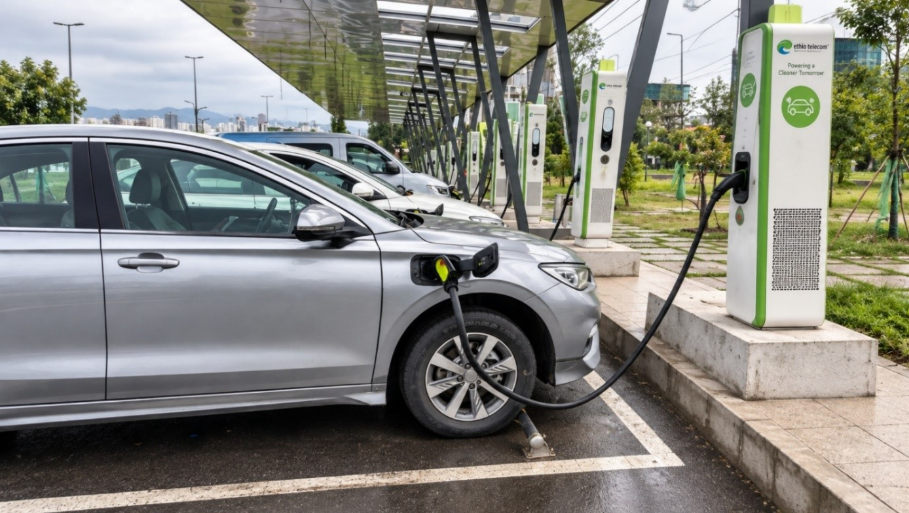
As Ethiopia’s EV market expands, the need for charging infrastructure is creating opportunities for companies outside the traditional energy and transport sectors. Ethio Telecom, a mobile network operator in Ethiopia, has entered the market with its own charging stations and a digital platform to manage charging services. Its involvement aligns with its Next Horizon: Digital & Beyond 2028 Strategy, which sets out plans to expand beyond traditional connectivity into financial services, digital platforms and smart city development.
In e-mobility, Ethio Telecom is applying capabilities from its telecommunications business to support a new set of services. The company operates nine charging stations across Addis Ababa and other cities, including Adama, with a combined capacity to charge 108 vehicles simultaneously. The stations use its connectivity network, drivers can access charging services and make digital payments through telebirr, and its experience managing batteries and power systems at telecom sites carries over to operating chargers. Between February 2025 and July 2026, the company reported more than 481,000 charging sessions and 11.2 million kWh of electricity delivered, with an estimated 15.4 million kg of CO₂ emissions avoided.
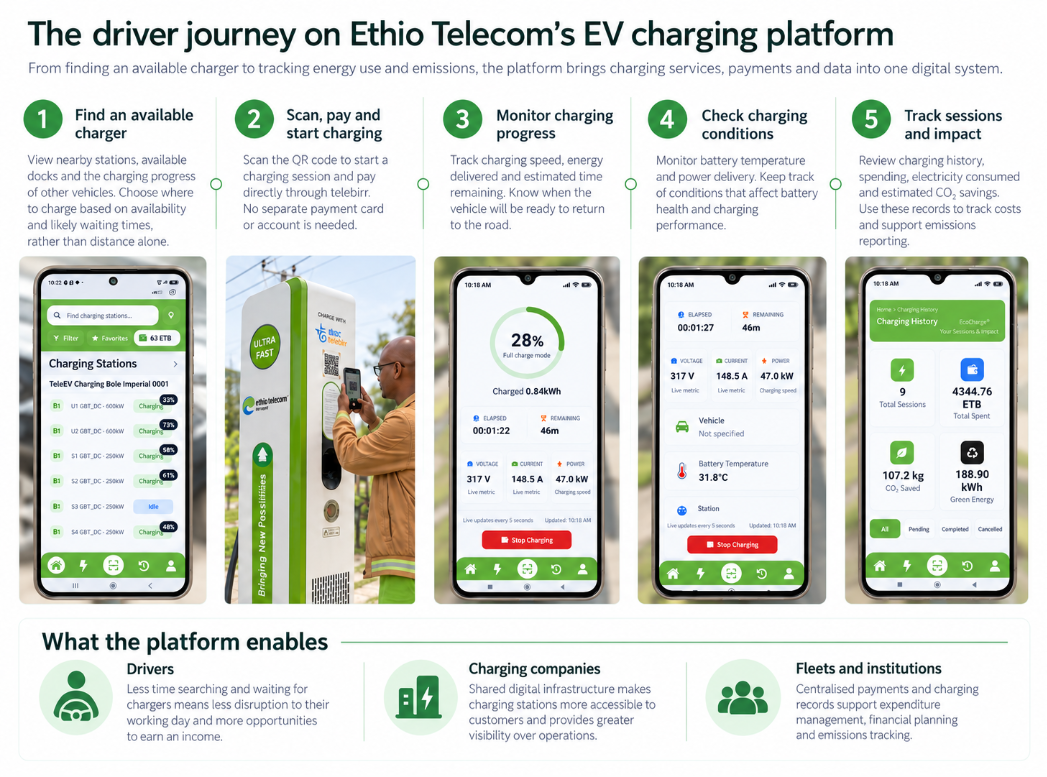
The charging stations are the most visible part of Ethio Telecom’s role, but the platform around them is what makes the case especially relevant for a mobile operator. EV charging depends on coordination between the driver, the charging point, the payment system and the operator managing the service. For drivers, this means being able to locate a charger, know whether it is available, pay easily and reduce the time lost searching for or waiting at a station.
Ethio Telecom’s National EV Charging Platform is built around that coordination. Through the app, drivers can view nearby stations, check dock availability and charging progress, and choose where to charge based on likely waiting times. Integration with telebirr allows drivers to top up a dedicated wallet and pay without a separate account or card. Charging sessions can be initiated through the EV charging app, telebirr app or by scanning a QR code at the station. Drivers can then monitor their charging progress in real time. Each completed session generates a record of costs, electricity consumed, charging time and estimated CO₂ savings.
Beyond individual charging sessions, the platform also supports fleet operators in managing charging across multiple vehicles. A driver can share their charging station and dock number with a fleet manager, who can then pay for the session remotely through a company account. This allows businesses to manage payments centrally, while maintaining records of where vehicles charge, how much electricity they use and what each session costs. These records can support budgeting, cost monitoring and fleet planning, while also helping businesses and institutions track energy consumption and report progress towards climate goals.
The platform also uses AI to support the technical management of charging. By analysing vehicle and battery data, the system can assess battery condition, identify potential maintenance needs and adjust charging parameters. At ultra-fast charging stations, for example, it can adjust how quickly power is delivered based on factors such as battery condition and how far a vehicle has recently travelled. This matters because charging a depleted battery too aggressively can accelerate battery degradation and shorten its lifespan. By managing charging speed and battery condition, the system aims to reduce unnecessary battery wear, which could translate into lower maintenance and replacement costs for drivers and fleet operators. These functions are less visible to drivers but are part of what makes charging a digitally managed service rather than simply access to a power source.
The National EV Charging Platform also extends beyond Ethio Telecom’s own stations. It is designed to integrate charging infrastructure operated by other providers, including the Ethiopian Electric Utility (EEU), hotels, shopping malls, etc. Through a common digital platform, drivers can access charging information and payment services across different locations, while providers gain a shared system for managing their charging services. This is where Ethio Telecom’s role extends beyond operating chargers to supporting the digital infrastructure that connects them across different providers.
Connecting infrastructure and data to support e-mobility
Whether an irrigation pump, cold room, e-cooking appliance or electric vehicle, the adoption and wider use of these assets depend on more than the equipment itself. Affordability, reliable electricity, payment systems, customer access, usage data and after-sales support all influence whether people and businesses can use them effectively. Ethio Telecom’s experience illustrates this wider argument, demonstrating how digital infrastructure can connect charging services across different providers while also highlighting the potential for charging data to support electricity planning.
1. The opportunity in shared charging infrastructure
Home charging may meet the needs of many private vehicle owners, but public charging remains important for longer journeys, commercial fleets and drivers without reliable access to charging at home. For drivers who depend on their vehicles for income, the availability and reliability of that network can directly affect how much time they spend on the road.
Expanding this infrastructure will require investment beyond any one charging operator. Utilities, private companies, hotels and other businesses have different reasons to install chargers, but not all need to build the digital systems that support them independently. A hotel or retail park, for example, could offer charging to customers without developing its own payment and monitoring services. This model is already beginning to take shape in Ethiopia, where Ethiopian Electric Utility (EEU) has connected its three public charging stations in Addis Ababa to Ethio Telecom’s platform. The opportunity presented by Ethio Telecom’s approach is to separate investment in physical charging infrastructure from the development of shared digital services. This could make it easier for additional providers to enter the market while giving drivers access to a more connected network.
For mobile operators, this represents an opportunity to build on capabilities and experience they already have. Ethio Telecom’s experience illustrates how these capabilities can be brought together to support charging infrastructure developed by other actors. The wider opportunity is not necessarily to become a charging operator, but to provide the shared digital systems through which a growing network of charging services operates.
2. Using charging data to manage electricity demand
For utilities, growing electricity demand presents both an opportunity and a planning challenge. In Kenya, for example, Kenya Power has positioned e-cooking and e-mobility as ways to encourage households and businesses to shift expenditure on other fuels towards electricity. But as electricity demand grows, utilities must also consider where and when it occurs. EV charging and battery-swapping facilities can concentrate consumption at particular locations and times, potentially placing pressure on local networks.
Digital charging platforms could help utilities better understand this growing demand. Ethio Telecom’s platform already records charging sessions and electricity consumed across connected stations, supporting expenditure tracking and service management. With appropriate access and analysis, these records could complement utility metering data, providing additional insight into when and where electricity is used. This becomes particularly interesting when considered alongside electricity pricing. In Ethiopia, Ethiopian Electric Utility (EEU) applies three time-of-use tariffs at its charging stations, ranging from 14.85 to 18.28 birr per kWh depending on the time of day. Time-of-use pricing is not new, having long been applied to larger commercial and industrial customers. As EV charging expands, the combination of metered charging activity and different tariff periods offers an opportunity to examine how electricity prices influence charging behaviour, with potential applications for future demand management.
As electricity becomes more central to transport and other income-generating activities, the connections between physical infrastructure, digital services and energy planning will become increasingly important.
For further reading on the policies and digital solutions supporting productive use of energy, explore GSMA’s research across India, Kenya, Uganda and Nigeria.
* Illustrative energy-cost comparison based on petrol at 167.50 birr/litre, petrol consumption of 9.1 litres/100 km, EV consumption of 15 kWh/100 km, public charging at 14.85–18.28 birr/kWh and residential charging at approximately 5.86–5.97 birr/kWh. Excludes charging losses and other vehicle operating costs.