


In 2001, Dr. Santos, a young doctor who originally hailed from one of the remote islands in the Philippines, moved to Manila to continue her medical residency in a much larger private hospital. Sometime in 2006, she received a call on her mobile phone at around 2:00 AM from her aunt, who was still living on the island. Her aunt needed medical advice—Dr. Santos’ uncle was bitten by a venomous snake. As the community health centre which her aunt normally relied on for basic healthcare services was closed (it operated from 8:00 AM until 5:00 PM) and the closest hospital admitting emergency patients this early in the morning was five to six hours away, her aunt’s only option was to contact her niece for first aid treatment advice.
If not for Dr. Santos’ first aid instructions, her uncle would have died but thanks, too, to the ubiquity of mobile technology, which made it technologically possible for her aunt to seek treatment advice remotely.
Dr. Santos’ relatives, who are mainly small landholding farmers, are fortunate to have access to 24 x 7 health advice through their niece. However, millions of other underserved consumers are less fortunate, especially those living in remote areas and who are less likely to have a relative with a medical background. With public hospitals often located hundreds of kilometres away, consumers living in remote locations tend to rely on self-medication or on the advice and treatment of traditional community healers, who are not scientifically trained and have less experience in diagnosing more complicated medical conditions.
Even if a private hospital were nearby, many do not have health insurance nor do they have the financial means to afford private hospital fees. As a result, many consumers could be misdiagnosed, or their conditions deteriorate to the point when more advanced treatment would be required, thereby making the cost of treatment considerably more expensive. Worse still, the condition may reach a stage that might not be treatable at all.
The story of underserved consumers from the Philippines is not dissimilar from the stories of underserved consumers in other developing countries, where access to basic healthcare is limited or where transportation infrastructure is inadequate. Nonetheless, as mobile phones and networks continue to spread with many developing countries reaching mobile penetration of 50% or more, health hotlines or medical call centres can be a good solution for underserved consumers to access general health-related information and advice, consultation, diagnosis, referral or treatment services.
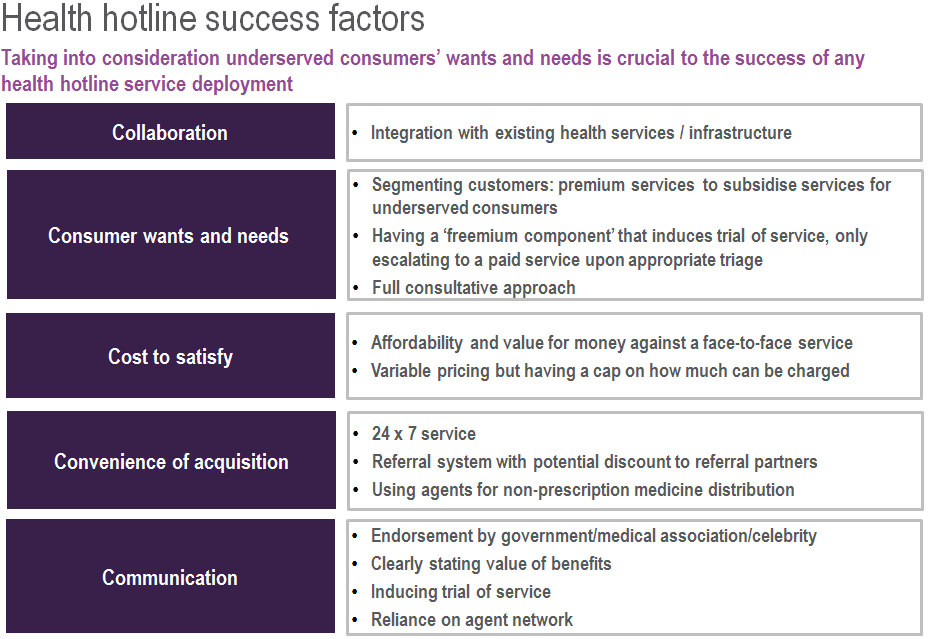 In a recently published report about health hotlines, it is shown that health hotlines can be valuable in preventative medicine and disease diagnosis, strengthening over-burdened health facilities and healthcare service delivery, especially in developing countries. The report also identifies which Mobile Network Operators (MNOs) globally have taken a more proactive role beyond providing connectivity in the delivery of health hotline services. It also examines the key drivers and barriers to adoption of health hotline services by MNOs and provides a question toolkit that can help any health hotline provider evaluate the level of adoption of the services by consumers.