


The Digital Leadership Forum at MWC Doha brought together industry leaders, ministers and policymakers around a common question: what will it take to build the connectivity foundations for the next wave of digital innovation?
Across both the industry and ministerial panels, one message stood out. Connectivity is no longer simply about coverage. It must be resilient, affordable and investment-friendly, while evolving to support AI, satellite integration and new digital services.
Mobile: Powering progress
The industry discussion highlighted a sector at an important turning point. AI is creating enormous demand for infrastructure, while operators are simultaneously being challenged to find new sources of growth and deliver greater value to customers.
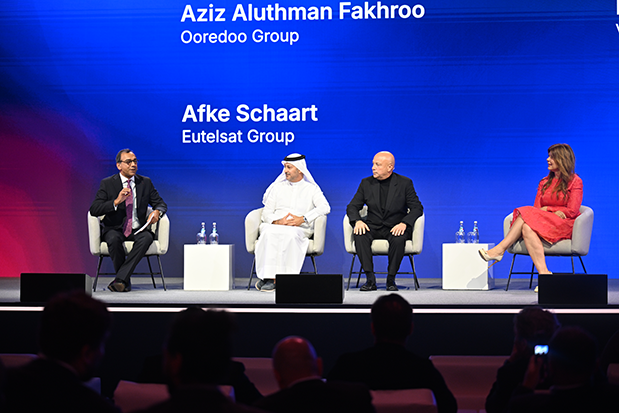
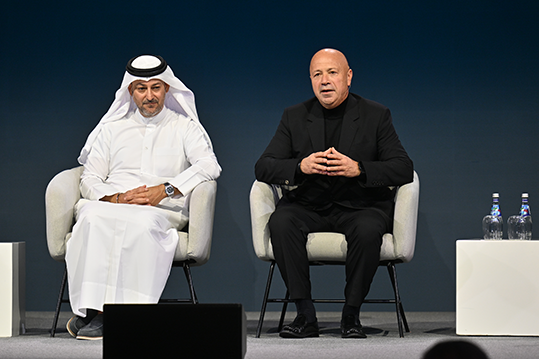
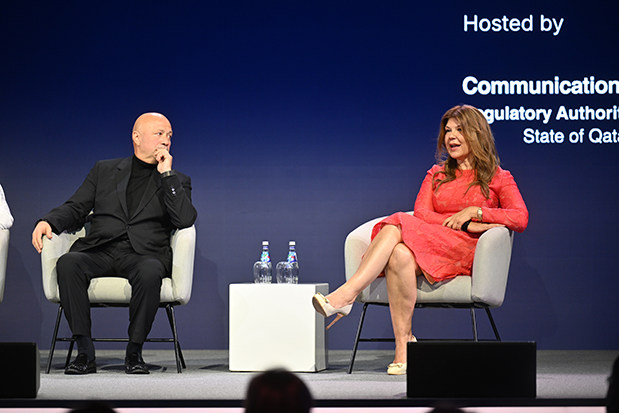
AI needs connectivity, but also changes its value
Aziz Aluthman Fakhroo, Group CEO of Ooredoo, highlighted the scale and complexity of the infrastructure build-out required for AI. Data centres require significant capital, energy, land and connectivity, and growing demand is putting further pressure on supply.
But AI presents an opportunity that goes beyond infrastructure or improving efficiency. Kaan Terzioglu, Group CEO of VEON, described AI as “augmented intelligence”, capable of helping individuals, businesses and countries achieve things previously constrained by time, skills or knowledge.
This could also redefine the operator value proposition. The industry has evolved from selling minutes, to messages, to data, and increasingly to digital services. The next step could see operators becoming intelligence platforms, creating new value for both customers and investors.
Terrestrial and satellite networks are converging
Satellite connectivity emerged as a central part of the discussion, not as a replacement for terrestrial networks, but as a complementary layer.
Afke Schaart, EVP of International and Institutional Affairs at Eutelsat, stressed the potential of hybrid networks, where users ultimately do not need to know whether their connection comes from terrestrial or space infrastructure. For operators serving large, geographically challenging or disaster-prone markets, satellite can provide an essential resilience layer when terrestrial infrastructure is unavailable.
Yet integration also raises regulatory questions. Speakers called for clear rules around spectrum, licensing and sovereignty, with equivalent services operating under fair regulatory conditions.
Investment must remain sustainable
The investment challenge ran throughout the discussion. Network sharing was identified as one way of making future infrastructure deployment more efficient, while policymakers were urged to consider connectivity as economic infrastructure rather than primarily a source of taxation.
Device affordability matters too. Without affordable access to smart devices, consumer adoption cannot grow sufficiently to support wider socioeconomic progress.
The same thinking applies to 6G. Technology evolution should be driven by compelling use cases and customer value, while allowing the industry to realise the full potential of existing 5G investment.
Accelerating cooperation for a connected digital future
The ministerial discussion broadened the lens from industry transformation to national digital strategies.
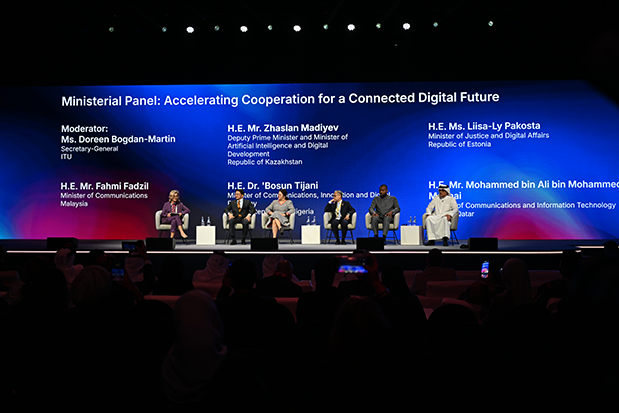
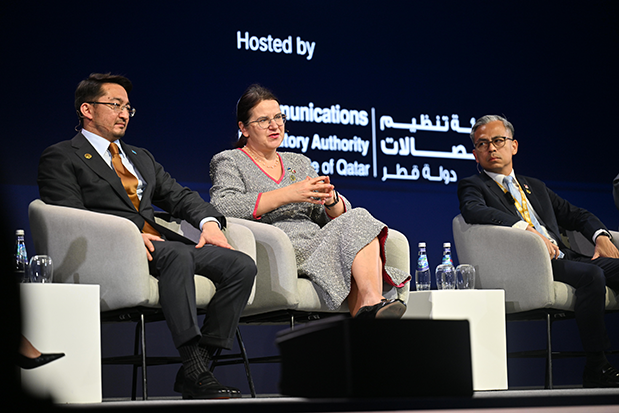
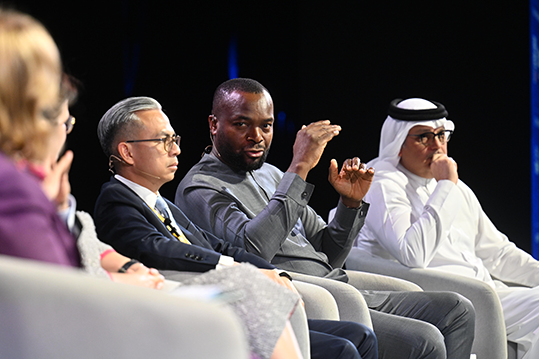
Doreen Bogdan-Martin, Secretary-General of the ITU, set the context: 6.3 billion people are connected, but 2 billion remain offline. And coverage alone is no longer enough. Meaningful connectivity must also be affordable, high-quality, secure and resilient.
Different countries illustrate how that ambition is being translated into action.
Zhaslan Madiyev, Deputy Prime Minister and Minister of Artificial Intelligence and Digital Development of Kazakhstan, highlighted how the country is combining fibre, mobile and satellite connectivity with investment incentives, aiming to extend fibre coverage to 90% of its 6,000 villages and using reduced spectrum fees to encourage rural deployment.
Liisa-Ly Pakosta, Estonia’s Minister of Justice and Digital Affairs, said that after achieving fully digital government services, Estonia is moving toward AI-enabled services while continuing community-based initiatives to ensure people have the skills and access to participate.
Bosun Tijani, Nigeria’s Minister of Communications, Innovation & Digital Economy, highlighted that the country is backing connectivity with major infrastructure investment, including plans for 90,000 km of open-access fibre. Crucially, he argued that closing the AI divide also requires “absorptive capacity”: talent, skills and affordable access to computing power.
Fahmi Fadzil, Malaysia’s Minister of Communications, demonstrated why resilience must be designed into networks, from hardening infrastructure against climate disruption to deploying satellite connectivity for emergency communications.
Mohammed bin Ali bin Mohammed Al Mannai, Qatar’s Minister of Communications and Information Technology, shared that, with extensive 5G and fibre coverage, Qatar is already looking towards 6G and greater convergence between terrestrial and satellite infrastructure to strengthen resilience, sovereignty and competitiveness.
A shared agenda for the connected future
Together, the two panels showed how the connectivity debate is evolving from expanding coverage to creating resilient digital foundations that enable AI, support economic growth and remain available when societies need them most.
Doing that will require sustainable investment, infrastructure sharing, affordable devices, harmonised regulation and integration between terrestrial and satellite networks.
Most importantly, it will require deeper cooperation between governments, industry and international organisations. The technology is moving quickly. Ensuring its benefits reach everyone will depend on policy, investment and partnership moving just as quickly.