


Speed, scale, and simplicity are everything in today’s digital economy. Whether you’re a developer building the next big app or a telecom operator looking to monetize your network, the ability to connect and innovate quickly is critical. That’s where GSMA Open Gateway and TM Forum come in – two organizations working hand-in-hand to make telecom networks programmable, interoperable, and ready for global scale.
At the heart of this transformation is a shared mission: to standardise and certify network Application Programming Interfaces (APIs) so they can be used seamlessly across markets and operators – unlocking new business models, improving customer experiences, and enabling a new wave of digital services.
Why now?
The timing couldn’t be better. As Mark Cornall, Technical Director, GSMA, explains, “We’re seeing real momentum. Developers want global reach, and operators want to monetize their networks. But to do that, we need consistency. Certification ensures that APIs work the same way everywhere.”
That consistency is essential. Without it, developers would need to integrate with each operator individually – an expensive and time-consuming process. With certification, they can “develop once, deploy globally.”
Andy Tiller, Executive Vice President at TM Forum, agrees, “We’re at a tipping point. Aggregators like Aduna are signing up partners, developers are coming on board, and operators are exposing APIs. The ecosystem is growing fast, and certification is what makes it scalable.”
What is certification – and why does it matter?
Certification is more than a stamp of approval. It’s a rigorous process, ensuring APIs conform to global standards – both in how they function and how they’re managed. For developers and channel partners, this means confidence that an API will work as expected, no matter where it’s deployed. For operators, it means faster time to market, lower integration costs, and fewer support headaches.
GSMA and TM Forum are working together to certify two key types of APIs:
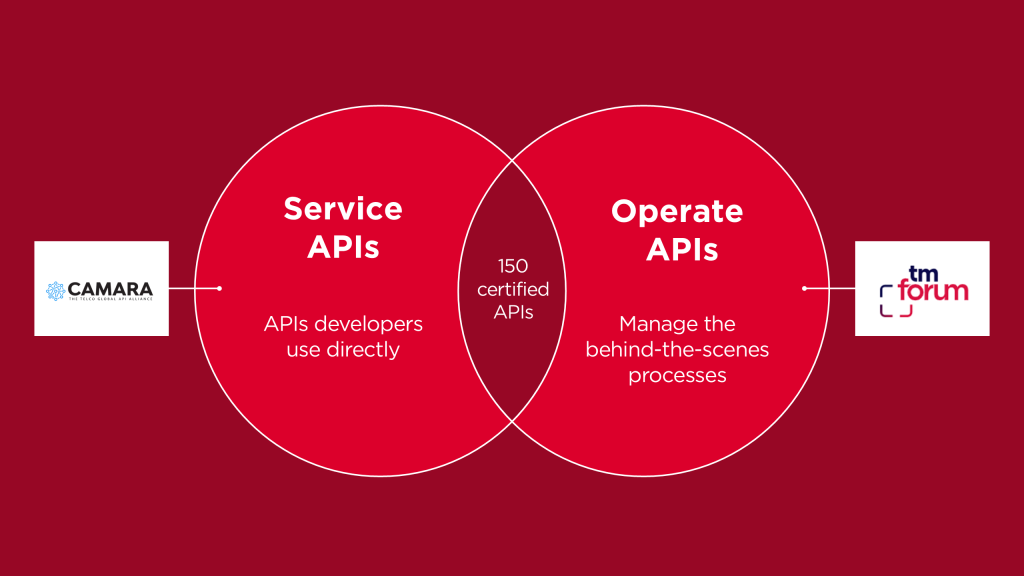
- Service APIs (From CAMARA): These are the APIs developers use directly – for example, to verify a phone number, check device location, or request higher network quality.
- Operate APIs (From TM Forum): These manage the behind-the-scenes processes – like onboarding developers, tracking usage, and managing API catalogues. They’re essential for monetization and scale.
So far, over 150 CAMARA APIs have been certified. And while none passed on the first try, that’s part of the value. As Mark notes, “Certification helps catch issues early, before they become real-world problems.”
Making network APIs simple: one front door
One of the biggest challenges in telecom has always been fragmentation. Different operators, different systems, different standards. That’s changing.
GSMA is becoming the “front door” for network API certification. Operators can go to one place to certify both their service and operate APIs. TM Forum provides the technical tools and expertise, but the experience is seamless for the operator.
This unified approach is critical. As Andy explains, “We don’t want operators to have to go to multiple places. We want to make it easy. That’s how we scale.”
The need for collaboration
With so many players involved – GSMA, TM Forum, CAMARA, Mplify Alliance, Communications Platform as a Service (CPaaS) providers, hyperscalers – it’s fair to ask: how does it all fit together?
The answer is collaboration.
Each organization has a clear role. CAMARA defines the Service APIs. TM Forum develops the Operate APIs and supports internal network processes. Mplify Alliance brings expertise in fixed-line services. And GSMA coordinates the ecosystem, ensuring everything works together.
“We’re all aligned,” says Andy. “We’re here to serve the industry. That means creating single standards, not multiple ones.”
This collaboration extends to events, proof-of-concept projects, and shared roadmaps. TM Forum’s Catalyst program and the GSMA’s Foundry both provide platforms for testing and demonstrating new use cases, from fraud prevention to immersive retail experiences.
The role of aggregators and hyperscalers
Certification is more than a stamp of approval. It’s a rigorous process, ensuring APIs conform to global sAggregators and cloud providers play a crucial role in bringing network APIs to life. They connect developers with network capabilities, often bundling APIs into easy-to-use products.
But there’s a balance to strike. While aggregators are free to innovate, GSMA and TM Forum are encouraging them to expose standardized CAMARA APIs northbound, so developers can switch providers without rewriting code.
“We want portability,” says Mark. “We don’t want developers locked into silos. Certification helps ensure that APIs are consistent, even when they’re delivered through different partners.”
Hyperscalers like Google and Microsoft are also key players. Not only do they host developer ecosystems, but they are also huge developer communities, building apps that can benefit from network APIs. Their involvement helps shape the standards and drive adoption.
What’s next for network APIs?
The roadmap is clear: more APIs, more certifications, more markets.
TM Forum’s Operate APIs are rolling out in phases. The first, focused on onboarding, is already live. Next up: catalogue federation (which APIs are available where) and usage tracking (for billing and analytics).
Meanwhile, the GSMA is expanding its certification program to include channel partners and aggregators – ensuring consistency across the entire value chain.
There’s also growing interest in more advanced APIs, like Quality on Demand, which lets developers request higher network performance for specific tasks, like livestreaming or gaming. These APIs introduce new challenges around pricing, regulation, and business models, but the potential is huge.
Proof in practice: real-world use cases
The value of network APIs is already being proven in the market.
- TikTok replaced SMS-based one-time passwords with number verification, creating faster sign-ups, better user experience, and higher conversion rates.
- Retailers are exploring geofencing APIs to personalize in-store experiences, like sending a message when a customer walks in, based on their online browsing history.
- Banks are using SIM swap detection to prevent fraud, protecting customers and reducing losses.
The end goal: global scale, seamless experience
So, what does success look like?
For Mark and Andy, it’s simple: global scale. A world where developers can build once and deploy anywhere. Where operators can monetize their networks efficiently. And where end users enjoy faster, safer, and more personalized digital experiences.
“We’ve spent years sending emails to request APIs,” says Mark. “That doesn’t scale. Now we’re building the infrastructure to automate it all, from onboarding to billing to assurance.”
It’s a bold vision. But with the right standards, the right partnerships, and the right momentum, it’s one that’s quickly becoming reality.