



Tuesday 1 September, 2026
Navigating brownfield connectivity
Most factories are brownfield environments containing a complex mix of new equipment and decades-old legacy machines. The primary objective of IIoT connectivity is to securely extract trapped data without disrupting live operations. Forward-looking industrial teams typically deploy a flexible connectivity architecture that combines existing operational technologies with modern networking and software layers. This often involves industrial gateways, edge computing platforms, and protocol translation services connecting legacy proprietary systems to standardised digital environments.
Industrial IoT depends on getting useful data from machines, people, assets and processes, then turning that data into better operational decisions. In a brownfield site, connectivity is a strategic smart manufacturing choice: it shapes how quickly a site can see downtime, track assets, monitor quality, reduce manual checks and adapt production layouts. Ethernet, Wi-Fi and gateways remain important foundations, but when the bigger picture includes broad coverage, mobile assets, reconfigurable lines or operations beyond the plant boundary, private 5G and cellular options may become stronger candidates. Final choices should still be validated against plant layout, existing systems, operational priorities, cost and business case. This section is for manufacturing leaders, plant teams, OT/IT teams and digital transformation leads making practical IIoT connectivity decisions
Part 3 | The how
Connectivity choices for brownfield IIoT
Factory visual
One factory, one set of IIoT data needs
The factory visual shows why connectivity strategy matters for IIoT and smart manufacturing. The scene keeps the same brownfield plant, then changes the connectivity model so you can see the effect on fixed machines, moving AGVs, robot cells, worker devices, legacy signals and conveyor data. Ethernet and gateways are strong for fixed and legacy assets, Wi-Fi supports familiar indoor device coverage, and private 5G becomes more relevant when the site needs broader wireless coverage, mobile operations and future flexibility.
Best fit
Brownfield discoveryStart by identifying what operational data is needed and where it exists today.
Watch-out
Mixed constraintsLegacy interfaces, moving assets and recabling limits can point to different technologies.
Typical IIoT use
Visibility firstDowntime, quality, production visibility, asset tracking, energy and manual checks.
Strategic point
Choose architectureThe connectivity mix shapes how easily the site can scale smart manufacturing use cases.
Visual key
Industrial Ethernet
Wi-Fi coverage
Gateway bridge
Private 5G path
Scene 1 · Brownfield overview
IIoT Connectivity Decision Guide
Start with the data need, then choose the connectivity mix
This guide consolidates the technology comparison, brownfield decision path and hybrid deployment message into one compact section.
| Technology | Strength | Limitation | Typical IIoT use |
|---|---|---|---|
| Industrial Ethernet | Reliable fixed connectivity for machines and controls. | Limited mobility; recabling can be disruptive when layouts change. | PLCs, CNCs, conveyors, robot cells and fixed production assets. |
| Wi-Fi | Familiar indoor wireless for people and devices. | Needs careful design for interference, backhaul, roaming and coverage. | Tablets, HMIs, scanners, operator dashboards and indoor data capture. |
| Gateway approaches | Practical bridge for legacy machines and protocol translation. | Adds devices that must be powered, secured, maintained and managed. | Brownfield extraction, sensor overlays and connecting older equipment onwards through Ethernet or Wi-Fi. |
| Private 5G | Controlled wireless option for mobility, coverage and flexible layouts. | Needs deployment planning, compatible devices, skills and a justified business case. | AGVs, AMRs, mobile operations and sites where layout flexibility matters. |
| Public cellular | Useful when IIoT assets operate beyond the factory network. | Less central to the factory-floor story; suitability depends on coverage, region and service model. | Remote assets, yards, fleets, temporary locations and off-site monitoring. |
What operational data do you need?
IIoT should start with a practical manufacturing question, not a preferred technology.
- Why did production output drop?
- Which asset is causing downtime?
- Where are work-in-progress materials?
- Which machine is using the most energy?
- What quality issue is emerging?
Illustrative example: packaging line visibility
A packaging line may start with a downtime question: which machine state, stoppage reason or operator check is missing from the current view? This points the project towards the data that must be collected before choosing a network.
Factory systems
MES · SCADA · analytics
Ethernet
Wi-Fi
Private 5G
Gateways
Public cellular
external assets
No single connectivity technology fits all manufacturing use cases
- Hybrid deployments are common in brownfield IIoT.
- Ethernet, Wi-Fi, cellular, private 5G and gateways can coexist.
- Gateways may connect onwards through Wi-Fi or Ethernet depending on site architecture.
- Network decisions should follow operational needs, not technology preference.
- Use this as a starting point. Final choices should be validated against your plant layout, existing systems, operational priorities and business case.
i
Choose connectivity by IIoT requirement first. Most brownfield factories use a combination of Ethernet, Wi-Fi, gateways and, where justified, private 5G. Public cellular may be relevant when assets extend beyond the plant boundary, and private 5G becomes more strategically attractive when mobility, wider coverage and long-term flexibility matter together.
Wi-Fi 6 is cost-effective for standard IT operations and static indoor environments. However, Wi-Fi suffers from coverage limitations, typically only reaching 30 to 50 metres indoors. It requires a dense access-point layout and often struggles with signal interference in steel-heavy industrial environments. Wi-Fi also struggles with seamless handovers. AGVs must often stop or slow down when switching between access points.
A private 5G network operates on licensed spectrum, avoiding electromagnetic interference and delivering the deterministic reliability that mission-critical operations require. A 5G network supports massive device density while guaranteeing strict latency boundaries.
Digital reconfiguration over physical cables
A major operational benefit of deploying a wireless network is the ability to reconfigure the factory layout digitally. Traditionally, adapting a production line meant halting operations to run new physical Ethernet cables. A wireless 5G backbone eliminates this rigid infrastructure. Facilities can relocate machines, deploy AGVs, and adapt production lines without running new cables. The digital flexibility cuts both material and labour costs.

Challenge
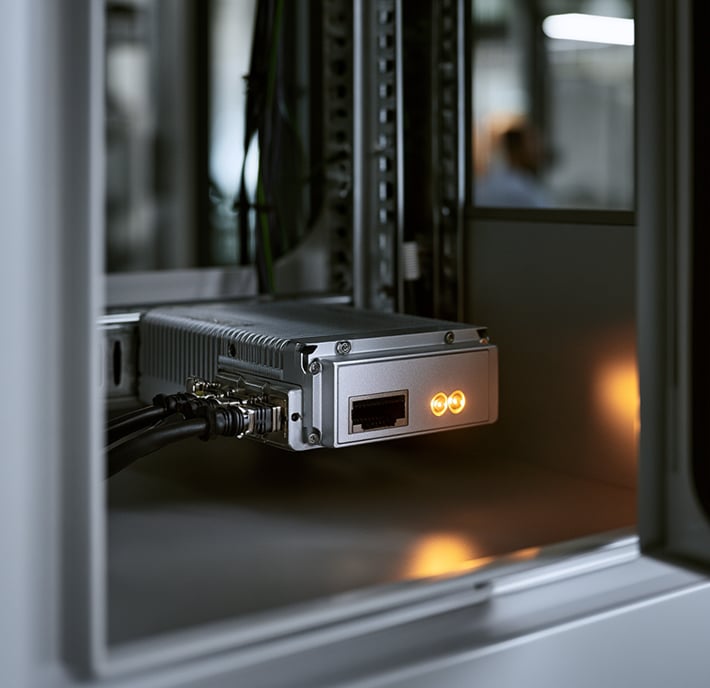
The most significant hurdle in a diverse factory is getting old machinery to speak a modern digital language. Industrial IoT gateways act as translators in this environment.
These ruggedised devices sit between machines and the network. They convert legacy serial protocols such as Modbus or PROFIBUS into cloud-friendly formats like MQTT or OPC UA.

Solution
Advanced 5G networks can now handle the conversion and transport of these industrial communication protocols within the network layer.
Layer 2 tunnelling over private 5G carries legacy industrial frames natively. No hardware modifications to existing PLCs are needed. This allows factories to integrate decades-old machinery into the modern digital ecosystem while protecting existing equipment investments.
Connectivity choices for Industrial IoT (IIoT)
IIoT deployments match connectivity to the job: private 5G for mobility, LPWAN for low-power sensors, wired Ethernet for deterministic control. Each technology section covers strengths, limitations, and typical use cases, with a rule of thumb at the end.
Key decision factors (before choosing)
When selecting connectivity, most industrial deployments balance:
- Coverage – indoor factory, campus, remote site, global footprint
- Latency – milliseconds (control) vs seconds (monitoring)
- Reliability & determinism – critical for automation and safety
- Bandwidth – small sensor data vs video / AI workloads
- Power consumption – battery devices vs mains-powered
- Security & isolation – private vs public networks
- Cost (CapEx + OpEx) – infrastructure, spectrum, devices
Main connectivity options
A. Wired (Industrial Ethernet & Fieldbus)
Examples: PROFINET, EtherNet/IP, Modbus TCP, CAN bus
Best for:
- Real-time control systems (robots, PLCs)
- Deterministic, ultra-reliable environments
Strengths:
- Very low latency and high reliability
- Deterministic performance
- Mature, widely deployed
Limitations:
- No mobility
- High installation cost and complexity
- Difficult to scale across large or dynamic sites
B. Wi-Fi (Wi-Fi 5/6/6E)
Best for:
- Indoor factory connectivity
- Non-critical data and worker mobility
- Video, tablets, handheld devices
Strengths:
- High bandwidth
- Relatively low cost
- Easy to deploy in existing IT environments
Limitations:
- Interference in industrial environments
- Limited QoS guarantees compared to 5G
- Roaming and reliability challenges for critical OT
C. Cellular Connectivity
4G (LTE – Public and Private)
Best for:
- Wide-area connectivity (primarily public networks)
- Asset tracking and remote monitoring
- Early-stage or cost-sensitive private network deployments
Strengths:
- Mature, proven ecosystem with broad device availability
- Extensive global coverage via public networks
- Reliable performance for non-time-critical use cases
- Can be deployed as private LTE for additional control and security
Limitations:
- Latency typically too high for real-time industrial control
- Limited support for deterministic performance
- Not designed for advanced automation or time-sensitive networking
- Less flexibility compared to 5G in supporting diverse IIoT requirements
5G (Non-Standalone – NSA, mainly Public today)
Best for:
- High-bandwidth applications (e.g. video analytics, AR/VR support)
- Connected assets across large geographies (public networks)
- Enhanced mobile broadband in industrial environments
Strengths:
- Lower latency than 4G (but still dependent on 4G core)
- Higher throughput for data-intensive applications
- Improved device density support
- Available widely via public network deployments
Limitations:
- Still reliant on 4G core network → limits full 5G capabilities
- Limited support for true determinism or guaranteed QoS
- Network slicing is limited or not fully implemented in practice
- Less suitable for mission-critical or closed-loop automation
- Less control compared to private deployments
5G Standalone (5G SA – Public and Private)
Best for:
- Advanced Industry 4.0 use cases
- Mission-critical operations and closed-loop automation
- Smart factories, ports, logistics hubs (often private networks)
Strengths:
- Ultra-low latency and improved responsiveness
- Support for deterministic performance (critical for industrial control)
- Network slicing with end-to-end QoS guarantees
- Integration with Time-Sensitive Networking (TSN) for industrial systems
- Ultra-Reliable Low Latency Communications (URLLC) capabilities
- High device density (massive IoT support)
- Strong security and isolation, especially in private deployments
- Full control of performance, policies, and data (private networks)
Limitations:
- Deployment still scaling globally (especially public SA coverage)
- More complex implementation (integration with IT/OT systems)
- Spectrum availability varies by country for private use
- Higher upfront investment vs public network usage
D. Private Cellular (4G and 5G, especially 5G SA)
Best for:
- Industrial campuses requiring secure, high-performance connectivity
- Mobility use cases (AGVs, AMRs, connected workers)
- Environments needing predictability and control
Strengths:
- High reliability and consistent performance
- Deterministic capabilities (especially with 5G SA)
- Full operational control (coverage, capacity, policies)
- Strong security with isolated networks
- Supports both legacy (4G) and advanced (5G SA) use cases
- Enables integration with industrial systems (PLC, SCADA, edge compute)
Limitations:
- Higher upfront cost and deployment complexity
- Requires careful spectrum strategy (licensed/shared/unlicensed)
- Integration effort across IT and OT domains
- Needs operational expertise or partner ecosystem
E. LPWAN (Low-Power Wide Area Networks)
NB-IoT / LTE-M (cellular LPWAN)
Best for:
- Massive IoT (metering, environmental sensors)
Strengths:
- Long battery life (years)
- Good coverage and deep indoor penetration
- Secure (licensed spectrum)
Limitations:
- Low data rate
- Higher latency
LoRaWAN (unlicensed)
Best for:
- Private, low-cost sensor networks
- Facilities, agriculture, utilities
Strengths:
- Very low power
- Low cost
- Can be privately deployed
Limitations:
- Limited QoS
- Interference risk (unlicensed spectrum)
- Not suited for real-time control
F. Other niche / emerging options
- Bluetooth LE / BLE Mesh – short-range sensors, wearables
- Zigbee / Thread – local industrial networks, building systems
- Satellite (LEO) – remote sites (mines, offshore, utilities)
Mapping technologies to industrial use cases
Use case and typical connectivity
- Real-time automation (robots, PLCs), Wired Ethernet / Private 5G
- AGVs / AMRs (mobile robots), Private 5G / Wi-Fi
- Predictive maintenance (sensors), NB-IoT / LoRaWAN / Wi-Fi
- Video analytics / AI, 5G / Wi-Fi 6
- Remote asset monitoring, 4G / NB-IoT
- Worker devices (tablets, AR), Wi-Fi / 5G
- Critical infrastructure (utilities), Private 4G/5G + LPWAN
Practical architecture insight
Most IIoT deployments are hybrid:
- Wired + wireless coexistence (deterministic + flexible)
- Private 5G for mobility + Wi-Fi for IT traffic
- LPWAN for low-power sensors layered on top
There is no single “best” connectivity - it’s about combining technologies appropriately.
Simple rule-of-thumb
Most IIoT deployments are hybrid:
- • Need real-time, deterministic control? → Ethernet or Private 5G SA
- • Need mobility across a site? → Private 5G (SA preferred) or Wi Fi 6
- • Need high bandwidth (video, AI)? → 5G or Wi Fi 6
- • Need low-power sensors at scale? → LPWAN (NB-IoT, LTE-M, LoRaWAN)
- • Need wide-area / remote connectivity? → 4G or public 5G
- • Need guaranteed performance and mission-critical reliability? → Private 5G SA

IoT Resources

