Tuesday 17 November, 2026
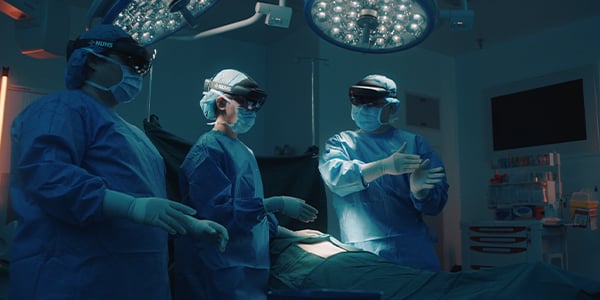
XR-assisted surgeries have been performed to date, demonstrating the adoption of 5G-enabled extended reality in clinical procedures.
%
Intra-operative XR guidance has reduced operating times by 10–30% on average across a variety of surgical procedures.
+
NUHS@Home cares for more than 100 patients at any one time, enabling remote monitoring and freeing hospital beds for patients with critical needs.
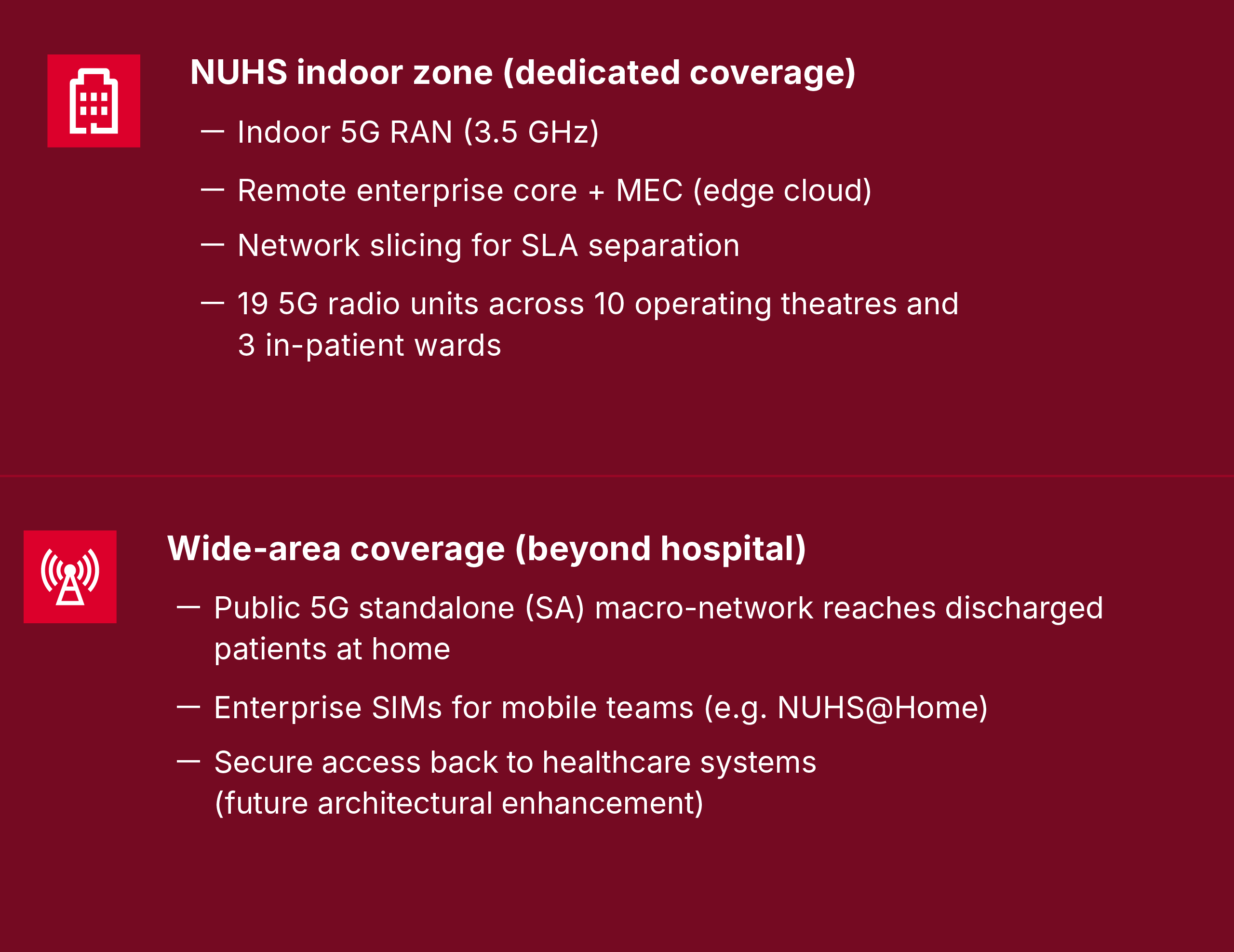
5G radio units provide dedicated coverage across 10 operating theatres and 3 inpatient wards, supporting connected clinical workflows.

Challenge
NUHS needed a secure, reliable, high-performance network to support connected, integrated and intelligent healthcare platforms, while extending connectivity beyond hospital campuses to enable hospital-at-home services, connected ambulances, remote monitoring and proctoring. Clinical workflows involving MR and medical imaging required predictable throughput and low latency, while maintaining end-to-end security, data segregation and compliance. Integrating 5G-connected devices with existing hospital systems and electronic medical records also presented challenges around data handling, device readiness and clinical governance.

Solution
NUHS, Singtel and Ericsson deployed a virtual private 5G network delivering dedicated campus coverage and service-level agreements (SLAs), while leveraging public infrastructure for wide-area connectivity. The solution enables XR-guided surgeries, remote proctoring and advanced care at home, supporting NUHS’s vision of an intelligent hospital platform. SIM-based provisioning through private DNN/APN configurations improves data security, while a secure-by-design 5G network provides data segregation between enterprise and consumer traffic. Network slicing supports SLA differentiation, with Singtel and NUHS exploring dedicated 5G radio resource partitioning for future in-hospital enterprise use cases.
Introduction
The National University Health System (NUHS), in collaboration with Singtel and Ericsson, has deployed a virtual private 5G network to transform healthcare delivery through advanced connectivity. Combining dedicated on-campus coverage with public 5G infrastructure for wide-area reach, the solution enables XR-assisted surgery, real-time clinical guidance, remote proctoring and hospital-at-home services. By integrating secure connectivity, network slicing and edge computing, the deployment supports more efficient clinical workflows and improved patient care, demonstrating how 5G technology can establish the foundation for connected, integrated and intelligent healthcare while supporting the evolution of future hospital services.
Figure 1: Architecture at glance
Solution
NUHS’s strategy is to build an integrated ecosystem with advanced connectivity at its core, creating a platform for the IoT environment and establishing the network as part of the AI fabric of the hospital. Moving beyond connected health, the approach focuses on integrated health, creating a single platform for data harmonisation and patient care coordination.
The virtual private 5G network provides the connectivity foundation for this ecosystem, supporting the integration of hospital systems, connected devices and clinical applications. This enables more coordinated healthcare delivery across clinical environments, patient services and hospital operations, while supporting the development of an integrated platform for patient care.
As NUHS moves towards intelligent health, the ambition is for AI to not only integrate data but also help make sense of it, automating responses to improve patient care and operational efficiency. This represents the next stage in the evolution of healthcare at NUHS, with advanced connectivity supporting the transition towards an intelligent hospital platform.
Figure 2: Development evolution
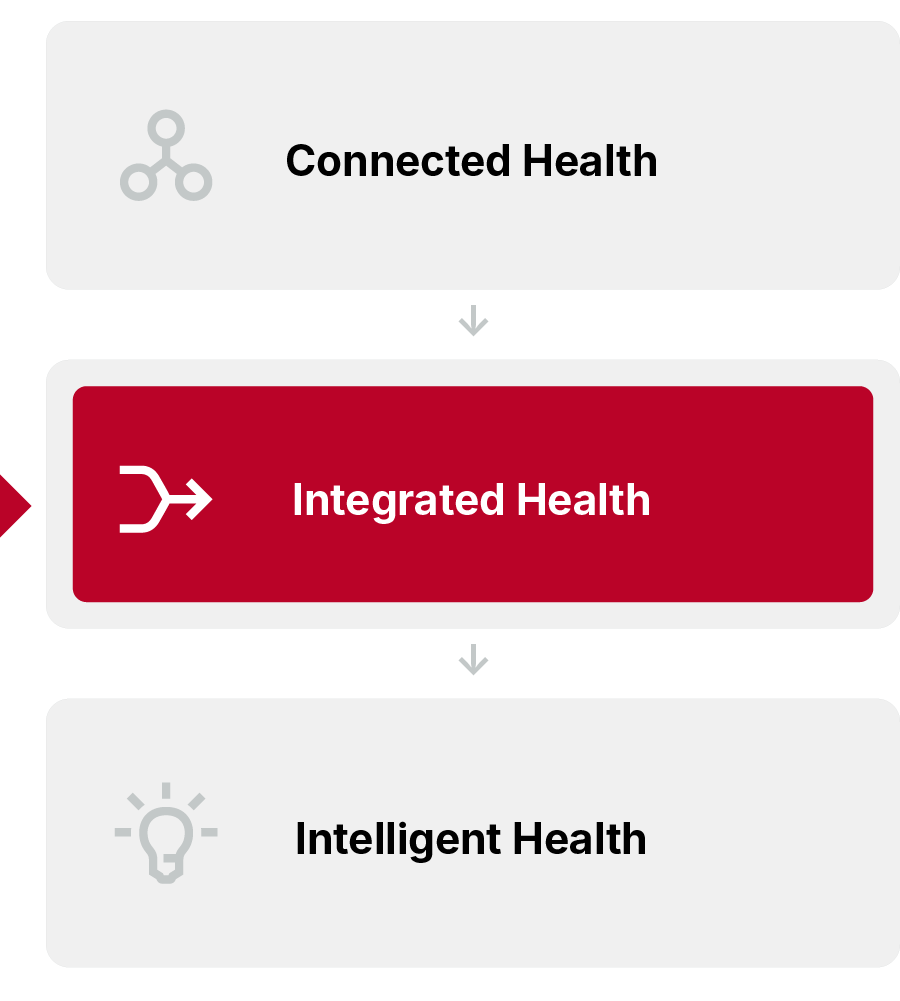
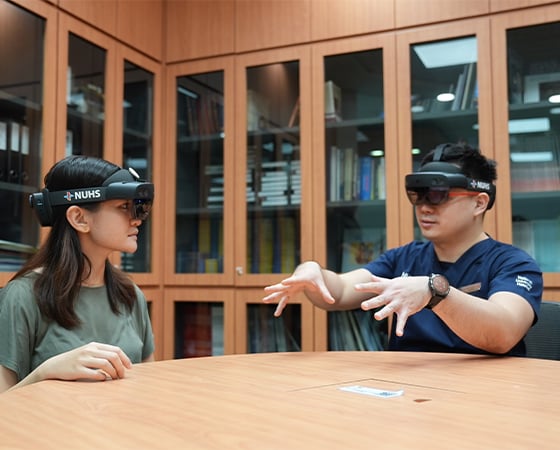
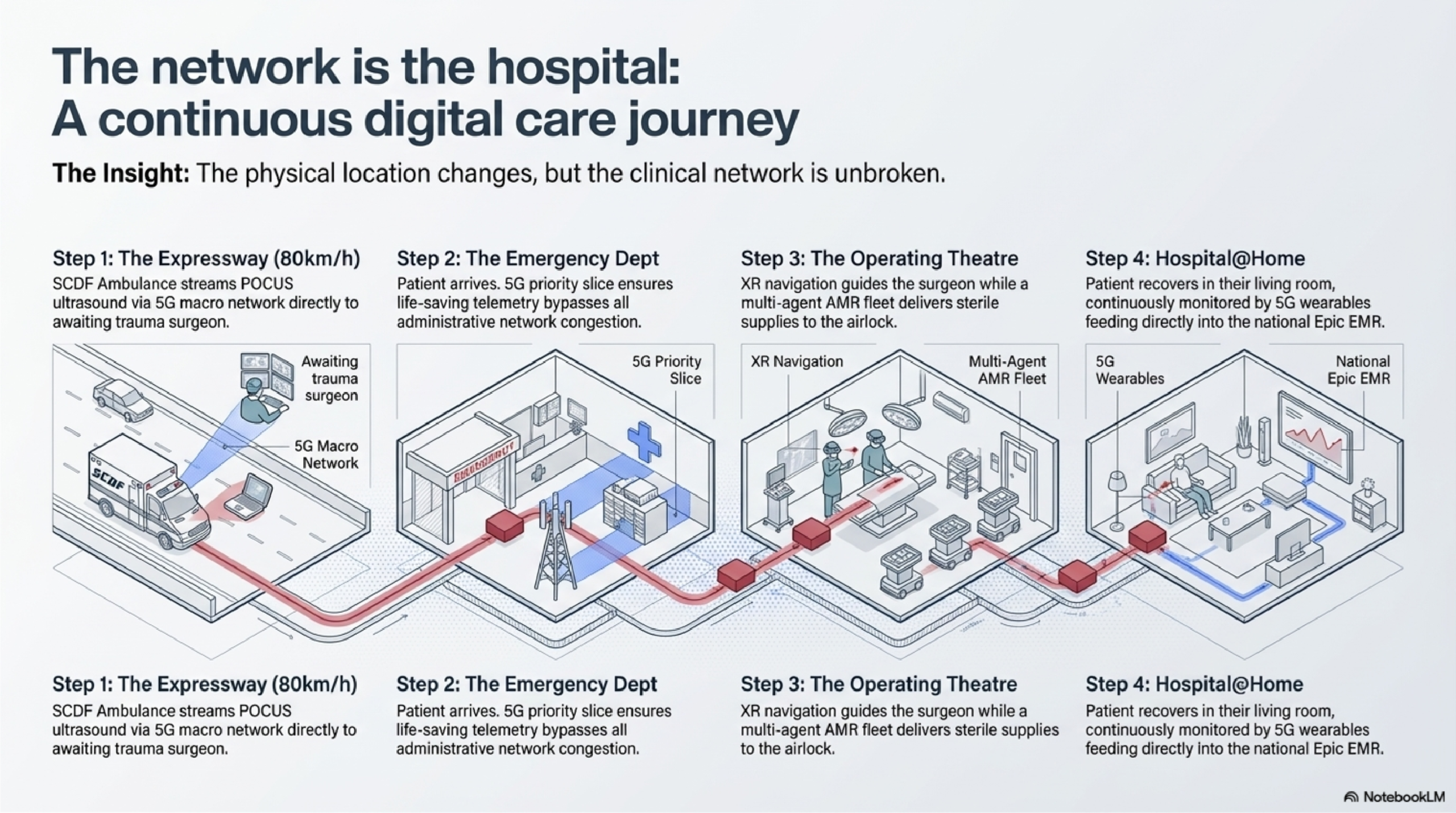
Figure 3: The network is the hospital: A continuous digital care journey

“As we move towards a more connected world, networks will no longer be just an information conduit. Advanced networks will form the core AI fabric on which services are built on, and bring us another step closer towards true connected-intelligence.
Adj A/ Prof. Gao Yujia, Consultant Division Hepatobiliary & Pancreatic Surgery , National University Hospital
Key takeaways
Key takeaways
The project demonstrates how virtual private 5G can provide the foundation for integrated and intelligent healthcare, connecting clinical systems, devices and patient services through a secure, scalable network architecture. It offers a practical model for healthcare organisations seeking to move beyond isolated technology trials towards integrated care delivery and AI-enabled hospital operations.

Lessons learned
Scaling connected healthcare requires more than advanced 5G connectivity. Successful adoption depends on a virtual private network model, strong security and governance, clinically usable performance, and collaboration across healthcare and technology ecosystems. Device availability, long-term planning and integration with existing hospital systems are also essential.

Success factors
A hybrid virtual private 5G model, secure connectivity, edge computing and network slicing support clinical-grade performance for high-resolution 3D imaging and real-time guidance. Collaboration between NUHS, Singtel, Ericsson and healthcare technology partners enables clinical validation, IT integration and operational governance

Scalability and future outlook
Over the next two to three years, NUHS plans to expand 5G coverage across critical care areas, wards and ambulatory spaces, supporting XR-assisted surgery, remote consultation, robotics, hospital-at-home and virtual wards. Future developments include 5G standalone capabilities, network slicing, deterministic latency, secure network APIs, positioning, sensing and digital twins. Integration with electronic medical records will enable bidirectional data exchange, while 5G will serve as the connectivity layer for edge cloud and AI.

Key partners