Tuesday 23 June, 2026
Standalone, cloud-native 5G connectivity can deliver substantial value across a variety of key use cases, explains Barbara Pareglio, Technical Director for GSMA
As it becomes more and more versatile, 5G is adding more and more value. With a dedicated cloud-native core, 5G standalone (SA) networks can support more demanding – and more valuable – use cases than 5G networks that still rely on a 4G core. In this article, we’ll cover why standalone is fundamental for next-generation networks.
Why is that? One of the key features of 5G SA is the built-in support for “network slices”, which customise connectivity to the needs of a particular application or service. For example, a network slice can be served up on-demand to provide a high quality of service in challenging scenarios, such as busy live events, or to customers using extended reality (XR) or fixed wireless access (FWA) services. For mobile operators, this kind of dynamic slicing enables them to deliver (and charge for) premium connectivity, without having to commit network resources on a more permanent basis.
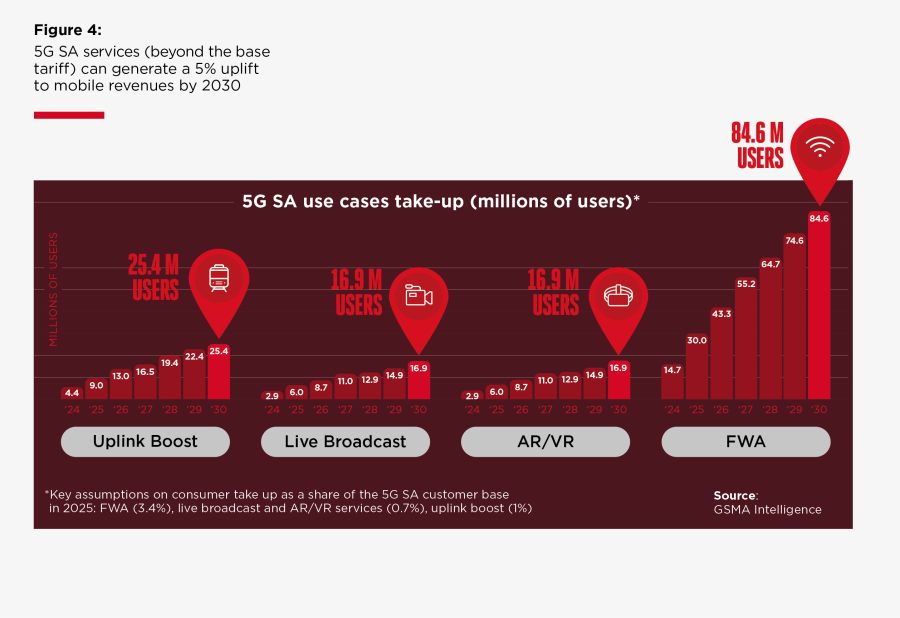
For example, 5G SA operators can use the new network data analytics function (NWDAF) to offer high speed uplinks to content creators and broadcasters who want to stream live from crowded places, such as festivals, concerts and sports events. Crucially, the NWDAF can detect a degraded user experience and activate a network slice to restore the promised service levels. In some markets, such as China, operators display a service assurance logo on the screen of the customer’s smartphone, which indicates they have access to premium connectivity. GSMA Intelligence estimates the number of 5G SA connections benefitting from premium uplinks for content streaming and live broadcasting will rise from 15 million in 2025 to more than 42 million by 2030.
Monetising customised connectivity
Network slicing can also be used to provide customised connectivity, on an ongoing basis, to specific segments of users, such as avid gamers or business travellers, via curated monthly packages. By offering VIP bundles and packages, whether it be for ultra-reliable or low latency connectivity, faster throughput or third-party service add-ons, mobile operators can better monetise their investments in 5G.
End-users are already taking up these offers, resulting in an uplift in average revenue per user (ARPU) of 5% to 15% for 5G SA operators across a range of different markets, according to research by GSMA Intelligence. These ARPU uplifts are in addition to the typical 5G connectivity price premiums when people upgrade from LTE.
Enhancing extended reality
Demand for assured XR and FWA services will further help mobile operators monetise 5G SA. By 2030, almost 17 million connections worldwide will be using 5G SA to support very responsive XR services, according to GSMA Intelligence. When deployed on optimal frequency bands, 5G SA networks can deliver latency in the single digit milliseconds. This translates into a near real-time response to user actions. For example, in the case of a field engineer wearing smart glasses to help repair a wind turbine, the digital overlay would move immediately when the engineer moves their head. That would help the engineer to keep track of individual components, making for a much more intuitive experience.
5G SA architecture is also optimised for edge computing, meaning XR developers can offload compute-heavy workloads from the device to a server. This has the dual benefit of conserving energy and egress costs while also helping slim down the form factor of glasses or headsets. Even if edge computing resources aren’t available, 5G SA operators can deploy network slices configured to provide the quality-of-service parameters that are needed for a high quality XR experience.
A boost for fixed wireless services
FWA services, which use 4G or 5G to provide high speed broadband to homes and businesses, can also benefit from a SA architecture. As FWA services need to co-exist with other 5G and 4G services, there is a risk that the bandwidth available may be impacted by peaks in conventional mobile usage. With 5G SA, operators can deploy a network slice that is configured to maintain the FWA throughput that has been promised in the customer contract.
Today, about 30 million FWA connections around the world are already benefitting from 5G SA, according to GSMA Intelligence. In India, Reliance Jio, for example, has used its 5G SA network to deploy network slices for FWA users. GSMA Intelligence forecasts the global number of 5G FWA connections will rise to almost 85 million by 2030.
Further flexibility to come
A 5G SA network can also streamline mobile operators’ DevOps. By introducing a cloud-native, and potentially AI-native, service-based architecture, 5G SA enables operators to create new services quickly and then manage those services easily.
Looking forward, 5G SA paves the way for mobile operators to deploy 5G Advanced capabilities, which begin come into play with Release 18 of the 3GPP standards, such as faster uplink speeds, highly accurate positioning, and low-cost RedCap (reduced capability) 5G connectivity for the Internet of Things.
In summary, 5G SA is now enabling mobile operators to consistently support a wide range of use cases that would have been too challenging in the past. Crucially, there are clear indications that businesses and consumers are prepared to pay a premium for the assured connectivity required to support such use cases. As a result, mobile operators look set to finally realise the full monetisation potential of 5G.
Read more about the opportunity of 5G SA networks in the consumer and enerprise segments in the latest GSMA market research “Destination growth: Completing the 5G Journey with Standalone Networks“.
We’ll be explore this and more at MWC Barcelona during the 5G Future Summit on Monday 2 March 2026. Join us for an insightful event with industry leaders. Learn more.
About the author
Barbara Pareglio, Technical Director, GSMA