


While mobile now supports more than 2 million jobs and underpins the digital ecosystem, key regulatory decisions in 2026 will shape Europe’s growth and competitiveness for years to come
Dublin, 12 June 2026: The impact of the mobile industry on the EU’s economy increased by 14% in 2025 to reach €1.15 trillion, according to new analysis from the GSMA, the global body representing mobile network operators.
The Mobile Economy Europe 2026 report, launched in Dublin ahead of a crucial Irish term in the presidency of the European Union – with the proposed Digital Networks Act in play – found that Europe’s mobile sector now directly accounts for 6.1% of the bloc’s GDP – up from 5.5%, or a €1.01 trillion contribution, in 2024.
The bulk of this economic success – some €820 billion – came from productivity, whereby the usage of mobile phones and mobile internet applications drives greater efficiency in accessing information, and in accelerating processes and communications. The sector’s overall economic contribution to EU GDP is now forecast to surpass €1.6 trillion by 2030.
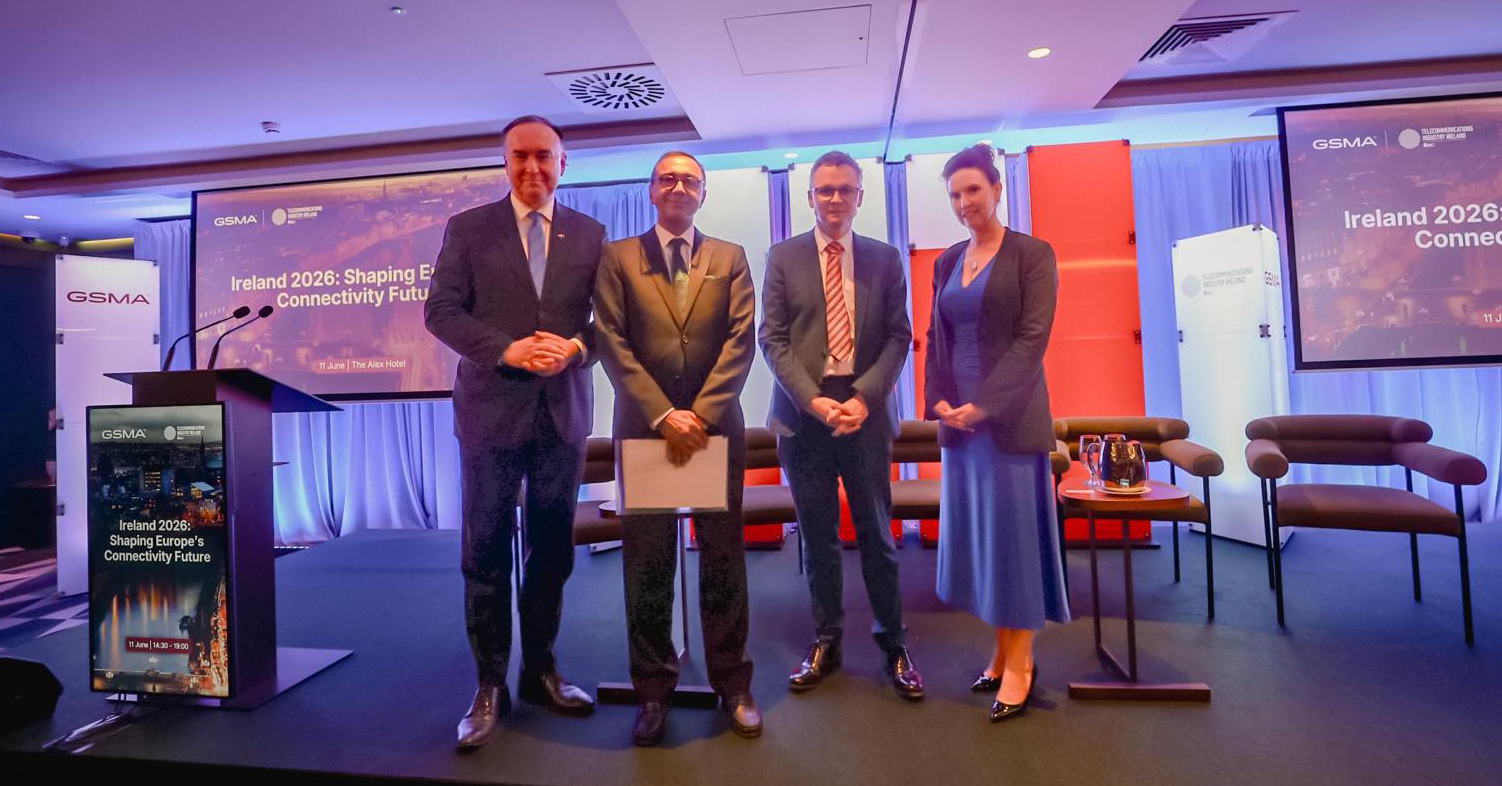
Patrick O’Donovan, Minister for Culture, Communications and Sport, commented: “Digital connectivity is essential for how the modern world functions and the geographical complexities of a country like Ireland mean our mobile operators do a vital job in underpinning our economy and society.
“As Ireland assumes the EU presidency, fostering conditions that allow Europe’s digital ecosystem to truly thrive is a high agenda item over the next six months. We must work with industry and policymakers to ensure opportunities are not missed to drive European competitiveness and growth.”
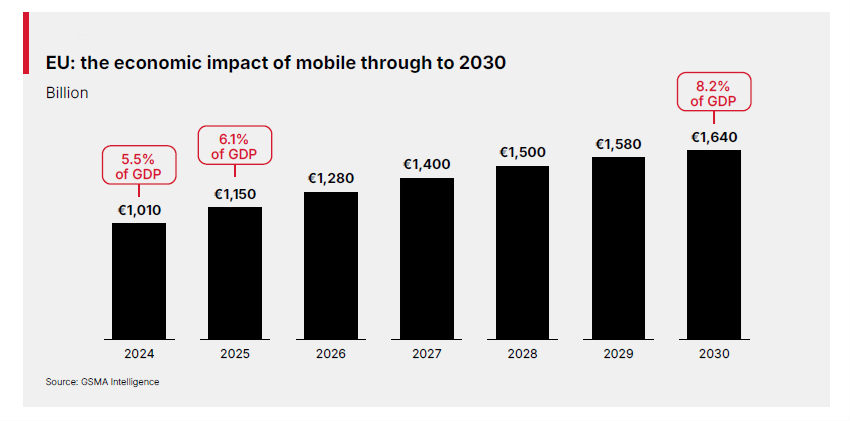
Source: GSMA Intelligence, Mobile Economy Europe 2026 report
The findings reinforce the mobile sector’s central and direct importance in driving Europe’s growth and success and comes against the backdrop of ongoing legislative reform for the industry that will be stewarded through a critical passage by Ireland’s presidency.
Vivek Badrinath, Director General of the GSMA, said: “The mobile industry’s central importance to Europe’s economy and jobs market is both clear and increasing.
“The fact that €1 in every €16 that is generated across the EU is the result of the mobile sector reflects how essential our connectivity infrastructure is, not only in accessing the broader digital ecosystem, but as an economic catalyst for European growth.”
An employment driver
Underpinning this economic growth was the number of jobs the mobile sector supports, numbering 2.4 million people across the EU at the end of 2025.
Of these, 1.3 million are directly employed by the mobile ecosystem, while 1.1 million jobs in other sectors are also the product of the industry’s economic activity.
Ireland’s own mobile ecosystem is robust, with 24,000 people employed by the sector and more than 10.5 million mobile connections across the country, according to the latest ComReg and Ibec data.
Nicola Cooke, Director of Ibec’s Telecommunications Industry Ireland (TII) association, said that digital connectivity is the backbone of Ireland’s economy and wider society:
“One million people can now work from home here due to major private and public investment in our mobile and broadband infrastructure. There has been a 460% increase in data traffic on the Irish networks over the last eight years, with €5bn invested by TII members during the same period. Remote working, e-learning and telemedicine are among the significant benefits of this.”
The mobile industry also continued to make a substantial contribution to the funding of the EU’s public sector, with €110 billion raised through taxes on the mobile ecosystem in 2025.
Europe lagging behind as investment gap widens
Against this backdrop, however, Europe’s quality of network service remains behind global leaders. Although 5G should become the dominant technology at some point this year, it still only represented 43% of mobile connections at the end of 2025.
While significant investment has been and continues to be made by operators across the EU – more than €140 billion has gone into mobile networks since 2021. Recent GSMA Intelligence analysis projects that €475 billion more is needed by 2035, of which only €270 billion is forecast to be accessible, leaving a €205 billion shortfall.
This investment gap reflects capex per user in Europe sitting at €35, half the €70 per user operators in leading connectivity markets have been able to invest in rolling out widespread 5G standalone networks. This is indicative of the unattractive investment conditions across Europe, the result of long-term overregulation.
Among the regulatory proposals in the coming months are the Digital Networks Act and the Review of the Merger Guidelines. Both represent critical opportunities to improve the investment landscape in Europe, by modernising the EU regulatory framework, and by creating more dynamic conditions to achieve scale.
Badrinath added: “Policy decisions made over the six months of the Irish EU presidency and into 2027 will ultimately determine how well we bolster the foundational role mobile technologies play in modern society and how well-equipped Europe’s digital ecosystem is to grow and compete with leading global markets.”
A strong Irish industry
Mobile connectivity also enables 25% of the Irish workforce to work remotely, significantly boosting productivity in more sparsely populated regions, while ecommerce, which largely depends on mobile networks, accounts for 21% of Irish SME turnover – an EU high.
Cooke added: “We are at an important cross-roads for the industry, facing multiple challenges with the DNA and Cybersecurity Act (CSA) 2. TII plan to work closely with the Government, regulators and other stakeholders during Ireland’s presidency of the EU, to ensure we can work to overcome these and enable the industry to progress its investment in this vital national infrastructure.”
To read the GSMA’s Mobile Economy Europe 2026 report, see here.