


Working with the Industry: AA.35

Working with the Industry: AA.35
Telecommunication services are becoming increasingly important across the globe to all aspects of everyday life. This continued growth is heavily dependent on the availability of interoperable technologies at all levels and across all platforms. Indeed, the diversification of platforms and technologies is being reflected in an increased and diversified range of standards organisations and companies that participate in enabling telecommunications standards.
In such a world, organisations such as GSMA who focus on bringing technologies to a position where they can be used interoperably across many organisation add value to the overall standards environment. In order to evolve GSMA’s role in standard setting, the GSMA has introduced a process specifically targeted to the production of these ‘Industry Specifications’ (AA.35).
AA.35 requires the GSMA to establish structural, procedural and reporting mechanisms that are specifically created to serve the creation and maintenance of mutli-stakeholder Industry Specifications.
GSMA’s AA.35 What is it?
- Specifications that affect operators and industry members alike are defined Industry Specifications.
- The GSMA Procedures for Industry Specifications are outlined in AA.35.
- AA.35 promotes principles such as openness, balance, due process, transparency, and consensus.
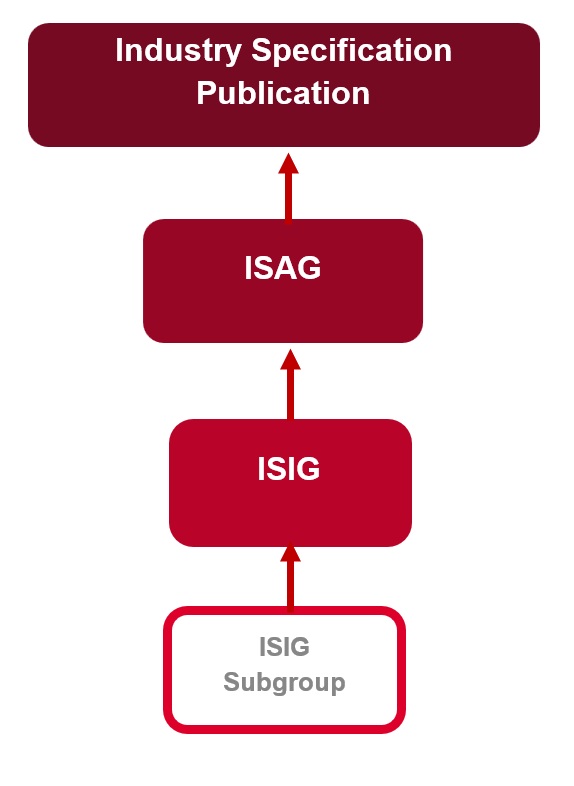
- The Industry Specification Approving Group (ISAG) oversees the maintenance of AA.35.
- Industry Specifications are maintained by Industry Specification Issuing Groups (ISIGs).
- All ISIGs are required to adopt and comply with the procedures in AA.35.
- AA.35 Procedures are based on the ‘ANSI Essential requirements’1
1 American National Standards Institute: Due process requirements for American National Standards link
AA.35 Introduction
Why did the GSMA create AA.35?
To facilitate broader input and support by all affected stakeholders within the industry to any GSMA Technical Specification.
What is a GSMA Industry Specification?
An industry specification created in the GSMA for:
- common adoption;
- repeated implementation, application and functioning;
- general use, operations and support in multiple segments of the telecommunication ecosystem; or
- consistent testing, verification and certification; of technology that would directly and materially affect simultaneously mobile network operators and non-mobile network operator participants within the mobile industry ecosystem; by industry
The definition of GSMA Industry Specifications does not include specifications that: (i) only affect interoperability or interworking between mobile network operators; or (ii) do not add additional specifications to technical solutions.
Who approves decisions under AA.35?
- Industry Standard Issuing Group (ISIG):
- Each topic within the GSMA has its own ISIG.
- One vote per company group.
- Decisions need 71% majority.
- Industry Standard Approval Group (ISAG):
- There is only one ISAG for all GSMA Technical Specification work.
- It is responsible for approval of Industry Specifications and also the management, closure, and as an escalation point for ISIGs.
- All editorial decisions are passed back to ISIG.
- It comprises two constituencies, i.e. one Operator Member and one Non-Operator Member of up to 30 members each.
- Operator Members participate through the GSMA Technology Group membership, Non-Operator Members through nomination and election.
- Non-GSMA members are not eligible to sit on the ISAG.
- Both constituencies need to agree by simple-majority respectively.
- ISIG subgroups:
- ISIG Subgroups are subject to ISIG approval.
- Participants in a Subgroup need to be ISIG Participants.
- ISIG Subgroups can issue recommendations but have no decision making power in their own right.
How can my organisation participate on the ISAG?
- The document is sent back to ISIG with comments.
- It is then the responsibility of the ISIG to address comments that have been made by the ISAG before resubmitting for approval.
What happens if a document is not approved by the ISAG?
- The document is sent back to ISIG with comments.
- It is then the responsibility of the ISIG to address comments that have been made by the ISAG before resubmitting for approval.
Can my organisation appeal decisions made by either the ISIG and ISAG?
Yes, there is a right of appeal in both the ISAG and ISIG , the respective appeal paths can be found in Section 10 of AA.35.
My organisation is not a GSMA member. How can I participate?
Any organisations that are not members of the GSMA will be allowed to participate in Industry Specification activities as part of the ISIG provided that all the following are met:
- demonstrated that the organisation is directly and materially affected in a particular GSMA Industry Specification
- has a commercial interest related to a specific GSMA Industry Specification
- has signed an Industry Specification non-member participation agreement (NMPA)
- paid the applicable participation fees as specified by the GSMA.
It is anticipated that the NMPA and fee mechanism shall be in place by 1 April 2020.
GSMA ISAG Members
The ISAG consists of two groups (“Constituencies”) (minimum of 12 members and a maximum of 35 members),
- Members from the Technology Group (“Operator Members Constituency”) and
- Non-Operator Members ( “Non-Operator Members Constituency”)
The ISAG Member term is 2-years.
ISAG Current Composition
ISAG Members
Structure of AA.35 Activities
Current active Industry Specification Groups
ISAG oversees all ISIG below
GSMA AA.35 Resources
| AA.35 Versions | Status | Publication Date | Link |
| AA.35 v5.0 | Current | October 2025 | Download here |
| AA.35 v4.0 | Expired | December 2023 | Download here |
| AA.35 v3.0 | Expired | January 2023 | Available by request |
| AA.35 v2.0 | Expired | February 2022 | Available by request |
| AA.35 v1.0 | Expired | November 2019 | Available by request |