


Wednesday 3 June, 2026
Affandy Johan, October 1, 2025
Market consolidation has reshaped Taiwan’s telecom market and the remaining operators now must prepare for the next phase
Taiwan’s mobile telecommunications market has undergone a major transformation, marked by market consolidation and a rapid, government-backed 5G deployment. This has reshaped the competitive landscape, moving from a five-player market to one dominated by three major operators: Chunghwa Telecom (CHT), Far EasTone (FET), and Taiwan Mobile (TWM). The mergers of Far EasTone with Asia Pacific Telecom and Taiwan Mobile with Taiwan Star have rebalanced market shares and enabled these operators to leverage expanded spectrum assets and achieve greater economies of scale.
Key Takeaways:
- Between the 1H 2024 and the 1H 2025, Taiwan’s 5G Availability increased from 62.1% to 69.3%. The nation lags behind regional leaders such as Hong Kong (83.9%) and South Korea (77.1%), but it is ahead of countries such as Singapore (67.9%) and India (60.5%). The timing of commercial 5G network launches, along with differences in spectrum access and market dynamics, influence each market’s reported 5G Availability.
- All three major Taiwanese operators showed improved 5G Availability, with FarEasTone leading at 72.4%, surpassing Chunghwa Telecom’s 69.8% and Taiwan Mobile’s 66.5%. From the 1H 2024 to the 1H 2025, Taiwan Mobile showed the largest gain, with an increase of 8.5 percentage points, followed by FarEasTone with a gain of 6.9 percentage points, and Chunghwa Telecom with 5.9 percentage points.
- Despite FarEasTone’s lead in 5G Availability, Chunghwa Telecom holds a significant lead in performance. Chunghwa Telecom’s median download speed of 344.25 Mbps is 31.6% higher than FarEasTone’s and 54.1% higher than Taiwan Mobile’s. Chunghwa also recorded the highest median upload speed at 34.52 Mbps and the lowest multi-server latency at 23 ms.
- A significant portion of 5G-capable devices are not using the 5G network, with 40.1% of users having a 5G-capable device but not connecting to 5G. Even for those who are connected, users spend more than double the time on 4G than on 5G. This presents an opportunity for operators to increase 5G connection time through network modernization.
Taiwan’s 5G Availability nears 70%, behind Thailand and other regional leaders
Speedtest Intelligence® data from the first half of 2025 shows Taiwan’s 5G Availability (the percentage of users on 5G-capable devices that spend most of the time with access to 5G networks) stands at 69.3%, placing it somewhere in the middle tier when compared to some of its selected neighboring countries. Taiwan’s 5G Availability is significantly behind regional leaders, such as Hong Kong at 83.9% and South Korea at 77.1%, but ahead of countries like Singapore at 67.9% and India at 60.5%. Factors such as the timing of commercial launches, spectrum access, and market dynamics, which include affordability and availability of 5G devices, influence each market’s reported 5G Availability.
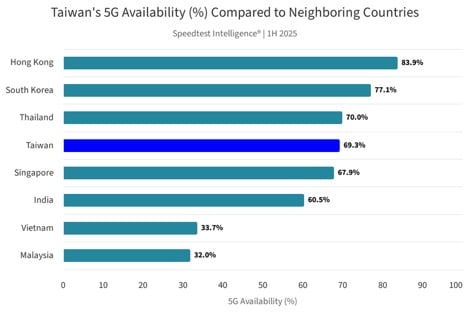
South Korea and Hong Kong benefited from their early commercialization of 5G, which gave them a significant head start. South Korea, for instance, was the first country globally to launch commercial 5G services in April 2019, and has maintained its high availability through aggressive nationwide deployment strategies. Similarly, Hong Kong’s operators moved quickly after the initial spectrum release, leveraging the city’s compact urban geography and the use of low-band spectrum to deliver near-universal coverage efficiently.
Strategic deployment and market consolidation drive Taiwan’s 5G Availability
Chunghwa Telecom, Taiwan Mobile, and FarEasTone secured significant holdings in the highly sought-after 3.5 GHz C-band during 2020 5G spectrum auction, with Chunghwa acquiring 90 MHz, FarEasTone 80 MHz, and Taiwan Mobile 60 MHz. While all three also won mmWave spectrum in the 28 GHz band, the C-band has emerged as the primary driver of both network performance and availability.
Since the auction, the market has been reshaped by two major mergers: Taiwan Mobile’s acquisition of Taiwan Star and FarEasTone’s acquisition of Asia Pacific Telecom (APT). These mergers have not only reduced the number of main operators from five to three but, more importantly, have led to the aggregation of spectrum, allowing the merged entities to create larger, more efficient bandwidth blocks. Taiwan Mobile’s merger with Taiwan Star enabled the company to combine their respective C-band holdings, forming a single 100 MHz block. Similarly, FarEasTone’s merger doubled its 28 GHz spectrum from 400 MHz to 800 MHz on top of the 80 MHz of the 3.5 GHz band it initially acquired.

Speedtest Intelligence data from the first half of 2025 highlights that C-band spectrum, a crucial mid-band frequency, accounts for the vast majority—85.5%—of all 5G Speedtest samples collected across Taiwan’s mobile networks. FarEasTone and Chunghwa Telecom showed a heavy reliance on the C-band, with 98.0% and 85.3% of their samples, respectively, originating from C-band. Taiwan Mobile, while still predominantly using C-band (78.6%), shows a more significant proportion of samples from the low-band at 21.1%, compared to its competitors. This reflects Taiwan Mobile’s strategic use of lower frequencies, which became more accessible following its merger with T Star.
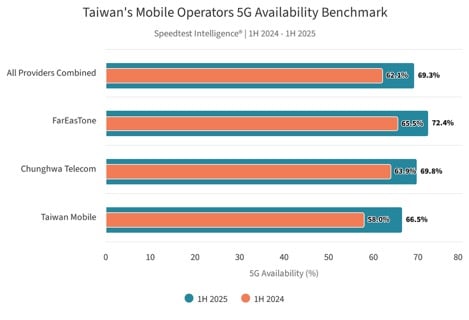
Between the first half of 2024 and the first half of 2025, Taiwan’s 5G Availability for all providers combined increased from 62.1% to 69.3%. All three major operators demonstrated an improvement in 5G Availability. According to Speedtest Intelligence data from the first half of 2025, FarEasTone leads the market with 72.4% 5G Availability, which also saw 6.9 percentage points year-over-year improvement from 65.5% in 1H 2024. Chunghwa Telecom improved its 5G Availability from 63.9% to 69.8%, a gain of 5.9 percentage points while Taiwan Mobile 5G Availability grew from 58.0% to 66.5%, an increase of 8.5 percentage points.
Chunghwa Telecom’s higher speeds indicate performance does not always correlate with network availability
The 5G performance results of Taiwan’s mobile operators show a more pronounced distinction than their 5G Availability scores. Based on Speedtest Intelligence data from the first half of 2025, Chunghwa Telecom held a commanding lead across both download and upload speeds, reaching a median download of 344.25 Mbps. This speed was 31.6% higher than FarEasTone’s and 54.1% higher than Taiwan Mobile’s. Chunghwa also recorded the highest median upload speed at 34.52 Mbps and the lowest multi-server latency at 23 ms.


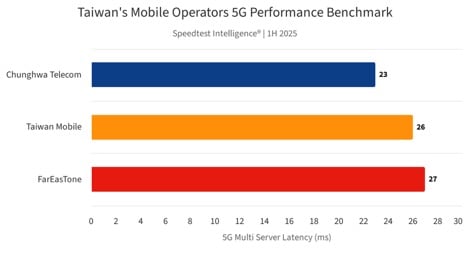
FarEasTone, while leading in 5G Availability, fell behind Chunghwa in median download and upload speeds, with a reported median speed of 261.17 Mbps and 28.92 Mbps, respectively. This difference clearly indicates that broader 5G Availability does not always translate to the same level of speed performance. Taiwan Mobile, meanwhile, trailed both rivals, with the lowest median download and upload speeds.
Proportion of 5G-capable devices shows opportunities for better adoption
Of all devices taking a Speedtest, only 46.7% were 5G-capable devices that were connected to a 5G network when running a Speedtest. A large portion, 40.1%, were 5G-capable but are yet to be connected to a 5G network, while 13.2% were non-5G devices. This suggests that despite the widespread availability of 5G-capable devices, a substantial percentage of users are either not on a 5G plan or are operating in areas with limited 5G coverage, a key area for operator focus.
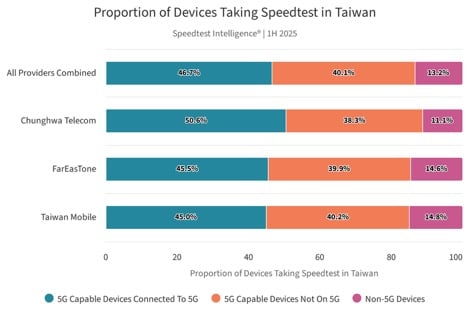
The operators already have a base of consumers who own 5G-capable devices, with varying levels of success in converting 5G-capable devices into active 5G connections. Chunghwa Telecom demonstrates the most effective user adoption strategy, with 88.3% of its customer base owning 5G-capable devices, and 50.6% of its users conducting tests on 5G in 1H 2025. Chunghwa’s performance is further highlighted by its low proportion of non-5G devices at just 11.1%, indicating a more modern device base compared to its rivals. In contrast, both FarEasTone and Taiwan Mobile trail the market in converting 5G-capable devices to active 5G connections. With 45.5% for FarEasTone and 45.0% for Taiwan Mobile, both operators fall below the national average. Additionally, both show a higher proportion of non-5G devices, 14.6% for FarEasTone and 14.8% for Taiwan Mobile, suggesting a potential lag in device modernization.
5G-capable devices still spend most of their connected time on 4G network
Even with a growing number of 5G-capable devices, Taiwan’s mobile users still spend the majority of their time on the 4G network. This trend is consistent across all three major operators. Data from the first half of 2025 shows that for all 5G-capable devices, time spent on 4G is more than double the time spent on 5G.

Chunghwa Telecom demonstrates the highest proportion of users spending time on 5G, with 5G-capable devices spending 32.4% of their time on the 5G network. In contrast, both FarEasTone and Taiwan Mobile trail the market, with their 5G-capable devices spending only 27.8% and 27.7% of their time on 5G, respectively. For all operators, the proportion of time spent on 4G is far higher, reaching 66.2% for Chunghwa Telecom and over 70% for both FarEasTone and Taiwan Mobile.
Spectrum choice can also play a big role in shaping the time users spend on a 5G network. Techniques like Dynamic Spectrum Sharing (DSS) allow operators to use the same frequency bands for both 4G and 5G simultaneously, facilitating a more rapid and cost-effective rollout of 5G services. Operators should also prioritize densifying their 5G networks by expanding indoor coverage and adding more small cell sites in high-traffic areas. These efforts would reduce the reliance on 4G for stability and a wider range of services, ultimately increasing the time spent on 5G and validating the significant network investments.
We will keep a close eye on the progress and effectiveness of 5G implementation in Taiwan and its regional neighbours. To find out more about Ookla Speedtest data, get in touch.
Ookla retains ownership of this article including all of the intellectual property rights, data, content graphs and analysis. This article may not be quoted, reproduced, distributed or published for any commercial purpose without prior consent. Members of the press and others using the findings in this article for non-commercial purposes are welcome to publicly share and link to report information with attribution to Ookla.
