


Friday 16 October, 2026
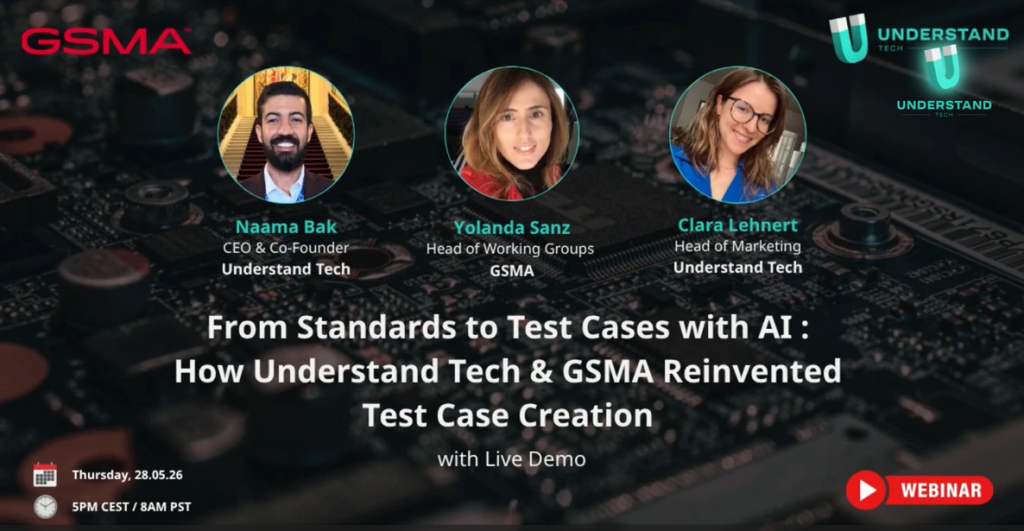
A recap of the LinkedIn Live session held on 28 May 2026, co-hosted by GSMA and its AI technology partner, Understand Tech.
Turning a technical standard into a validated test specification has long been one of the slowest, most manual stages of standardisation work a matter of weeks of expert effort per test plan, and months before a specification reaches publication. On 28 May, GSMA and Understand Tech showed a live audience how the two organisations co-built a tool that brings that first draft down to hours, while keeping expert oversight firmly at the centre.
The session brought together Yolanda Sanz, GSMA Head of Working Groups, who leads GSMA’s working groups and the technical direction of eSIM standardisation; Naama Bak, CEO and Co-founder of Understand Tech; and Clara Lehnert, Head of Marketing at Understand Tech, who hosted. What made it compelling was that this wasn’t a vendor pitch – it was a problem GSMA lived, handed to an AI partner, and solved together.
The challenge, from someone who lived it
GSMA’s working groups exist to bring the telco industry together – to identify the gaps in the ecosystem, monitor work across bodies like 3GPP, ETSI and the IETF, and deliver the specifications that keep mobile interoperable. Test specifications are a critical part of that output, and, as Yolanda explained, also one of the hardest to produce.
The problem is people. Testing tends to be low priority across the industry, so working groups attract few contributors, and those who do step up are usually experts in the core specification rather than in test design. The result is incomplete coverage, hidden edge cases that only surface once a product is on the market, long validation cycles, and slow acceptance.
Yolanda spoke from direct experience. While managing the eSIM test group, faced with too few volunteers, she drafted a test plan herself – roughly 13 full working days of effort, before validation and acceptance even began. And the documents are vast: a released test specification can run to around 1,000 pages, large enough, she noted wryly, to crash a laptop just opening it. As Naama put it during the demo, people assume test cases simply appear – but behind every one of them are engineers doing painstaking, time-consuming work.
Rather than buy a generic tool, GSMA chose to co-build a solution shaped around its own workflows.
The solution: an agentic pipeline built for standards
Naama introduced the result – the Test Case Generator (TCG) – and ran it live. TCG is an agentic pipeline that moves from specification to requirements to tests to automation in clear, controllable steps. You upload a specification, choose your own test case format and level of detail, and the system goes to work.
First it extracts requirements. In the demo, from the TS.34 specification, TCG surfaced around 233 requirements – including the implicit ones that aren’t neatly numbered but buried in prose. A deterministic analysis layer then flags duplicates (catching, for example, two requirements with 87% text overlap that a human would struggle to spot across hundreds), splits compound requirements that mix two concerns, and surfaces vague ones that need tightening before they can be tested. The user stays in control throughout, editing manually or with AI assistance.
The part Naama called the “secret sauce” was built directly with GSMA: most good test cases depend not just on the specification in front of you but on the documents it references – 3GPP, OMA and other standards. TCG pulls in those references (around 500 in GSMA’s case) into a knowledge base that grounds the generating agent, so the output has the context it needs rather than drifting or hallucinating.
From there it generates the test cases – each with entry criteria, procedure, exit criteria and a reference back to the source document – and lets you add edge cases on demand, generate executable scripts in your language of choice (with GitHub push or ZIP export), and review everything in a workspace where AI edits are applied transparently.
Trust by design
Crucially, TCG treats quality as something to measure, not assume. It scores every generation on two axes: a deterministic check of structure – duplicates, compound or untestable cases, traceability – and the accuracy of the AI itself, including faithfulness to the requirement and whether the output stays within the spec or drifts beyond it. Coverage is tracked so no testable requirement is left without a test case, and low-confidence cases are flagged for human attention rather than hidden.
Two features drew particular interest for standards work. Delta generation compares an old specification version against a new one and produces only the test cases the change requires – essential when revalidating a 1,000-page document from scratch isn’t an option. Section generation does the same for a single approved change request. Both target exactly the maintenance burden Yolanda described.
Control over your data
Understand Tech’s architecture has three layers: the large language model, which can be a private model such as Anthropic’s or OpenAI’s, or an open-source model run inside the customer’s own infrastructure where confidentiality demands it; the agentic workflow that enforces templates, verification and control; and the interface itself. For a standards body handling sensitive contributions from across the ecosystem, the ability to apply AI without confidential specifications ever leaving the organisation’s perimeter isn’t a feature — it’s a precondition.
The impact, and what’s next
The throughline is acceleration without loss of control. Understand Tech estimates TCG saves around 70% of the time engineers spend on this work, while the experts who own the specifications stay in charge of the result. The roadmap goes further still: an automated execution environment, built with a major hardware partner in the semiconductor industry, that will take generated scripts all the way through to running on target hardware — expected by the end of Q3.
“This isn’t an idea we pushed into the market – it’s built on the real problem GSMA and its members face. That’s the kind of collaboration between industry and AI that every company should aspire to. It’s a real ecosystem effort.” – Naama Bak, CEO & Co-founder, Understand Tech
“This is just the first stone that we’ve laid. GSMA is really keen to invest in AI and understand how it can help, particularly in standardisation activities.” – Yolanda Sanz, Head of Working Groups, GSMA
Our thanks to everyone who contributed to enhance the tool. The collaboration between GSMA and Understand Tech continues – and the test case generator is available to try at https://understand.tech/product/apps/tcg
Understand Tech is GSMA’s AI technology partner on this initiative, building sovereign, on-premise AI applications for regulated and technical enterprises. Learn more about TCG at docs.understand.tech.
