


Wednesday 21 October, 2026
Networks will change, and security threats will evolve long before today’s vehicles leave the road. Automakers need to design connectivity and security that can adapt.
By Vincent Korstanje, CEO, Kigen
In 2001, Arthur C. Clarke imagined that by 2040, nanotechnology would let us make almost anything on demand. Maybe that is still a little ambitious, and the less glamorous test of the future may be this: will the car built in 2026 still be secure and connected? By then, it will have outlived several generations of phones, at least one generation of mobile networks, and a very different set of threats. The question for automakers is no longer only how to connect a car at launch. It is how to keep that car useful, safe, and trusted for its whole working life.
The scale of the problem is growing fast. Omdia forecasts more than 1.05 billion connected vehicles by 2035, more than double today’s number, and Transforma Insights puts the figure at 2.1 billion once cars connected through drivers’ phones are included. Omdia also warns that operators could begin switching off LTE networks from 2030. The two forecasts measure different aspects, but they agree on where this is heading: mobility will increasingly depend on connected services. And many vehicles sold this decade will still be driving long after the network assumptions on which they were built have expired.
Connectivity is now part of the vehicle.
Losing connectivity used to mean losing a convenience. Now the car depends on it. Connectivity delivers software fixes and security patches after the car leaves the factory. It plans charging routes for electric vehicles, sends map and traffic data to driver assistance systems, and handles emergency calls. If the link fails, the vehicle is worth less and does less, and in some cases, it becomes less safe.
In autonomous fleets, connectivity becomes a basic safety requirement. With no driver on board, a robotaxi, driverless shuttle, or autonomous freight vehicle depends on its link to remote operators and fleet systems when something unexpected happens. Across our roads, public transport, and freight networks, connectivity is now an essential utility. It helps operators respond to incidents before small delays turn into missed services. Vehicles carrying high-definition cameras can also survey roads, rail lines, and their surroundings as they travel. That means damage to infrastructure and the environment gets spotted earlier, and costly, time-consuming manual inspections are needed less often.
That is why automakers are paying close attention to new IoT eSIM technology that moves the ownership of connectivity to the fleet owner. This means that it is they, not the networks, who can manage connectivity remotely: a capability that allows exporting a single product to markets with the best-suited connectivity and, over the years, changing it without recalling the vehicle. But we should be honest about the limits. An eSIM cannot turn an LTE modem into a 5G modem. Radio hardware, software support, subscription management, and security have to be planned together from the start, not added one at a time.
What automakers told us
Our move into automotive was shaped by listening. In our work with automakers and autonomous fleet developers, three priorities come up repeatedly:
- Regulatory Compliance: Ensuring safety-critical connectivity meets mandates, like India’s AIS-140 and the latest EU e-Call requirements.
- Market Adaptability: Creating a unified connectivity strategy that caters to connected cars and autonomous transport across different markets.
- Revenue Generation: Enabling subscription-based services, from streaming to in-car applications, that provide ongoing revenue after the sale.
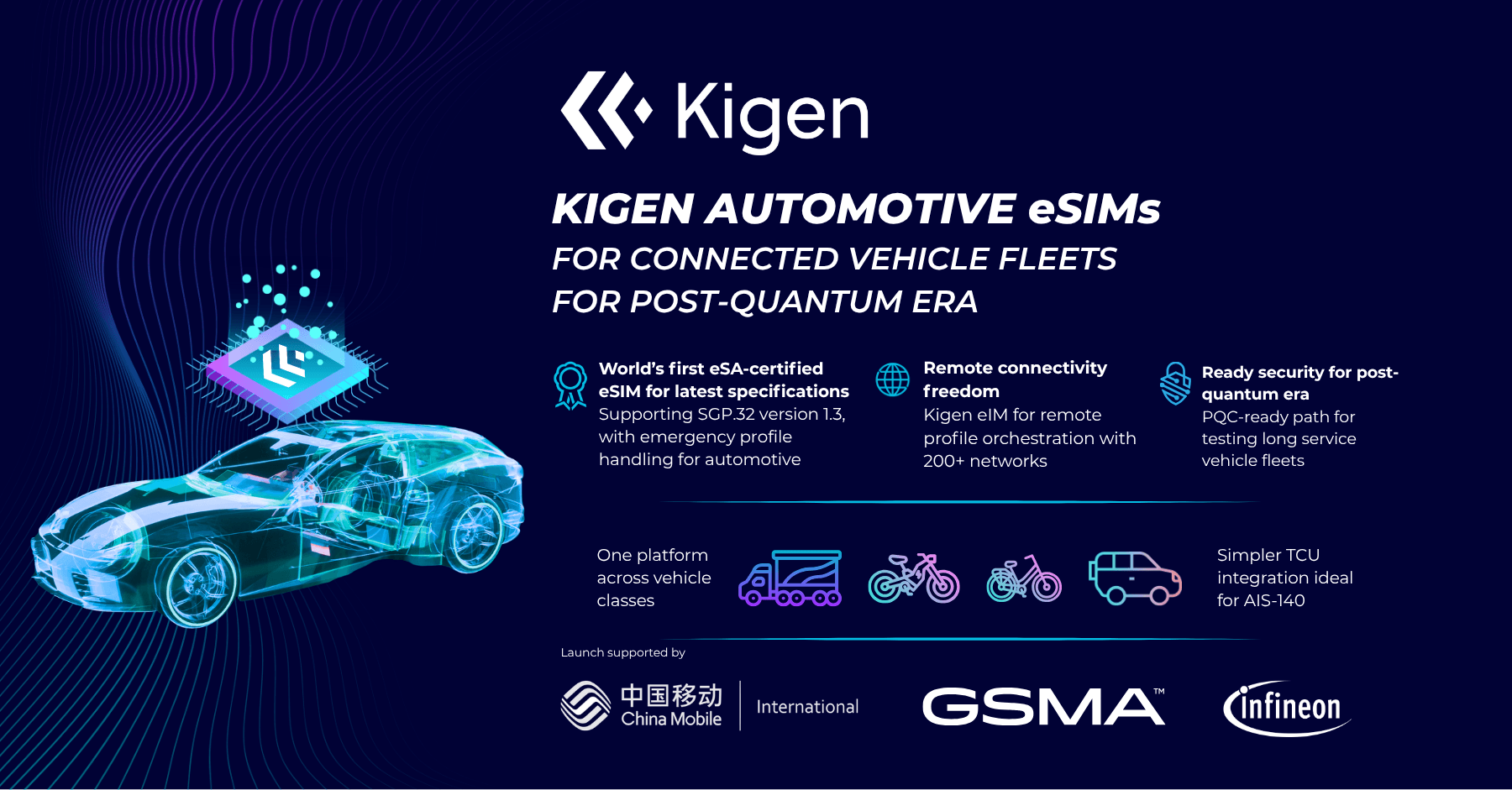
These needs became our guiding principle as we built products for fleets that will remain in service long after launch. Kigen’s new Automotive eSIM, which combines our eSIM operating system with Infineon’s TEGRION SLI22 automotive security controller, is the first of its kind to bring leading-edge IoT features suited for next-generation auto fleets. Because it shares a single platform and set of development tools across automotive, consumer, and industrial variants, automakers can maintain a more consistent architecture across vehicle systems.
Trust also shows up in operating costs.
Security is not only about avoiding attacks. It affects the bottom line. In research by Motive, industrial fleet leaders estimated that 19% of fleet spending is lost to fraud or theft, rising to 22% in the construction industry. These are the leaders’ own estimates, but they show how much revenue rides on the transactions across vehicles.
Secure eSIMs authenticate transactions, prevent network gaps, and protect credentials. That gives telematics applications a reliable foundation for spotting when a vehicle’s location doesn’t match its toll, fuel, or charging transactions, working alongside application authentication and payment controls.
Prepare for threats that don’t exist yet.
A vehicle that lasts 15 years will almost certainly face cryptographic threats that don’t exist today, and quantum computing is on automakers’ minds. Migration paths can be tested now. Trialling hybrid approaches to post-quantum security today will inform the architectures that go into production tomorrow.
Design for change
For carmakers, rolling stock manufacturers, telematics providers, and fleet operators, the lesson is the same: design for change. The networks will change, the threats will change, and so will what customers expect. The vehicles being engineered now need connectivity and security that can evolve over their whole working lives. Get that right, and the engineering decisions made today will still support safety, efficiency, and passenger confidence in 2040.
Bio
Vincent Korstanje is CEO of Kigen, a global leader in secure eSIM technology that empowers manufacturers to address the future of connected and autonomous fleets. Find out more at kigen.com/contact/
