


GSMA and its members explain the importance of a standardised and seamless Entitlement Server approach to enabling new digital services
With the rollout of embedded eSIMs (eSIM), 5G standalone (SA), Rich Communication Services (RCS) and other advanced technologies, mobile networks are becoming increasingly capable and versatile.
To meet the rising demand for these sophisticated capabilities, operators need a fast and efficient way to configure connected devices so that they work seamlessly with their networks. To that end, operators are increasingly turning to entitlement servers, which use standardised application programming interfaces (APIs) to automatically provision the operator’s services on authorised devices connected to its network. As its name suggests, the entitlement server notifies the device which advanced features it is entitled to use (having checked with the operator’s BSS). The device then interacts with the network accordingly.
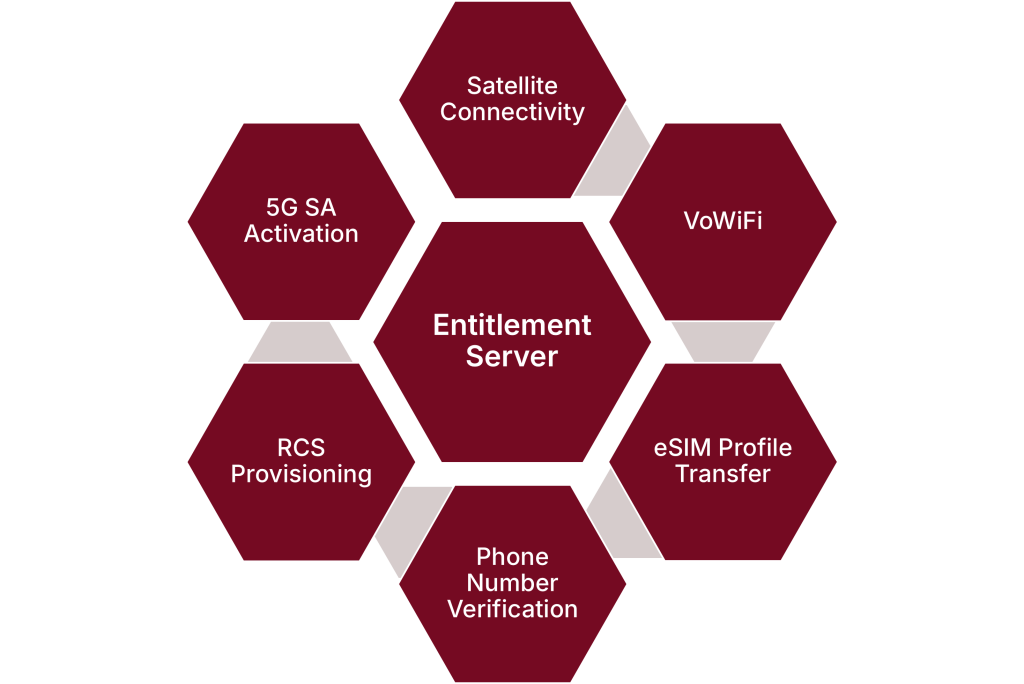
By following the GSMA’s TS.43 specification, the APIs used by the entitlement servers ensure interoperability between different devices and networks, streamlining the process. Unlike proprietary approaches, employing standardised entitlement servers ensures interoperability and delivers a seamless experience for end users. As a result, they can immediately benefit from eSIMs activation, 5G SA Settings, RCS, Voice-over-Wi-Fi, Voice-over-New Radio, number phone verification and other new services that are enriching mobile connectivity for consumers and businesses alike.
“A key objective of an Entitlement Server is to facilitate a modern, seamless “on-device” digital experience, enabling consumers to easily access, use, and activate advanced Carrier Services. For carriers, this platform has already become one of the key service and network monetization enabler, poised to sustain that advanced evolutionary momentum into the future. GSMA’s TS.43 has been instrumental in achieving all that and more.”
Ashok Passavula, Ericsson AB, Sweden
Understanding opportunities and challenges for individual use cases
In particular, we are keen to verify the relevance of each use case to the industry and whether some use cases need to be modified so that they are better aligned with the industry’s needs. In cases where the telco industry is using alternative mechanisms to the TS.43 specification, we need to understand why that is and make changes in the specification, as appropriate. In general, we want to ensure that the ecosystem maximises economies of scope by employing entitlement servers to support a broad range of use cases.
The GSMA TS.43 specification continues to evolve. First developed in July 2018, the specification is now on to version 12. Today, GSMA TS.43 supports a dozen use cases, but some are much more widely used than others. To understand why that is and explore the implementation challenges facing the value chain, the GSMA is engaging with operators, device makers and providers of entitlement servers (typically OSS/BSS vendors).
To help us engage with the industry, the GSMA hosted a two-part webinar in which speakers from Deutsche Telekom, Ericsson, Google, HCL Tech and T-Mobile outlined various use cases from actual deployments across diverse telco environments. For example, Pavan Nuggehalli, Standards and System Engineer for Android connectivity at Google, outlined how entitlement servers are supporting adoption of Satellite Connectivity, eSIM Transfer, RCS and Phone Number Verification.
The Operators and Entitlement Server providers highlighted the evolving needs of GSMA TS.43 clients/servers, as well as technical and operational hurdles and compatibility issues with existing infrastructure and services for key GSMA TS.43 use cases. The webinar also covered collaboration between entitlement server providers and mobile operators and standardised approaches for seamless server integration to optimise service delivery.
By engaging the ecosystem in this way, the GSMA is aiming to ensure that both the industry and its customers fully benefit from the sophisticated capabilities of today’s mobile networks. The rollout of 5G SA and standardised network APIs is making mobile connectivity increasingly programmable and customisable. At the same time, eSIMs transfer, RCS and other services are giving end users much greater choice and flexibility. But to benefit from these capabilities, devices and the networks need to be fully interoperable. Standardised entitlement servers are an essential part of the puzzle.
Get involved
If you’re a GSMA Member and interested in collaborating on this topic, please join the most relevant working groups for you on Member Gateway.