


Industry experts from GSMA and Orange explore how working groups are simplifying roaming and setting standards for the 5G era.
Roaming services play a pivotal role in enabling people, vehicles and other mobile assets to stay connected as they travel from place to place. As digital services are now fundamental to both our personal and professional lives, it is vital that roaming is reliable, secure and ubiquitous, while supporting advanced connectivity, such as that delivered by 5G standalone networks.
Here at the GSMA, we are working continuously to help mobile operators deliver on that promise. One of our key goals is to enable the many players in the large and diverse roaming ecosystem to work together seamlessly to deliver a compelling experience for end users.
As explained in our latest seminar, the GSMA PRD IR.21 (International Roaming, Permanent Reference Document Number 21) is an important tool in this regard. This document sets out a standard mechanism through which operators share roaming data with each other, reducing the time and effort required to ensure customers and their equipment remain connected as they travel across borders.
The session also delved into GSMA Working Groups and the collaboration between GSMA and its members to create best practices and set standards.
To that end, IR.21 defines a standard way to distribute the necessary information, including technical data, identifiers, such as TADIG (Transferred Account Data Interchange Group) codes, network and operator contact information. Fully completing this document ensures their roaming partners will have all the data they need. If information is missing, problems and issues can arise.
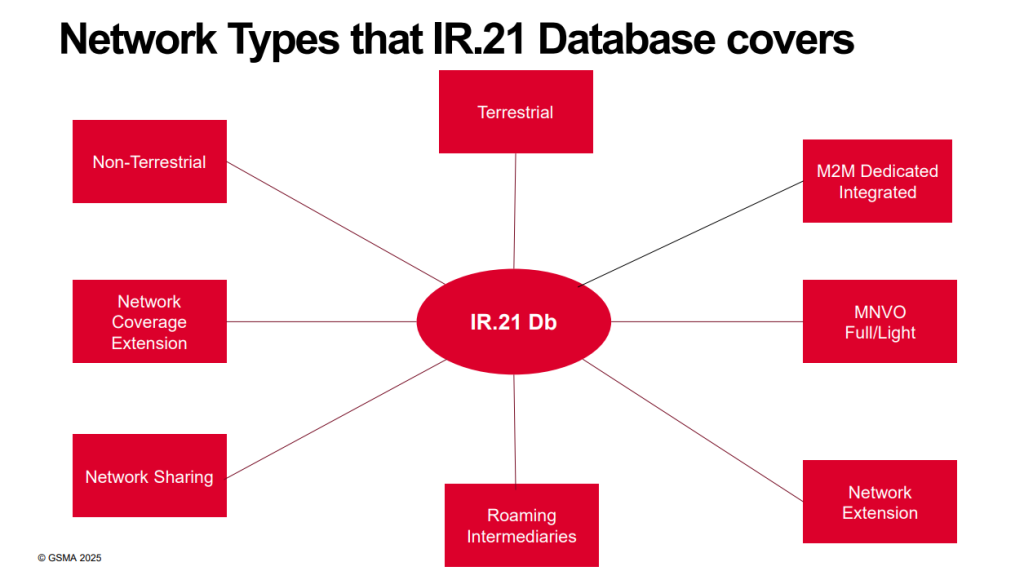
In short, IR.21 is a crucial technical document for companies participating in the roaming ecosystem. It will help them take advantage of charging and settlement synergies available to them.
IR.21 isn’t the only key reference document for roaming. To reduce the complexity of providing roaming services, many mobile operators connect to “roaming hubs”, which act as intermediate entities to facilitate the communication and data exchange between different operators. To serve this segment, the GSMA created IR.85, which is an adapted version of IR.21 for roaming hubs. As well as encompassing some of the data required by IR.21, IR.85 identifies further data needed to enable roaming hubs to function smoothly.
If an operator captures the necessary data in a Word or Excel file, the GSMA has created a tool called RAEX (Roaming Agreement Exchange), which automatically converts the information into a standardised file format based on IR.21. Free for GSMA members to use, RAEX distributes roaming data securely and efficiently.
Enabling 5G standalone roaming
The seminar also outlined how the GSMA is supporting the rollout of roaming services that employ 5G standalone networks, which have a cloud-native 5G core that can support tailored connectivity propositions using network slicing and other features.
The GSMA has defined several development models for 5G standalone roaming, which differ from a business, security and operational perspective.
- GSMA Model 1 – Direct Bilateral is a direct bilateral deployment model between a VPMN (visited public mobile network) and a HPMN (home public mobile network), whereby both the VPMN and HPMN have their own internal SEPP (security edge protection proxy) deployed within their networks.
- GSMA Model 2 – SEPP Delegation is where the mobile operators have delegated the SEPP management to a third-party service provider.
- GSMA Model 3: Service Hub involves connecting the VPMN and HPMN via roaming intermediate signalling actors (service hub providers), based on a bilateral roaming agreement between the two networks.
- GSMA Model 4: Roaming Hub intermediaries – global actors (roaming hub providers) – connect the VPMN and HPMN, based on a roaming hub contract.
As 5G standalone networks are highly versatile, mobile operators are set to employ them to support many different use cases across many different sectors of the economy. The GSMA’s roaming models give operators the flexibility to develop their own distinctive 5G standalone propositions, while travelling in a direction and pace appropriate to their specific market.
To learn more, watch a replay of the seminar here.
Networks Group
If you are already a GSMA Member and would like to collaborate on this topic, join our Networks Group on Member Gateway today!
GSMA Membership
Not yet a GSMA Member? Find out more and join us today!