


Thursday 7 August, 2025
English
Energy efficiency, along with strategies towards significant reduction in energy consumption, coupled with minimisation and elimination of energy waste, has become an essential requirement. Energy efficiency responds to environmental as well as economic sustainability, particularly in the presence of the ongoing energy challenges. These challenges include the significant increase in processing of data with new and expanded network capabilities, despite the more efficient 5G technology.
Accelerating modernisation of RAN equipment to benefit from next generation energy efficient solutions is one of the major methods to reduce energy consumption. ZTE Ultra Broadband Radio (UBR) enables industry-leading radio and network convergence, offering extreme integration on three fronts, multi-sector-in-one, multi-band-in-one, and multi-transmission-channel-in-one. The extensive range of highly integrated products offers unparalleled flexibility, enabling operators in complex markets worldwide to easily evolve their networks.
By ZTE in-house Power Amplifier (PA) – Super-N, the power consumption of UBR is reduced by 35% compared to other radios on the market. Meanwhile, UBR supports higher output power of over 1000W, enhancing the experience for edge users. And the UBR provides more transmission channels, delivering high capacity and excellent performance. For instance, 8T8R doubles the capacity of traditional 4T4R. It alleviates traffic congestion and offers operators increased opportunities for revenue generation.
ZTE advances the circular economy by enhancing recycling, extending equipment reliability by 10%, and adopting eco-friendly packaging. ZTE focuses on internal and external recycling to maximise resource reuse, achieving 92% material reuse in 2023 and collaborating globally for sustainable practices, reducing waste and adopting eco-friendly packaging.
In the last two years, UBR has been deployed in more than 30 projects with 500,000 shipments in Bangladesh, China, Ivory Coast, Kazakhstan, Malaysia, Nigeria, South Africa and Uzbekistan.
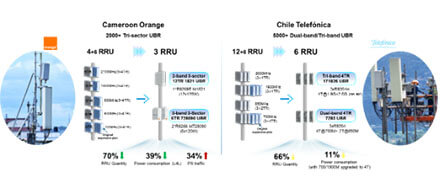
In Cameroon, Orange has deployed over 2,000 OmniUBR units, with 3 UBRs covering 5 frequency bands. Compared to the original network upgrade plan (10 Units covering 5-frequency bands), the number of Remote Radio Units (RRUs) has been reduced by 70%, power consumption of like for like swapping site has decreased by 39%, and 4G traffic has increased by 34%.
In Chile, Telefonica has deployed over 5,000 Tri-band/Dual-band UBR units, with 6 UBRs covering 4 frequency bands. Compared to the original network upgrade plan (18 RRUs covering 4 frequency bands), the number of RRUs has been reduced by 66%, and power consumption of like for better (from 2TR to 4TR) swapping site has decreased by 11%.
Chinese
在5G时代,网络能效提升已从环保议题升级为兼具环境价值与商业效益的战略要务。尽管5G单比特能耗较4G下降90%,但激增的数据流量仍使全球移动网络年耗电量突破2000亿度。应对这一挑战,需要从设备革新、架构优化和生态协同三个维度实现突破。
加速无线接入网现代化演进,引入下一代高能效设备,是降低无线接入网络能耗的关键途径之一。中兴“超宽带无线”(UBR)产品在无线与网络融合方面实现了三大极致集成创新,树立行业新标准:
- 多扇合一:低频和中频两个模块即可支持五频三扇,为业界最简站点,适用于铁塔站点。
- 多频合一:2/3/4/5频段都可实现整合,铁塔/楼顶站点都适用,部署非常灵活。
- 多通道合一:从2T2R、4T4R到8T8R甚至32T32R,实现更高频谱效率,支持更大容量。
UBR设备方案搭载中兴通讯自研Super-N功率放大器,在达成1000W超高输出功率的同时,较业界平均水平节能35%,边缘用户速率提升40%。这种”高性能+低能耗”特性,使运营商在网络流量年增30%的背景下仍能控制能耗曲线。
除此之外,UBR产品通过加强原材料可回收率、绿色包装、提升设备可靠性等举措,推动在网设备资源最大化再利用。仅2024年就实现了 92% 物料循环利用,并与全球伙伴协同践行可持续发展,减少废弃物排放。
在过去两年内,UBR 已在孟加拉国、中国、科特迪瓦、哈萨克斯坦、马来西亚、尼日利亚、南非、乌兹别克斯坦等 30 余个项目部署,累计出货 50 万台。
- 喀麦隆案例:Orange 部署超 2,000 台 多频多扇合一OmniUBR,3 台 UBR 即可覆盖运营商的5 个频段。与原升级方案(10 台 RRU 覆盖 5 频段)相比,RRU 数量减少 70%,等规模等容量站点方案下,功耗下降 39%,同时站点4G 流量提升 34%。
- 智利案例:Telefonica 部署超 5,000 台三频/双频合一 UBR,6 台 UBR 覆盖运营商 4 个频段。与原升级方案(18 台 RRU 覆盖 4 频段)相比,RRU 数量减少 66%,在实现网络现代化改造,容量翻倍的基础上,站点功耗降低 11%。
展望未来,随着全息通信、智能交互、数字孪生等新兴业务需求爆发,无线接入网能效挑战愈发严峻。通过深度融合AI算力与无线网络,不仅能显著提升资源利用率,还能进一步压减无线网络整体能耗,为全球数字社会迈向低碳、可持续未来提供坚实支撑。
