“We understand that we cannot operate in isolation. We are moving towards convergence, towards working together. At the end of the day, we are all working towards removing limits to people having access to their funds” noted Jean Claude Gaga in his address at the launch of the Kubaka Ubushobozi Hifashishijwe Ikoranabuhanga (KUHI) initiative. The KUHI initiative translates to “building capacity through technology”.
The idea behind this initiative is that a community of practice (COP) can help to remove the silos that development actors often work in so as to better serve those who are left behind. Ideally, this work leverages a broader swath of expertise, enables continuous learning and innovation for numerous players, allows numerous voices to contribute to policy and the enabling environment, builds community engagement and trust, scales solutions and mobilises further resources.
Therefore on March 14, 2024, the KUHI Consortium hosted a landmark event aimed at advancing digital and financial inclusion for refugees and host communities in Rwanda. With increasing global humanitarian needs and aid budgets under strain, KUHI is an example of how organisations can work through communities of practice together to bring digital finance to underserved communities.
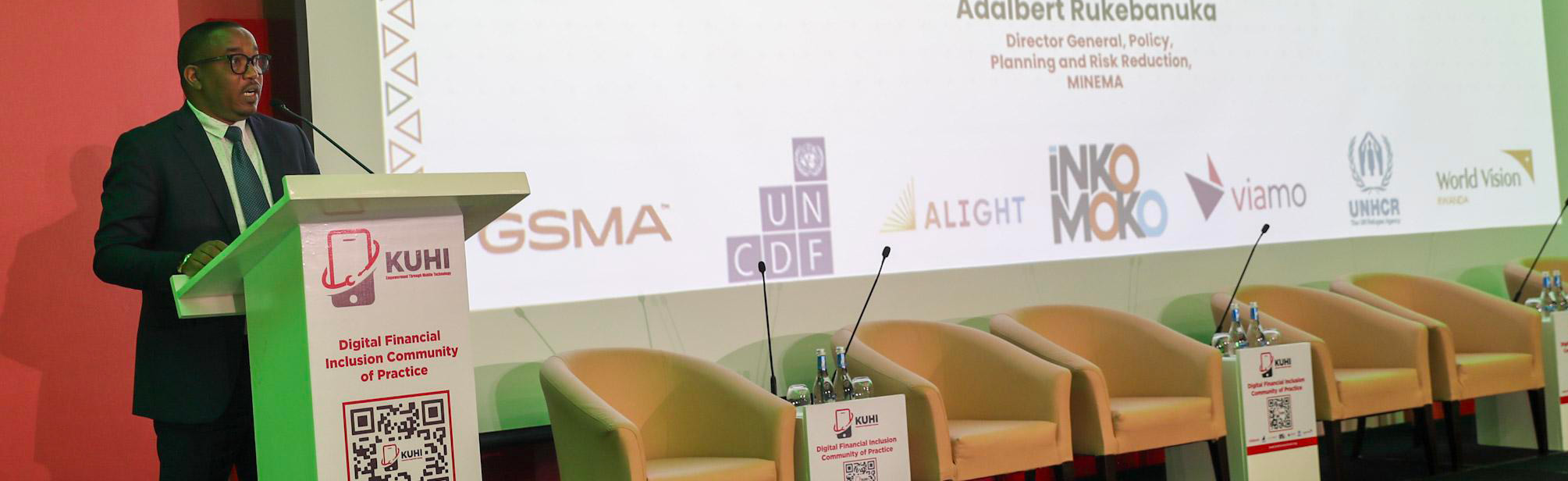
Albert Rukebanuka, Director General of Policy, Planning and Risk Reduction, MINEMA, delivers keynote speech at the KUHI Consortium launch at the Kigali International Convention Centre
History of the KUHI Consortium
The KUHI Consortium was initiated by the GSMA in partnership with UNCDF, Alight Rwanda, Viamo, Inkomoko, World Vision, and UNHCR at the onset of the COVID-19 pandemic in 2020. Its original aim was to promote economic resilience during the pandemic, but it has since evolved to promote digital financial inclusion in the present. KUHI brings together diverse stakeholders from government, private sector, and academia with a distinct mission: to drive digital and financial inclusion for refugees and host communities in Rwanda. Through monthly virtual and quarterly in-person events, KUHI inspires innovation, raises awareness about digital financial services, and identifies gaps to better serve communities.
Voices of impact: Jacqueline’s journey
A Burundian refugee, Jacqueline, shared her inspirational story on how she overcame significant challenges to become a successful businesswoman to which she credited training and support from Inkomoko and their digital and business skills programmes. Her journey from making mandazis (doughnuts) to establishing her own soap-making enterprise, DETEX, is just one testament to the transformative power of upskilling, community support and digital tools.
Insights on policies that work for refugees
Adalbert Rukebanuka, Director General of Policy, Planning, and Risk Reduction at MINEMA highlighted Rwanda’s progressive policies that grant refugees the ability to work, own businesses, and access banking services in his address. At the same time he underscored the imperative to better fully integrate refugees into the local economy, given that humanitarian aid is on the decline.
Laser focus on digital financial inclusion
Mark Mico (Equity Bank) and Jean Claude Gaga (Airtel Money) shed light on new and innovative financial solutions tailored for refugees and rural communities by their institutions. Of particular note is that Equity Bank’s digital drive for financial inclusion has empowered over 46,000 refugees with access to digital financial services, while Airtel Money offers affordable 4G-enabled smartphones and cost-effective data plans. These initiatives highlight the role of technology in enabling financial wellbeing and resilience among the vulnerable and underserved populations.
“Digital financial inclusion is a topic of critical importance in Rwanda. This isn’t just about access to technology, it’s about empowering individuals and giving back to communities to ensure that we build a more secure and prosperous future for vulnerable groups.”
~ Marc Mico, Equity Bank Rwanda
Creating economic growth in a digitalised world
Experts from the GSMA, Rwanda ICT Chamber, UNHCR, World Vision Rwanda, Inkomoko, and CMU Africa engaged in a panel discussion on the need for partnerships to create equitable economic growth and digitalisation. The panel emphasised the importance of innovative approaches in combining skill building that helps trainees fill real market niches with access to finance and digital competencies and skills, as well as the role of digital inclusion in achieving economic integration. The panellists advocated for more inclusive strategies that encompass refugees and host communities.
What is next?
The launch marked a significant step towards leveraging digital innovation for the economic integration and resilience of refugees and host communities in Rwanda. By fostering collaboration, enhancing knowledge sharing, and scaling impact, KUHI aims to unleash the collective potential of its members. For marginalised communities, such as refugees and host populations, the benefits can be transformative.
For more information on the KUHI Consortium and to participate in upcoming events, visit the KUHI Consortium website.