



Climate change is exacerbating existing vulnerabilities, especially in the poorest, most marginalised communities, by worsening food and water insecurity, triggering displacement, affecting health, and by intensifying extreme weather. Adaptation in this context means taking practical steps to build resilience to ongoing and future risks posed by climate change. When this is locally led, it is owned and steered by community partners, aligning with eight widely recognised principles of locally led adaptation.
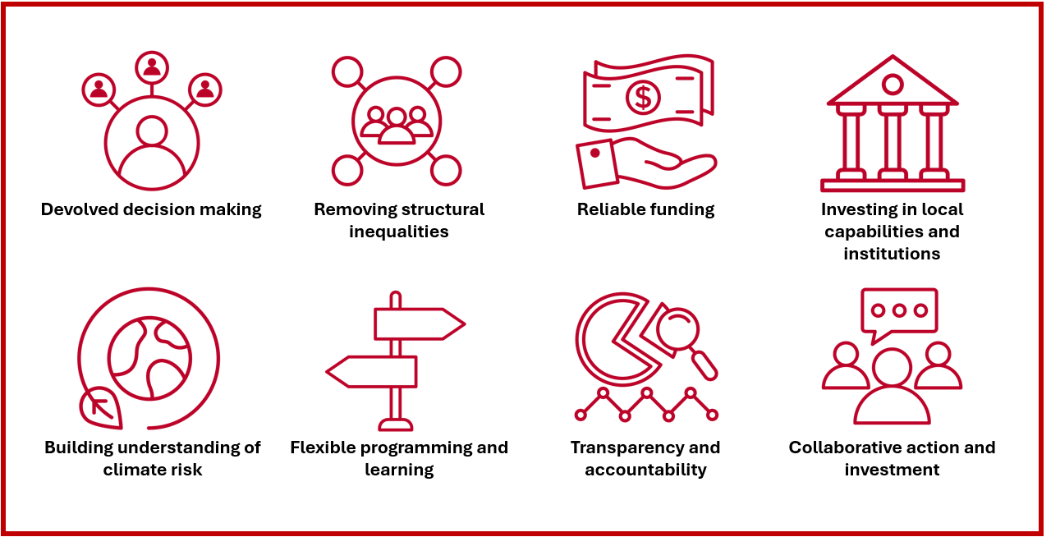
Figure 1: Eight principles of locally led adaptation
Mobile and digital technology can play a catalytic role. When designed and funded in line with the principles of locally led adaptation, climate tech can help devolve decision making (e.g. with community facing data dashboards), confront structural inequalities (e.g. through interfaces in local languages, voice/USSD for low-literacy users, women-led data stewardship), and channel patient, predictable finance (e.g. mobile money for steady disbursements with community oversight). It can also build lasting local capabilities through training and open standards; combine scientific and traditional knowledge to strengthen risk understanding; and enable flexible programming via real-time monitoring that communities interpret and act on.
Against this backdrop, the GSMA Innovation Fund for Climate Resilience and Adaptation offers practical examples of how such approaches work in the real world. In November 2022 following COP27, the GSMA, with funding from FCDO and Sida, awarded 11 start-ups across Africa and Asia with a grant as part of the GSMA Innovation Fund for Climate Resilience and Adaptation. The fund was designed to support start-ups, small and medium enterprises (SMEs) and social enterprises in leveraging mobile and digital technology to build the climate resilience of vulnerable low-income communities and marginalised groups.
The 11 successful start-ups received an equity-free grant of between £100,000 and £250,000 to pilot and scale their innovation over 18 months, with additional benefits such as GSMA-facilitated industry partnerships, mobile and digital technical assistance, monitoring and evaluation and market expertise from GSMA staff, as well as a platform to raise the profile of their organisation to potential investors.
This blog profiles three grantees to highlight how mobile and digital technology can play a role in locally led adaptation.
It highlights key lessons learnt across the cohort, including key challenges and milestones that climate tech ventures face in their journey to scale, and the extent of impact these ventures have had on helping low-income populations build resilience to climate change.
Komunidad, Philippines
Komunidad is a weather and environmental intelligence start-up founded in 2019 by Felix and Allister Ayque. It has evolved from an email alert service into a SaaS platform that helps local governments, businesses and communities plan for safety and continuity with localised dashboards, mobile and web apps, and SMS alerts. Its mission is to turn climate and environmental data into actionable, community-relevant decisions.
With the support of GSMA, Komunidad customised its Resilience Suite as a typhoon early warning system (for nine local government authorities across Siargao – an island in the Philippines particularly vulnerable to typhoons. The project invested in strengthening the capabilities of the municipal disaster management staff and helping build their understanding of climate risk through a web dashboard with tailored analytics, SMS and email alerts for tropical storms, and training on both the software and foundational climate concepts. 97% of staff surveyed said they were better able to get accurate, localised weather information and anticipate threats because of Komunidad’s service, and 94% felt better able to make protective decisions.
Komunidad also enabled devolved decision making by creating a public web app for residents and tourists, so that they can access to typhoon risk-rated local forecasts. The public web app recorded over 181,000 unique visits during the period, and 30% of municipal disaster management staff used it for community dissemination alongside existing channels.
Dayaxa Frankincense Export Company (DFEC), Somaliland
DFEC is a Somaliland-based start-up founded in 2019 by Abdirizak Salah Mohamed to make the frankincense trade fairer and more sustainable for remote harvesting communities. With support from the GSMA Innovation Fund for Climate Resilience and Adaptation, DFEC built two tools: a blockchain traceability app that logs where resin was tapped and how much harvesters were paid, and a tree-health app to monitor frankincense trees.
Each activity was designed to operationalise locally led adaptation principles. By recording origin and price on-chain and sharing the data with buyers, DFEC ensured transparency and accountability in a supply chain long plagued by opacity and human rights concerns. Paying harvesters at the point of purchase reduced the influence of exploitative intermediaries and gave producers more control over when and how they sell, thereby removing structural inequalities and improving bargaining power.
Hands-on training in sustainable tapping, post-harvest handling and use of the tree-health app invested in local capabilities to manage forests over the long term. The project gathered ecological, chemical and geospatial data to create a baseline that builds an understanding of how climate change might threaten the local frankincense forests, and therefore local livelihoods. DFEC’s model aligns buyers, harvesters, local agents and the GSMA in a shared data environment, advancing collaborative action and investment.
During the grant, supported 1,300 harvesters to adapt to climate change, with many reporting fairer payment and improved financial stability because of DFEC. While trust barriers, connectivity and security slowed scale-up, the project demonstrated that digital traceability and participatory monitoring can strengthen livelihoods and forest stewardship, putting community actors at the centre of climate-resilient value chains.
GeoKrishi, Nepal
GeoKrishi is a Nepali agri-tech start-up that provides smallholder farmers with hyperlocal weather, climate-smart advisory and a marketplace via a mobile app. This is complemented by an enterprise app for municipalities and cooperatives. Together with GSMA, GeoKrishi upgraded its platform with digital learning content for with climate-smart practices and expanded last-mile delivery through co-ops, municipal partners and offline “e-Chautari” clinics. This coupling of online and offline channels tackles access barriers for underserved groups by reaching farmers with limited connectivity or literacy in local languages, and by engaging women in adaptation decisions.
Farmers receive risk-rated, hyperlocal forecasts and an “ask-the-expert” plant disease service; municipalities access map-based analytics, farmer diaries and market insights. These tools strengthen communities’ grasp of shifting climate hazards (combining scientific data with local observations) and put choices directly in farmers’ and local officials’ hands. Parallel brokering helped GeoKrishi progress a partnership with a mobile network operator to subsidise SMS alerts and data bundles, further lowering access barriers.
Shared dashboards, price information and farmer diaries open information flows and reinforce public scrutiny between farmers and local government, while the multi-stakeholder operating model (co-ops, municipalities, agrovets, MNOs) mobilises joint efforts and co-investment across the value chain.
GSMA research showed that 94% better access to localised weather information because of GeoKrishi’s service, whilst 96% said that they had acted on climate-smart recommendations provided by the start-up.
These cases show that digital technology can be used to support locally led adaptation in practical, grounded ways. Komunidad, DFEC and GeoKrishi employed the use of digital innovation to help local actors make decisions, share information and manage resources. The lesson is not that technology is a panacea, but that it can serve community priorities when designed for real constraints, delivered through trusted institutions and resourced predictably. With the right partnerships, digital tools can help people understand climate risks, act sooner and sustain improvements over time. This is the opportunity the GSMA Innovation Fund for Climate Resilience set out to demonstrate.
This initiative is currently funded by UK International Development from the UK government and by the Swedish International Development Cooperation Agency (Sida) and is supported by the GSMA and its members.
