




In an age of intensifying disasters, mobile technology offers a powerful opportunity to reach at-risk communities at scale with early warning messages. In France, mobile network operators (MNOs) are playing a central role in delivering life-saving alerts. A recent publication by the GSMA’s Mobile for Humanitarian Innovation (M4H) programme, provides insights into FR-Alert and the collaborative approach taken by the government and MNOs to address France’s complex geographic reality.
Deployed in 2022, FR-Alert represents France’s commitment to public safety, fulfilling the 2018 EU-wide directive to establish a public warning system capable of sending alert messages using a mobile channel. By incorporating both cell broadcast (CB) and location-based SMS (LB-SMS) technologies, this innovative system ensures universal coverage, national cohesion and equal protection across France’s geographically and technologically diverse territories.
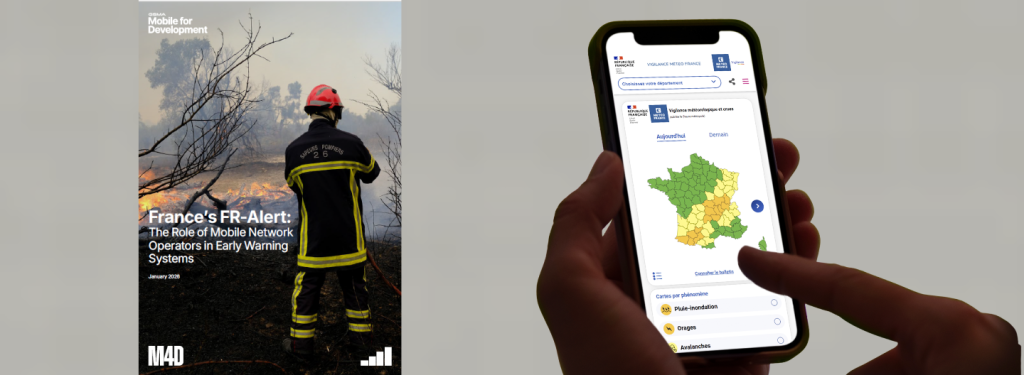
This national approach aligns with global efforts to implement and strengthen early warning systems (EWS). The UN’s Early Warnings for All (EW4All) initiative aims to ensure everyone is protected by a multi-hazard EWS. The M4H programme plays a leading strategic and operational role in pillar 3, led by ITU on warning dissemination and communication. This is through supporting enabling environments where MNOs are actively engaged in national EWS design, implementation and operation. M4H has also produced a body of research, including technical reports, inclusion insights and case studies of effective MNO engagement in EWS in Chile, Japan and France.
France’s disaster risk profile
While metropolitan France faces increasing natural hazards from flooding, extreme heat and droughts, its overseas territories face other hazards such as cyclones, earthquakes, volcanic activity and coastal erosion.This geographic complexity demanded a sophisticated EWS capable of addressing both European climate threats and tropical hazards.

Disaster management and governance
France’s disaster management system operates through a decentralised yet hierarchical chain of command which escalates as needed. Municipal authorities handle initial crisis management, with coordination provided by the Ministry of the Interior’s, Directorate-General for Civil Security and Crisis Management (DGSCGC). This structure provides the legal and operational foundation for disseminating emergency alerts.
A doctrine of use formalises FR-Alert’s governance model. This doctrine standardises procedures, roles and coordination mechanisms across all administrative levels. The doctrine defines how authorities assess risks, trigger alerts, coordinate between response actors and communicate with the public, while ensuring that emergency alerting is integrated within broader civil security operations. This framework is supported by early and sustained engagement with MNOs, embedding multi-stakeholder coordination into FR-Alert’s operational design.
France extends the same approach to its overseas territories, which often face heightened socio-economic vulnerabilities and disaster risks. The decentralised governance model allows local operational responsibility while maintaining integration with national civil security, making FR-Alert a unifying national warning mechanism sustained through early and sustained MNO engagement and multi-stakeholder coordination.
FR-Alert’s government-funded financial model reinforces disaster alerting as a state responsibility without costs to MNOs or end users, with sustained public investment ensuring operational costs, system upgrades, testing and cross-network interoperability for long-term sustainability across mainland and overseas France.
Technical and operational architecture of FR-Alert
MNOs provide critical infrastructure for disseminating alerts, ensuring inclusive and comprehensive coverage. FR-Alert involves the coordination of 21 MNOs; its dual-channel approach combining CB and LB-SMS technologies addresses variations in handset compatibility, network capabilities and the continued use of legacy 2G and 3G devices across different territories.
FR-Alert is designed to accommodate France’s overseas territories through a decentralised technological model, enabling local operators to manage alert dissemination according to their local network conditions and regulatory environments while remaining integrated with the national system. Central to the integration of multiple alerting channels is the Common Alerting Protocol (CAP) standard, a structured format for creating and disseminating alerts across systems. MNOs maintain active involvement in the operations of FR-Alert by engaging in testing and simulation exercises, monitoring and reporting issues, maintaining infrastructure and implementing system updates. This collaborative operational model has resulted in a system with robust technological foundations.
France’s collaborative approach benefits from a high degree of mobile connectivity and state investment that may not be replicable everywhere. However, the French model offers many insights and practical considerations for governments seeking to engage MNOs effectively in developing a successful national EWS. A selection of these considerations include:
- Robust regulatory frameworks clearly define MNO roles and public safety obligations, supported by trusted stakeholder coordination and institutional capacity building to ensure proper alert use.
- Multi-channel alerting combining CB, LB-SMS, and traditional methods maximises reach.
- Using CAP enables instant and consistent messaging and interoperability.
- Supporting handset compatibility guarantees delivery to intended recipients.
- Continuous improvement through iterative testing and evaluation enhances effectiveness and maintain readiness.
- Sustainable financing models support long-term viability and reliability of these critical life-saving systems.
Learn more about France’s early warnings model and the role of MNOs: