


Monday 22 June, 2026
Japan is one of the world’s most disaster-exposed nations, facing frequent earthquakes, tsunamis, typhoons, floods and volcanic eruptions. These ongoing threats have cultivated a robust culture of preparedness, with early warning systems (EWS) playing a critical role in protecting lives and communities. This GSMA Mobile for Humanitarian Innovation report examines Japan’s early warning system (mobile-enabled EWS) as a compelling case study of effective disaster communication, with a particular focus on how mobile network operators (MNOs) contribute to this life-saving infrastructure.
A multi-layered approach to public safety
Japan’s EWS architecture demonstrates the power of integrated systems working in harmony. The framework combines the national J-Alert system for life-threatening hazards, the L-Alert platform for local evacuation and service information, and standards-based mobile cell broadcast alerting operated by the country’s four major MNOs. This layered approach ensures that rapid, consistent warnings reach the public across multiple networks and channels – even when infrastructure faces extreme stress during disasters.
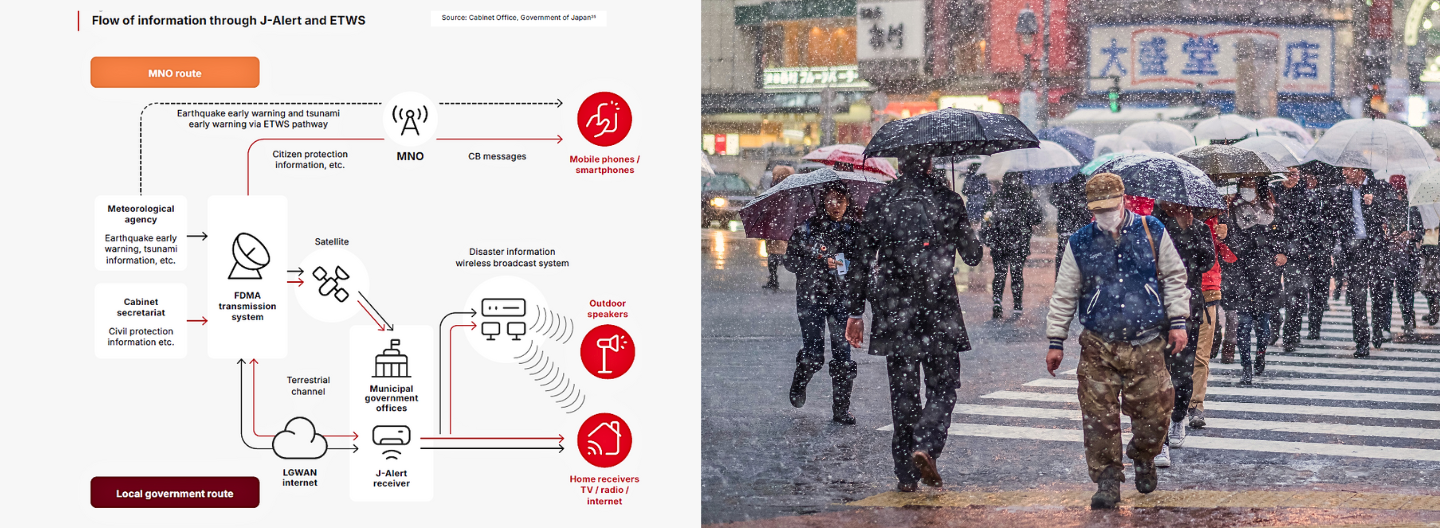
Mobile alerting in Japan rests on the collaborative role of its MNOs
Rather than viewing disaster communication as a competitive arena, Japan’s MNOs work together on technical specifications, shared operational guidelines and joint testing protocols. This extends to mutual aid arrangements, shared restoration assets, joint emergency connectivity hubs and coordinated drills. The result is a system that delivers consistent alerts across all networks and enables faster service recovery when disasters strike. Combined with redundant delivery paths and multi-channel alert dissemination, this collective approach significantly enhances system reliability during critical moments.
Drawing on lessons from Japan’s experience, this report offers 10 key considerations for effective MNO engagement in mobile-enabled EWS. These insights provide valuable guidance for disaster-prone regions worldwide and key stakeholders such as regulators and policymakers, emergency management agencies and humanitarian actors and donors.
