The GSMA Mobile for Development team is conducting an extensive research project on the role and opportunity for the mobile industry to enable digital health solutions across high- and low- to middle-income contexts. October was a particularly active month, with engagements at the Africa HealthTech Summit (1,800 delegates) and MWC Kigali (4,000 delegates), where digital health featured prominently.
Local innovation driving Africa’s digital health transformation
Across both events, one message stood out: Africa’s digital health transformation is increasingly being led from within. The focus is shifting from external pilots to the integration of locally developed, community-driven solutions into national health systems.

Under the Africa HealthTech Summit’s theme, “Connected Care: Scaling Innovation Towards Universal Health Coverage,” discussions explored how homegrown digital tools can accelerate progress toward SDG 3.8 by improving access, quality, and efficiency of care. Evidence from across the continent, from telemedicine and mobile diagnostics to digital surveillance and logistics platforms, shows how innovation developed in African contexts is expanding access and strengthening health systems.
At MWC Kigali, examples such as eHealth Africa’s logistics platforms and Zipline’s drone delivery networks illustrated how local innovation can reduce stock-outs, improve emergency response, and enhance service delivery in remote areas. Participants across both events underscored the urgency of scaling these community-driven technologies, supported by regional enablers such as HealthTech Hub Africa and sustained investment in scalable, context-specific solutions embedded within national systems.
Digital health in practice: The case of Rwanda
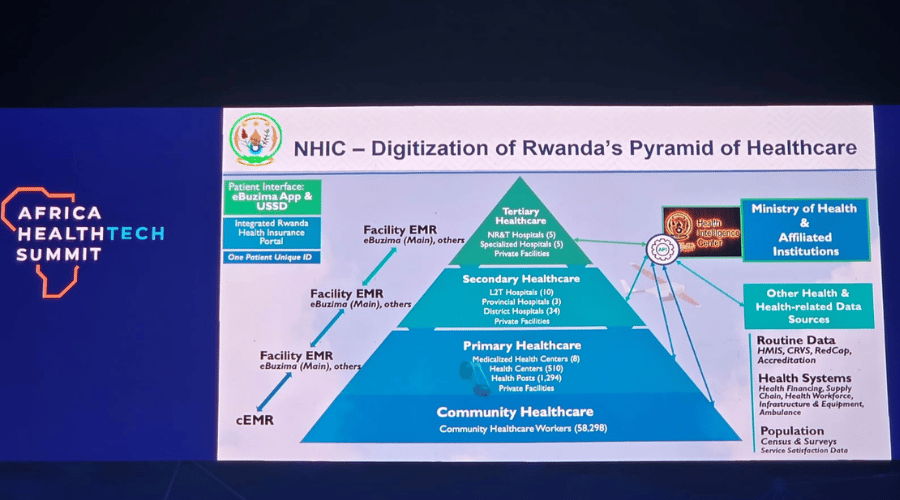
During the event, the Rwandan Ministry of Health presented ongoing efforts to strengthen national digital health infrastructure. The National Health Intelligence Centre, launched earlier this year, integrates real time data from public health systems to inform planning and resource allocation. Two complementary platforms launched at the Summit (e-Buzima and e-Bankuga) aimed to digitise health records, link data across facilities, and improve emergency coordination. Developed by teams with an average age of 21, these platforms showcase how young developers are shaping public sector innovation.
Al-driven innovation
Al is emerging as a strategic lever for improving health system performance. With only a small proportion of Rwanda’s health data currently analysed, Al-driven approaches could enhance data utilisation, predictive analytics, and clinical decision support. The Africa Centre for Disease Control and Prevention (CDC), the specialised public health agency of the African Union, is prioritising health data governance to enable these developments at continental scale.
Embedding data protection and security at every level of the health system is equally critical to uphold privacy, maintain safeguards, and build public trust. Panellists recognised the need to drive significant investment in AI readiness, particularly in terms of developing ethical guidelines and regulatory frameworks to ensure that equity-based principles are embedded to prevent widening health inequalities. Initiatives led by the ITU Regional Office for Africa and Africa CDC are instrumental in developing these frameworks and advancing the responsible use of AI in health.
With an estimated 1000-2000 languages spoken in Africa, proactively training AI models for use in healthcare settings on diverse linguistic datasets will be vital to mitigate linguistic bias and promote equitable access to the benefits of AI tools deployed in healthcare across the continent.
The role of the mobile industry
Mobile network operators (MNOs) globally are expanding their offers beyond connectivity in response to rising digitalisation across varied industries. When it comes to digital health, the mobile industry has a unique opportunity to leverage its wide reach and core strengths in connectivity, security and interoperability to accelerate digital transformation in the health sector.
At MWC Kigali 2025, GSMA’s flagship event for the region organised in partnership with the Ministry of ICT & Innovation in Rwanda, digital health was one of the key topics discussed under one of the conference’s overarching themes, Africa’s Digital Frontier.
Through strategic partnerships with healthcare providers and healthtech companies, to 5G deployments enhancing critical digital health infrastructure, mobile operators are already proving they are a highly valuable partner for health systems.
At the event, the GSMA Mobile for Development team convened a roundtable with stakeholders from the mobile and digital health sectors to explore how the mobile industry is advancing digital health and addressing communicable diseases. The discussion highlighted mobile operators’ expanding role beyond connectivity, from enabling core digital health infrastructure, such as Health Information Exchanges and healthcare interoperability solutions, to delivering end-user services like health apps and telemedicine platforms.
The GSMA team outlined how the role of MNOs within the global digital health landscape has been steadily increasing in recent years, with many mobile operators transcending their traditional role as connectivity providers and now offering specific products and services for the healthcare sector.
There are also clear examples of how the mobile industry is supporting public health systems to tackle communicable diseases, such as:
- In Côte d’Ivoire, the M-Vaccin mobile app, developed in partnership between Orange Côte d’Ivoire, GAVI and Côte d’Ivoire’s Ministry of Health, is improving the uptake of routine immunisation for children and aiming to reach national scale;
- Digital payments for healthcare workers via mobile money are improving the efficiency of mass vaccination campaigns for diseases such as polio in over 20 countries across Africa;
- Digital solutions led by Mezzanine, a Vodacom subsidiary, are streamlining laboratory testing processes for HiV and tuberculosis at scale in Zambia and South Africa.
Building the foundations for sustainable digital transformation
Discussions across the two events underscored that the sustainability of digital health in Africa depends on strengthening system-level enablers: interoperability, financing, cross-sector collaboration, and workforce capacity.
Interoperability and harmonisation with international data standards are essential to enable real-time information exchange and cross-border collaboration. Ensuring sustainable financing through innovative and blended models will help countries implement and maintain digital health solutions at scale. In parallel, cross-sector coordination (engaging actors beyond health ministries) remains vital to align digital infrastructure, regulatory systems, and policy frameworks.
Finally, workforce capacity and equity must remain at the centre of this transformation. Frontline health workers need digital literacy, connectivity, and tailored training to use new platforms effectively, while targeted capacity-building can help prevent widening existing inequalities.
Overall, the conversation reflected a clear shift from piloting innovations to institutionalising digital health, supported by stronger governance, sustainable financing, skilled human capital, and integrated systems.
The GSMA Mobile for Development team extends its sincere thanks to all participants. If you would like to learn more about the GSMA’s research or the evolving role of mobile network operators in digital health, please get in touch: centralinsights@gsma.com.