Small and medium enterprises (SMEs) are an important source of livelihoods and economic activity in Sierra Leone. For these businesses, digital technologies can open several pathways to greater productivity and growth. Mobile money can make payments faster and safer, messaging and social media can connect businesses with customers, digital records can improve financial management and potentially help establish a transaction history, and digital information can help businesses make better decisions about markets, prices and suppliers.
But access to technology does not automatically translate into better business outcomes. For Sierra Leone, an important question is not simply whether SMEs are adopting digital technologies, but how they are using them, what difference this makes to their businesses, and what conditions are needed for the benefits of digitalisation to be more widely shared. This also means ensuring that digital technologies are inclusive and accessible, particularly for women entrepreneurs, so they can benefit equally from digitalisation.
The Central Insights Unit (CIU) of GSMA Mobile for Development (M4D), supported by the British High Commission in Freetown, has undertaken a research study to explore these questions and identify opportunities for digitalisation to contribute to sustainable and inclusive economic growth in Sierra Leone.
The enabling environment for digitalisation in Sierra Leone
Digital transformation has emerged as an increasingly important part of Sierra Leone’s development agenda. The country’s National Digital Development Strategy identifies digital technologies as an opportunity to create jobs and wealth, improve access to services and enable greater participation in the digital economy. The government’s Medium-Term National Development Plan 2024–2030 also identifies Technology and Infrastructure as one of its five strategic “Game Changers”.[1]
At the same time, the country’s financial infrastructure is evolving, following the government’s launch of the National Payment Switch in 2023, which supports greater interoperability between banks and, progressively, other financial service providers.

Despite this progress, SMEs continue to face constraints related to infrastructure, capital, and markets. Previous GSMA work in Sierra Leone has also highlighted digital skills as an important barrier to digital adoption, alongside broader challenges around affordability, safety and security. The next challenge is therefore ensuring that improvements in the digital environment translate into meaningful and productive adoption of digital technologies, including among SMEs.
Unmet opportunities in sectors at the centre of Sierra Leone’s economy
Our research will focus on agriculture and agribusiness, and wholesale and retail trade, while recognising the considerable overlap between them. Both sectors play an important role in Sierra Leone’s economy and present significant opportunities for digitalisation.
Agriculture, including forestry and fisheries, contributes over 55% to GDP and provides employment to 75% of the Sierra Leone population, according to the World Bank. Yet, it continues to face challenges such as limited market connectivity, low productivity, weak infrastructure. Links between mainstream agriculture and other related subsectors also remain underdeveloped, making it harder to coordinate production, processing, distribution and other activities needed to develop the downstream agri-food systems. To boost agriculture productivity to fuel inclusive growth in Sierra Leone, the Government’s flagship Feed Salone programme places agriculture at the centre of its economic transformation agenda.
Digitalisation could support this transformation at multiple points along agricultural value chains. For example, farmers and agribusinesses can potentially use digital tools to access information on prices, weather and inputs; communicate with buyers and suppliers; coordinate transport and logistics; receive payments; maintain records; and access financial services.
Wholesale and retail trade provides another important pathway to digitalisation. For traders, general-purpose technologies such as mobile money, WhatsApp and social media may help improve communications with customers, receive orders, advertise products, coordinate with suppliers and transact beyond their immediate location.
What is holding SMEs back?
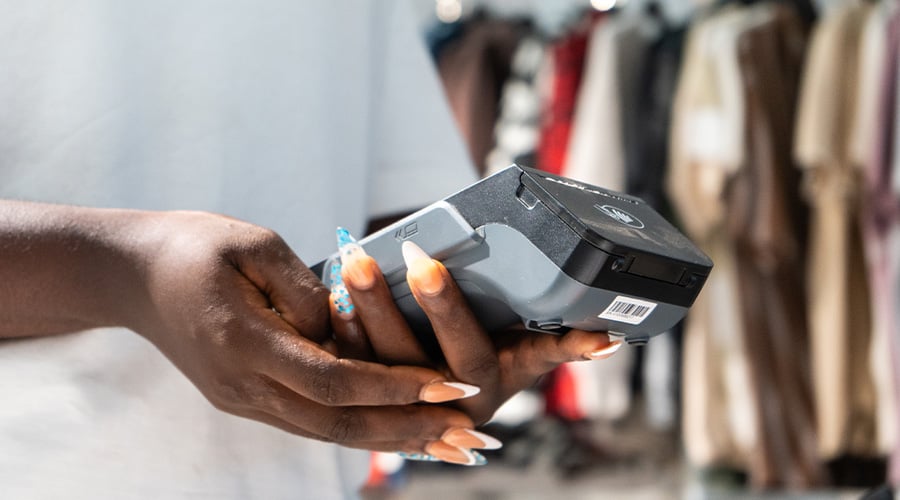
Despite a growing policy and institutional framework to support digital transformation, SMEs continue to face barriers that can prevent adoption or hinder digitalisation from translating into meaningful and inclusive economic gains. Across low and middle-income countries (LMICs), barriers to adopting and making fuller use of mobile internet include affordability, literacy and digital skills, safety and security, and perceived relevance. For example, the cost of 1GB of mobile data in Sierra Leone is estimated at 2.3% of average monthly income, above the United Nations Broadband Commission’s global affordability target of 2% or less.[2] This can limit regular internet use and uptake of data-intensive services such as e-commerce, digital learning and cloud-based business tools.
SMEs in Sierra Leone and across many LMICs also face business-specific constraints, including limited access to appropriate digital solutions, weak financial and transaction records, continued reliance on cash, difficulties accessing finance, logistics and infrastructure constraints, and limited awareness or understanding of how digital tools could address particular business needs.[3][4] A business may also see little reason to accept digital payments if customers overwhelmingly prefer cash. These constraints can reinforce one another: for example, limited record-keeping and reliance on cash can make it harder for businesses to demonstrate creditworthiness and access formal finance.
These barriers may disproportionately affect certain businesses, such as women-owned enterprises, rural businesses and informal enterprises which face additional constraints around access to devices, finance, mobility, time and digital skills. Further, in frontier markets such as Sierra Leone, informality is pervasive, with most MSMEs operating outside formal regulatory systems which may limit their access to formal programmes designed to promote the growth of SMEs.[5]
Addressing these gaps will be essential to unlocking the full economic potential of digitalisation. Our research will therefore look at both sides of the market: what prevents SMEs from going further, and what may be missing from the ecosystem around them.
Looking ahead
The central question for Sierra Leone is not whether digitalisation matters for SMEs. It is how and under what conditions digitalisation can enable enterprises to become more productive, resilient and connected to economic opportunities, as well as how those benefits can reach businesses that might otherwise be left behind.
Our upcoming research will combine evidence from SMEs with perspectives from government, the private sector and other ecosystem actors. It will examine how enterprises currently use digital technologies, what prevents deeper and more productive use, how digitalisation relates to business outcomes, and where the most promising opportunities for intervention lie.
The findings will provide a practical evidence base for the British High Commission Freetown’s future approach to sustainable and inclusive growth, while contributing to the wider evidence on what meaningful SME digitalisation looks like in LMICs.
[1] Government of Sierra Leone (2024), Medium-Term National Development Plan 2024-2030 / Big Five Game Changers.
[2] GSMA Intelligence, internal analysis and modelling of mobile data affordability (1GB as a percentage of income), based on income and pricing data 2024
[3] World Bank — Sierra Leone Economic Update 2022: Leveraging SME Financing and Digitization for Inclusive Growth
[4] IFC (2025) MSME Banking in the Digital Era https://www.ifc.org/content/dam/ifc/doc/2025/msme-banking-in-the-digital-era.pdf
[5] The ILO defines formal enterprises as those registered with relevant government bodies and comply with regulatory and taxation requirements. On the other hand, informal firms are typically unincorporated units that operate at a low level of organisation, and are often characterised by limited access to finance, lower productivity, and lack of formal labour relations. See ILO (2018). Women and Men in the Informal Economy: a statistical picture (third edition). https://www.ilo.org/sites/default/files/2024-04/Women_men_informal_economy_statistical_picture.pdf
The Central Insights Unit is currently funded by the UK Government’s Foreign, Commonwealth & Development Office (FCDO) through its Global Research and Technology Development Portfolio and is supported by the GSMA and its members.