
This blog presents key insights from a recent GSMA field visit about how AI is currently being used in agriculture and aquaculture across Indonesia. This ongoing research is being conducted in partnership with Icenergy Institute and Angin.
Recent reports from the World Economic Forum and the FCDO discuss Al as one possible mechanism to address agricultural challenges in low- and middle-income countries (LMICs). Against this global backdrop, Indonesia presents an interesting case study due to its unique archipelagic composition of over 17,000 islands, with millions of farmers working in diverse agricultural and aquaculture value chains. These farmers face mounting risks to their livelihoods from climate change, pests, diseases, and market fluctuations.
In November 2025, as part of our ongoing research on how AI can enhance smallholder farmers’ livelihoods, the GSMA conducted a field visit to Jakarta and Bali. We engaged with multiple stakeholder groups, including technology startups, NGOs, international development organisations and farmer cooperatives. We also had the opportunity to speak firsthand with smallholder farmers and artisanal fishers working in horticulture, coffee, rice paddy, and seaweed, to further understand how some of the AI-driven agritech tools perform in the field.
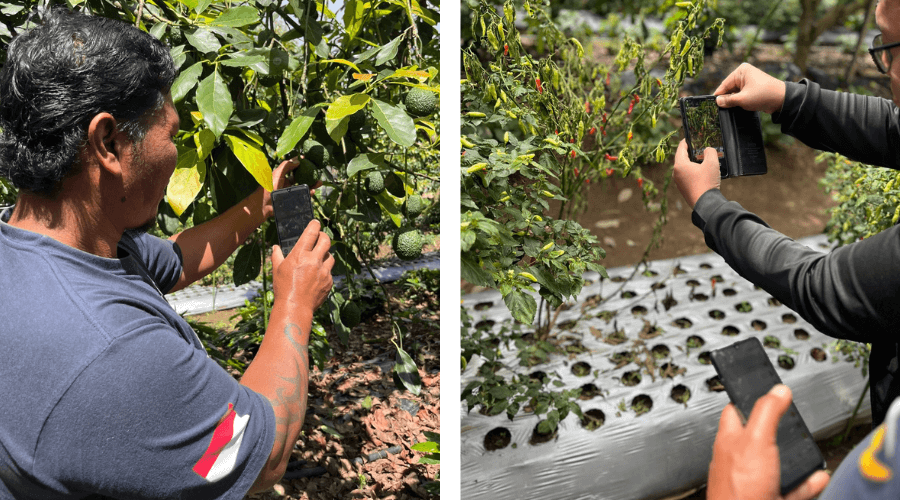
Live testing the tools in the field
In peri-urban and rural areas of Jakarta and Bali, we tested four applications with farmers, chosen for their accessibility and user-friendly design:
- Elevarm App is an AI-enabled agritech application developed by the Indonesian startup Elevarm, which focuses on supporting smallholder farmers across Java and Sumatra. The platform integrates AI across multiple features, such as crop monitoring and a farmer-facing agri-knowledge repository, much like a “Wikipedia for farmers”, which provides localised information on crops, inputs, and farming practices. During the field research, GSMA specifically tested Elevarm’s AI-powered crop health diagnostic feature, which allows farmers to upload photos of their crops for analysis and receive tailored agronomic recommendations.
- Pak Dayat is a local AI-powered agronomic chatbot developed by the Indonesian NGO Edufarmers, in collaboration with agritech startup DayaTani. The tool is accessible through WhatsApp and provides farming advice via text, IVR (voice) and photo uploads in Bahasa Indonesia and selected local languages. It is designed to complement extension services by offering farmers real-time access to advisory support.
- Perplexity AI is a general-purpose AI chatbot developed by the US-based company Perplexity AI, which was tested informally for agricultural queries via WhatsApp during field research. While not designed specifically for smallholder farmers, its use highlighted the growing accessibility of large language models (LLMs) and their potential to answer basic agronomic questions when adapted to local contexts. However, limitations around localisation, trust and relevance underscore the need for sector-specific AI tools in agriculture.
- PemPem is an Indonesian digital platform that provides live pricing information and traceability services for oil palm fruit across multiple regions in Indonesia. It was developed to improve price transparency and reduce information asymmetries between farmers and buyers, but is not currently AI-enabled. Despite this, interviews with farmers highlighted clear interest in AI-driven predictive pricing and demand forecasting of different crops to help smallholders better time sales and negotiate fairer prices.
Challenges to scaling AI-enabled agritech
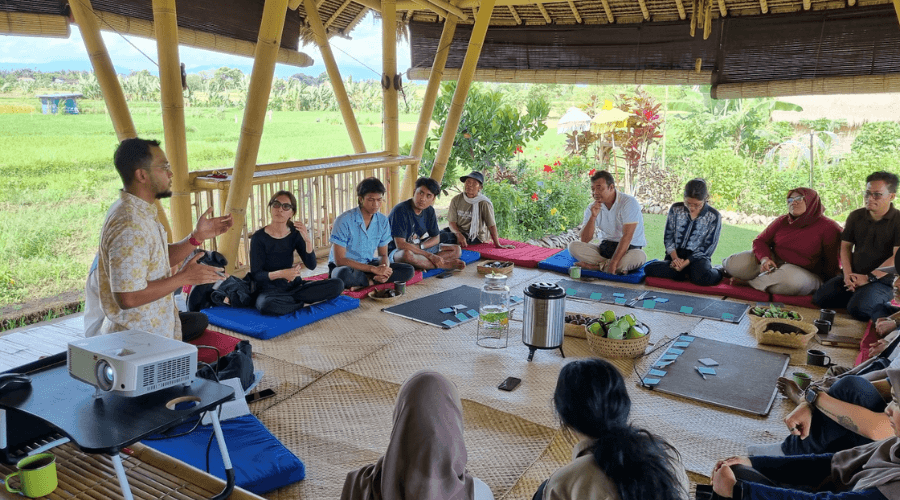
As farmers were introduced to and engaged with these tools in the field, their reactions revealed curiosity and openness to experimentation. They actively explored features and asked questions about how the tools worked. As engagement deepened, several challenges emerged with implications for adoption and scalability:
1. Low familiarity with digital tools: Most farmers lacked prior exposure to digital agritech services, including basic tools such as weather apps, creating a learning curve for sustained use. This reflects broader nationwide trends: according to the GSMA’s Mobile Gender Gap Report 2025, the leading barrier to mobile internet adoption for both men and women in Indonesia is a lack of literacy and digital skills. Voice-enabled AI-chatbots proved particularly useful to address this gap, allowing farmers with lower literacy levels to interact with AI solutions easily. Features such as photo uploads also made interactions more practical and engaging.
2. Trust concerns: Farmers’ lack of familiarity with the technology also led to questions about who was behind the tools and how information was generated. When engaging with AI chatbots, some assumed they were interacting with a human advisor and expressed uncertainty upon learning this was not the case, reinforcing the importance of both digital literacy skills and the need for a human layer to build trust in the tech, such as agricultural extension workers to raise awareness and increase engagement.
3. Accuracy as a driver of trust: Once farmers were introduced to the weather applications on their smartphone, it became apparent that they considered hyper localised, predictive climate advisory highly valuable, since they consistently struggle with unpredictable rainfall and weather patterns that threaten their crop yields. In one instance however, a farmer identified an inaccuracy in market pricing information provided by an AI chatbot, leading other farmers to lose trust in the tool as well. This highlighted how quickly inaccuracies can erode user confidence, and how the accuracy of data, which serves as the backbone of AI-enabled solutions, is a key determinant of trust in digital tools.
4. Connectivity constraints: Limited internet access in some rural areas prevented optimal tool performance, highlighting the importance of reliable 4G coverage to fully leverage AI in digital agriculture. This challenge calls for collaboration with mobile network operators to expand rural connectivity and the integration of adaptive features, such as offline functionality and lightweight models optimised for low bandwidth, to ensure farmers can access predictive insights and localised recommendations even in connectivity-challenged environments.
Our field visit cemented that technology is only the first part of success. Meaningful adoption requires that trust and awareness go hand-in-hand with technological innovation, so that smallholder farmers can harness the full potential of AI-enabled agritech tools to improve their livelihoods and build a more resilient future.
What’s Next?
Our full report, to be published early next year, will incorporate these field-level insights while diving deeper into the supply side of AI-driven agritech, case studies of local AI-driven solutions, and last-mile adoption challenges. To receive updates on the report, you can follow the GSMA Mobile for Development on LinkedIn and subscribe to our newsletter.
This project is funded by the UK Foreign, Commonwealth & Development Office and supported by the GSMA and its members.