



Over the past decade, digital technologies have made climate risks more visible and increasingly helped turn visibility into action by improving prediction, coordination, and real-time decision-making. The question now is no longer whether climate impacts can be detected, but whether societies can act on them, at scale, and in time.
Across the climate ecosystem, innovation is increasingly organised around a chain of intelligence. Environmental signals are captured through sensors, monitors, satellites, and mobile devices; interpreted using AI models analysing weather patterns, crop stress, or energy demand; verified often through digital monitoring systems and delivered through early warning alerts, mobile advisories, insurance payouts, or digital financial services that reach communities in time to act.
These capabilities are already being deployed in practice: from smallholder farmers receiving AI-driven advisories through mobile platforms, to clean energy and cooking solutions generating real-time data that feeds into climate finance mechanisms.
Yet despite this progress, many solutions remain fragmented, often designed as isolated pilots rather than as parts of an interconnected system.
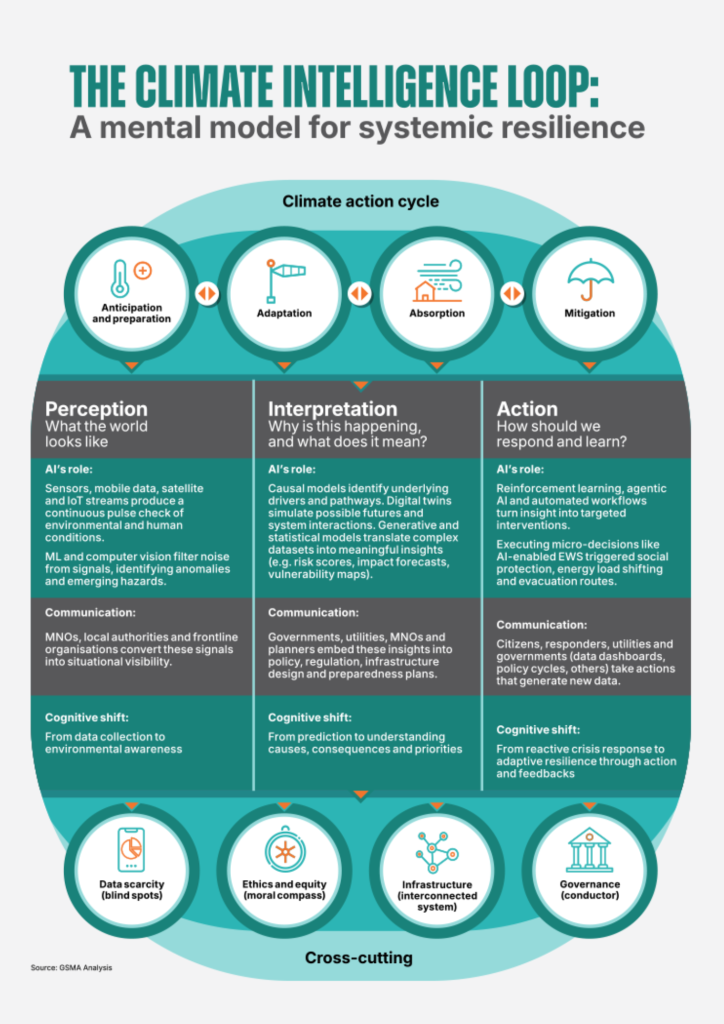
The Climate Intelligence Loop responds to this gap. It is a mental model that captures how data, technology, and human decision-making combine to create this adaptive system and provides a systemic way to understand how climate intelligence moves through society. It reframes the challenge and moves beyond what individual tools can do. It asks a different question: how do climate systems learn?
The answer lies in three interconnected stages: Perception, Interpretation, and Action, linked by continuous feedback.
1. Perception: detecting what the planet is saying
Perception is the sensory foundation of climate intelligence. It encompasses all the ways environmental and behavioural signals are captured via mobile phones, on-device IoT sensors, tower-based weather probes, satellite imagery, drone mapping, field agents and citizen reporting, acting as essential enablers. The sensing layer is increasingly embedded in our everyday systems and services, making the data richer, more continuous, and more grounded in lived experience.
For instance, in agriculture, AgriTech startups supported through the GSMA Innovation Fund use soil sensors and mobile platforms to generate hyperlocal data on moisture levels, crop health, and weather conditions, enabling farmers to make more informed decisions. In energy, pay-as-you-go solar and clean cooking solutions generate continuous streams of usage data, revealing patterns in energy access while also helping quantify emissions reductions.
2. Interpretation: understanding what it means
AI models, including machine learning (ML) and computer vision, then filter noise from these streams, stitching together signals across geographies and populations, identifying anomalies, stress or patterns that reveal vulnerability. But perception without interpretation is not intelligence. Data must be interpreted: contextualised, explained, and prioritised.
Tools like causal AI, digital twins and scenario modelling help answer critical questions: Why is this happening? Who is most exposed? What could happen next? Causal AI reveals underlying drivers like deforestation, drainage and urban heat. “Digital twins” simulate future scenarios, allowing cities or utilities to rehearse climate futures before they happen.
Interpretation translates complex climate signals into insights that governance, planning, and finance can act on. It enables cities to stress-test infrastructure, insurers to price risk more accurately, and climate finance mechanisms to verify real impact.
3. Action: responding to and reinforcing the system
Action makes interpretation become impact. AI-enabled systems can trigger early warning, optimise resource allocation, release anticipatory cash transfers or adjust infrastructure operations in real time. Mobile money platforms, alerts, and automated workflows turn insight into response at population scale. Clean energy and cooking models for instance, link verified usage data directly to financial incentives.
Every action generates new data on how communities respond to alerts, how systems perform under stress, how funds flow during recovery. These outcomes feed back into the next cycle of perception and interpretation. Reinforcement learning and emerging agentic AI systems can help optimise decisions in real time, for example by adjusting energy loads, managing irrigation schedules, or refining early warning thresholds, so that small improvements accumulate into stronger, more adaptive systems over time.
Why this matters now
As climate risks intensify, the limitations of reactive, siloed approaches are becoming increasingly clear. Data scarcity, ethical blind spots, infrastructure gaps, and fragmented governance can weaken even the most advanced technologies. Resilience depends not only on better models, but on stronger data ecosystems, inclusive design, trusted governance frameworks, and connectivity as the backbone that allows intelligence to flow where it is needed most.
This recursive loop is how climate systems and societies become intelligent. AI accelerates the learning. Connectivity delivers it. Communities validate it.
The Climate Intelligence Loop is one of the central ideas explored in ClimateTech Horizons report. Drawing on examples from across agriculture, energy, humanitarian response, climate finance, and urban resilience, the report focuses on how mobile technology and other emerging technologies can support climate action as a coherent, adaptive system – one designed to not just respond to climate risk but to learn it. Read the full report to explore how.
Download the ClimateTech Horizons Report 2026
This initiative is currently funded by UK International Development from the UK government and by the Swedish International Development Cooperation Agency (Sida) and is supported by the GSMA and its members.
