At the end of last year, UNHCR projected that 136 million people would be forcibly displaced in 2026, many of them women. As digital services have become central to how people access information, assistance and financial tools, refugees, especially women, risk being left behind. In Ethiopia, refugee women are twice as likely to have their SIM registered in the name of a friend or family member, while in South Sudan, refugee women are more likely than their male counterparts to rely on shared or borrowed devices.
These examples point to a wider issue at the heart of GSMA’s new research on how refugee women use and experience mobile connectivity in their daily lives. Drawing on the experiences of Venezuelan refugee women in Colombia and in Mauritania’s Mbera refugee camp, the research looks beyond whether refugee women are connected to understand the circumstances that shape meaningful, safe and independent use.
This work sits within GSMA’s wider contribution to the Connectivity for Refugees initiative, which aims to improve connectivity for forcibly displaced people and their host communities. In refugee contexts, the gender digital divide is not only about coverage or phone ownership, but whether displaced women can hear about, access and use digital services safely and independently.
Looking across the full user journey
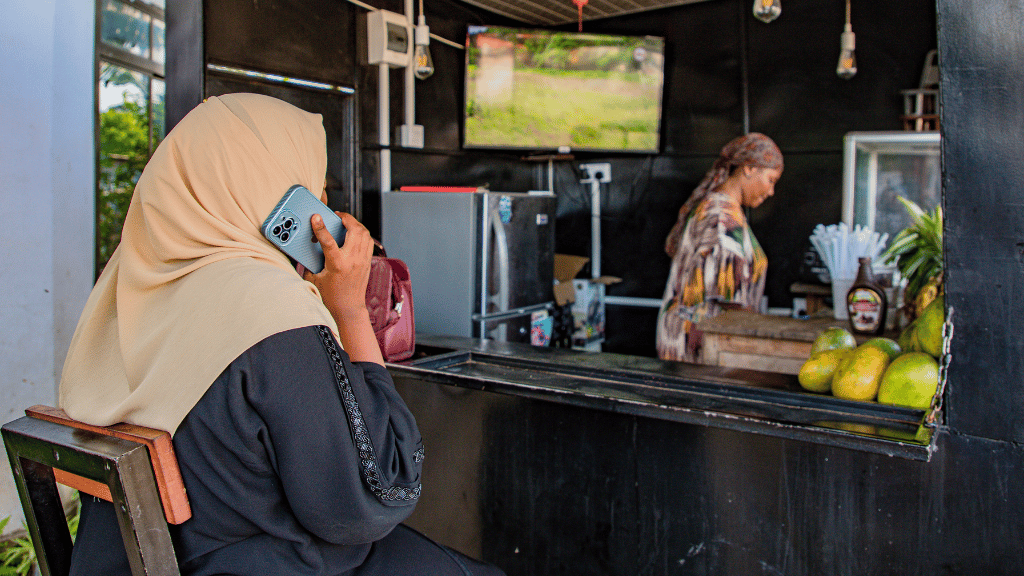
Mirroring the mobile internet user journey in the GSMA Mobile Gender Gap Report, the journey often begins with awareness. A digital service may exist, but displaced women may not hear about it through trusted channels or may depend on others for information. In Jordan’s Al-Azraq and Za’atari camps, access to digital tools is shaped by household decision-making, mobility constraints and confidence using technology. Many services also assume users can receive SMS, open links or use apps independently, while refugee women often rely on a shared household phone, a borrowed device or a male relative’s smartphone.
“The phone is usually with the husband. We only use it when he is around.”
Refugee woman, South Sudan
This is where the difference between basic and meaningful access becomes important. In Ethiopia, refugee women are less likely to own smartphones or use the internet, while in Uganda only around a quarter of refugee women use the internet compared with about half of men. In several settings, basic phone access is relatively high, but the gap widens when services require smartphones, data, digital confidence or privacy.
Affordability determines whether access is regular or occasional. In Uganda and Rwanda, the cost of handsets, airtime and data is one of the main barriers to mobile ownership and internet use for refugee women, particularly where women have fewer income-generating opportunities and depend on male household members for credit or data. Digital access can therefore become something negotiated within the household, rather than available when refugee women need it.
Registration is another critical step. SIM registration, mobile money and some digital services require recognised identity documents, nearby agents and confidence navigating formal systems. Generally, refugee women are more likely than men to have SIM cards registered in someone else’s name. In Tanzania, national identity requirements mean refugee women often rely on local citizens or intermediaries to register SIMs. This can enable connectivity, but it may also reduce women’s control over their digital identity, communications and financial transactions.
“It’s very difficult to obtain a SIM card without an ID. As newcomers, we face challenges getting a SIM card in our own name.”
Refugee woman, Ethiopia
Once connected, refugee women may still face barriers in actual use. Low literacy, limited digital skills and lack of confidence can make apps, mobile money and online services difficult to navigate. In Lebanon, literacy gaps among Syrian refugees were linked to lower confidence using mobile internet and mobile money, while in Bidi Bidi in Uganda and Kiziba in Rwanda, refugee women were more likely than refugee men to cite reading, writing and not knowing how to use a phone as barriers. Digital skills therefore determine whether access becomes meaningful use.
“Some women don’t know how to use the internet, even if the phone is there.”
Refugee woman, South Sudan
Trust and safety shape the journey throughout. Refugee women may limit mobile use because of concerns around surveillance, scams, harassment, social disapproval or misuse of personal data. In Lebanon and Jordan, refugee women reported concerns about online visibility and monitoring, while in Yemen refugee women raised concerns about needing male technicians to repair devices and the potential misuse of photos or messages. These perceived risks influence behaviour: refugee women may avoid certain platforms, limit who they communicate with, or avoid services that do not feel private or safe.
Designing for meaningful, safe and independent use
Designing around the full journey changes the questions we ask: whether refugee women know about a service, have access to a suitable device, can afford to use it, can register safely, understand the interface, use it privately and trust the people and systems behind it.
These questions matter as humanitarian assistance, information services and financial tools become increasingly digital. Closing the gender digital divide among refugee populations means looking beyond coverage or device access alone. It means removing barriers at each stage so that mobile technology can support greater agency, inclusion and choice for refugee women.
This initiative is funded by the UK government’s Foreign, Commonwealth & Development Office (FCDO) through its Global Research and Technology Development portfolio and the Swedish International Development Cooperation Agency (Sida) and is supported by the GSMA and its members.