The role of monitoring, evaluation and learning (MEL) has evolved from being a project management aid to a tool for measuring impact, generating insights and supporting iteration of digital services and products. In the innovation sector, there is a balance of how MEL is operationalised, as it has to be adapted to fit the private sector needs, while also focusing on the measurement and assessment of the impact of digital agricultural solutions on farmer livelihoods, climate resilience and financial inclusion.
Through experiences from the GSMA AgriTech Accelerator, we have gathered insights for how MEL has supported agritechs in generating and pursuing opportunities for partnerships and investment.
AgriTech Accelerator MEL Approach
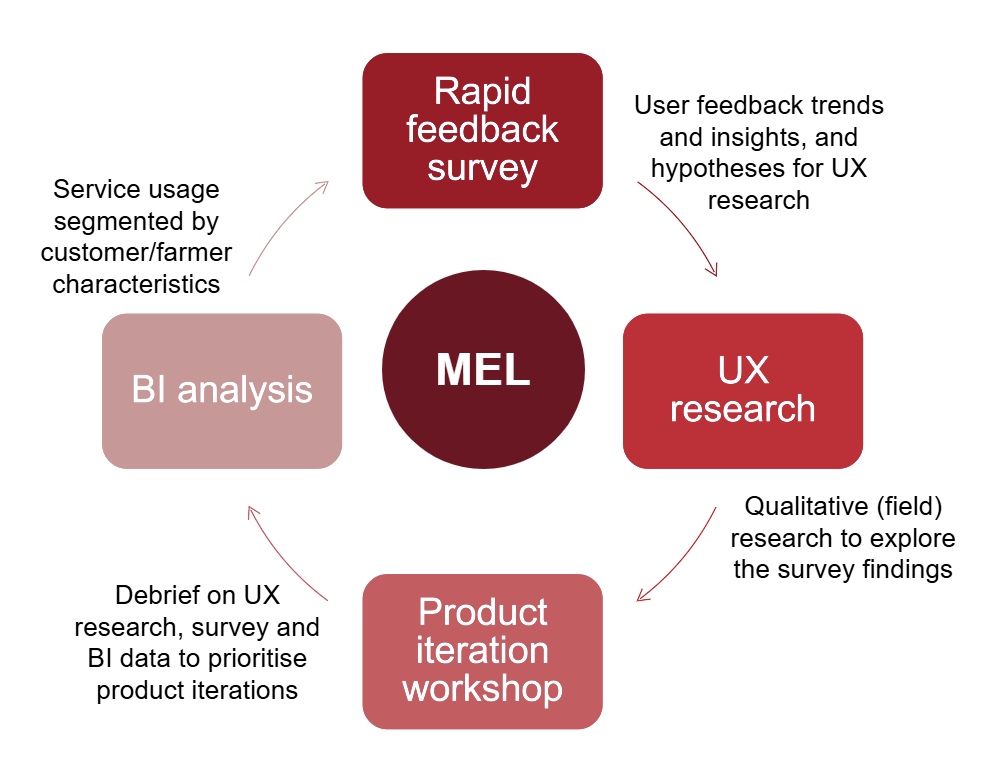
Our approach to MEL focused on generating user insights for agritechs through rapid feedback surveys (RFS) to identify usage trends for different user segments and functions. The results allowed us to tailor the UX research to delve into specific areas. The insights of each were synthesised to inform product iteration workshops (PIW) to develop strategies to make the digital agriculture services more farmer-centric and user friendly.
The Accelerator found that the agritechs also needed to understand the value and use of MEL to their wider business, as many treated it as a necessary administrative chore – a compliance checkbox for their partners and investors rather than a strategic asset. However, we found that this perception changed during the Accelerator as we progressed through the delivery of RFSs to each agritech. Data and insights generated were applied in practice through product iteration and presented to partners and investors to showcase impact.
Source: GSMA (2025)
MEL for Partnerships
The application and relevance of MEL, as well as the data and insights produced were influenced by the specific types of partnerships the agritechs were seeking to establish. Agritechs in the Accelerator developed a variety of partnerships to implement their core services, pilot new services and models and expand their user base. The use of MEL provided immediate feedback to partners, validated the impact of the service and supported the product iteration process – this helped to build and sustain partnerships.
TDX’s strategic partnership with the Mennonite Economic Development Agency (MEDA) focused on providing smallholder female farmers with access to market linkages through stable and better market prices, regular buyers and ease of payments (via mobile money). To date more than 4,500 farmers have been onboard successfully. Findings from the the survey showed that 98% of farmers were positively satisfied with the service1, and that the partnership between TDX and MEDA resulted in farmers having improved access to markets and better prices that they would not have had before. Early results from the partnership are encouraging, TDX and MEDA are extending their partnership to reach an additional 15,000 women smallholder farmers.
Jokalante built strategic partnerships with agribusinesses and cooperatives such as the National Network of Seed Producer Cooperatives of Senegal (RNCPS), and Consultation Framework of Peanut Producers (CCPA) in order to reach a wider number of farmers through their digital platforms – SMS, voice and IVR for agronomic advisory relating to seed production, standards and planting.
The studies with Jokalante found that they were able to expand their reach, as 97% of users2 highlighted that the service provided improved access to agricultural advisory. Additionally, we found that 80% of users implemented the advice 3, which led to improved yields and production. The insights reaffirmed their partnerships with RNCPS and CCPA, as they saw the value of Jokalante’s service on agricultural practices for smallholder farmers in Senegal.
MEL for Investment
Investment in agritech is increasingly linked to impact, MEL is essential for presenting data and stories that resonate with diverse groups of investors.
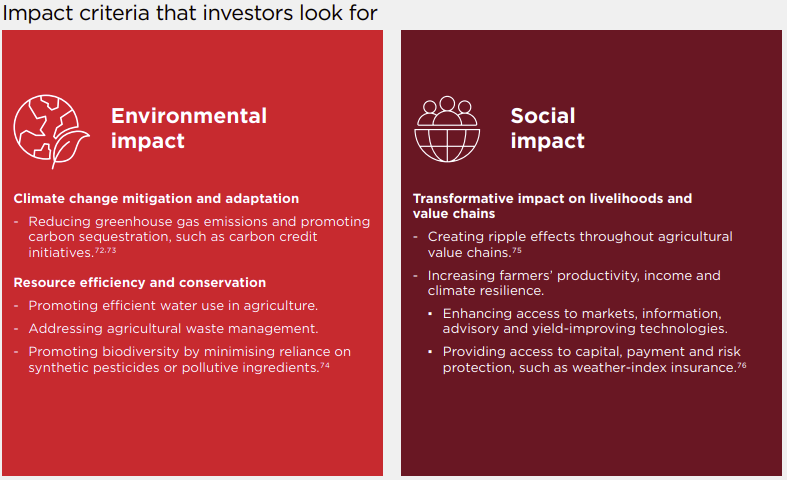
Our AgriTech Investment Readiness Toolkit finds that social and environmental impact is becoming a key focal point for guiding the investment decision for many investors including commercial investors. These investors are focused on different types of impact from livelihoods to climate change, as outlined in Figure 2.
Source: GSMA AgriTech Investment Readiness Toolkit (2024)
Investors will prioritise different agricultural outcomes depending on their organisational type and strategy. Figure 3 shows the spectrum of agritech investors from philanthropic donors to financial investors versus the different approaches to impact and the expected financial return4.
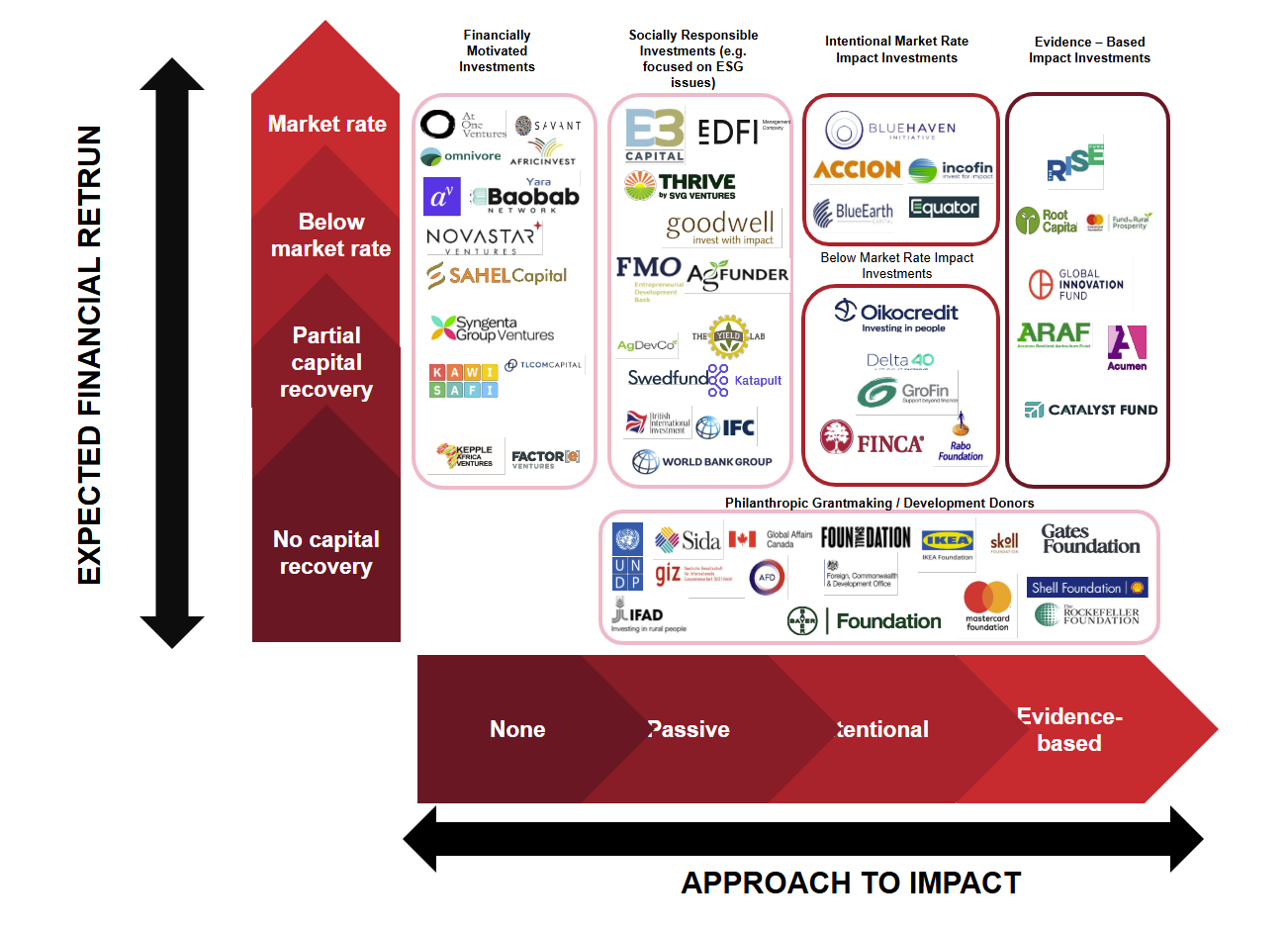
Source: GSMA (2025)
Agritechs under the Accelerator have found that some VCs focus solely on business metrics like year-on-year revenue growth or user adoption rate, as TDX experienced, without considering MEL data or impact metrics. Impact investors or strategic grantmakers prioritise social and environmental metrics that balance qualitative and quantitative metrics. TDX ‘s engagement with development finance institutions (DFIs) found that they were required to provide a feasibility assessment of their value proposition and were able to leverage the RFS data and insights alongside the UX research to validate their case for funding.
Winich Farms discovered during their seed round that MEL data and insights were crucial for investor agreements. Investors prioritized measurable social and environmental impact along the agricultural value chain, including but not limited to:
- Impact on smallholder farmers finances (e.g. revenue/income)
- Number of active smallholder farmers
- Volume of commodity transacted cycle on cycle
- Number of tonnes connected to market
- Number of indirect jobs created
The studies with Winich Farms found that 86% of farmers reported a positive change on their incomes5.
More crucially, investors can also become more actively involved in how the business operates and understanding how the development of new partnerships and business models scales the business is imperative. For example, Winich Farms bundled financial services into their product offering by partnering with financial service providers (FSPs) to issue debit cards to their users and pay their farmers directly through this method. Studies with farmers showed that 52% of debit cardholders use their debit cards weekly and use it for money transfers, cash withdrawals, purchases 6 This feedback validated the partnership with FSPs to offer digital payments; and helps understand the financial profile of farmers through their spending habits and behaviours, which expands the case for financial inclusion. This will also be used as evidence to further the case for investment going forward as Winich Farms scale.
MEL has been used with greater versatility and adaptability by agritechs to meet different investor requirements, as besides simply tracking revenue and market metrics, more emphasis is placed on understanding the user and environment in more detail through insights. Agritechs understand that there is an expectation that impact will be a key component that investors will assess and seek to achieve if they do invest.
MEL as a Strategic Asset
Through the AgriTech Accelerator, MEL has undergone a rebrand to become a strategic asset that ensures a clear value proposition for the private sector.
MEL does not need to be an entirely private sector tool, but instead MEL approaches, systems and tools should be adapted and applied to these different contexts to learn how data and insights can be useful. The GSMA AgriTech Accelerator has been able to adapt MEL to be more useful for audiences outside of traditional development sectors.
Agritechs and investors see clear value in what MEL can offer them, but it is modelled in different ways based on the approach to impact and the returns that they seek. MEL becomes a bridge—connecting farmer feedback to service design, and impact data to investment decisions.
Read more about the key lessons and impacts in our AgriTech Accelerator, Lessons from Scaling Digital Agriculture Services report.
Read more about the UX research and design approach in our UX toolkit in partnership with Bopinc.
The GSMA AgriTech Accelerator is funded by the German Federal Ministry for Economic Cooperation and Development (BMZ) and supported by the GSMA and its members.