UNESCO has proclaimed 19 March as the International Day of Digital Learning to encourage greater discourse on digital learning and its potential to overcome challenges in unequal and low-resource learning settings. Digital learning is defined as the use of digital technologies to improve education. While the use of digital technologies has been seen in developed countries for more than a decade, the COVID-19 pandemic has accelerated their use in low- and middle-income countries (LMICs) and in low-resource settings.
This blog explores the importance of digital learning for low-resource settings in LMICs and highlights key pain points experienced by parents and caregivers, and teachers in the delivery of EdTech, bringing in examples of how EdTech solution providers are addressing these challenges.

The importance of digital learning
LMICs are prone to be impacted adversely by extreme climate events, which have increasingly occurred over the past few years and have led to considerable learning loss for students. With the COVID-19 pandemic came the wide-spread closure of schools, highlighting the need for digitally-enabled learning methods that allowed students to continue learning outside of the classroom. However, areas with low digital connectivity remain largely excluded from the potential benefits of digital education.
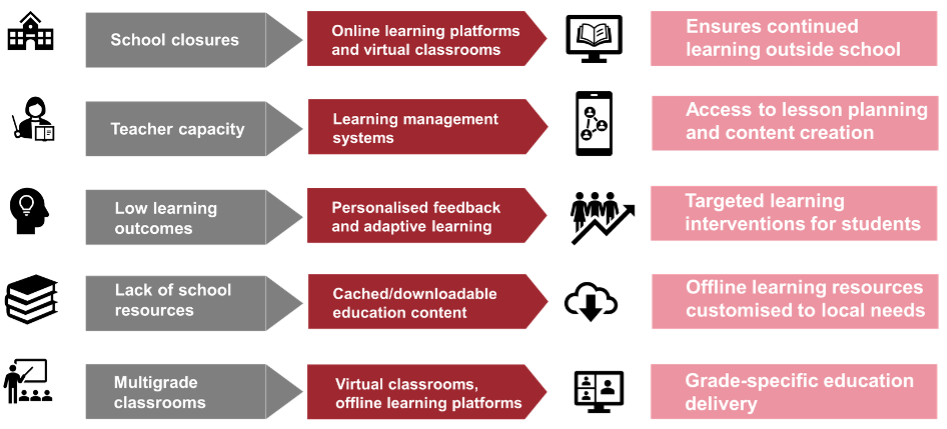
EdTech solutions can help address some of the most pressing challenges in the education sector, by ensuring continued learning outside the classroom on virtual platforms, improving access to customised learning content, identifying and supporting students with different learning needs, enhancing teacher capacity, and enabling teacher training and upskilling.
Figure 1. Potential of EdTech in addressing challenges in education in LMICs
Challenges in the deployment of digital learning
Teachers face barriers such as inadequate digital skills, training and capacity building programmes that are not aligned with their needs, and a lack of access to digitised teacher materials that prevents them from effectively engaging with students using digital mediums. To enable teachers to effectively deliver learning in low-resource settings during the COVID-19 pandemic, the Asian Development Bank set up the EdTech solutions for last mile schools project in the Philippines. The project provided local area network access points in schools, digitalised learning content, and launched a learning management system (LMS) to enable virtual classrooms, as well as capacity building and training sessions for teachers and school officials to utilise blended learning pedagogies. Another example is Edmicro, an EdTech startup based in Vietnam, which aims to address this through a teacher-focused approach to onboarding public schools on their LMS, where teachers attend a 3-month intense programme to familiarise themselves with the platform. Edmicro also leverages popular messaging platforms to offer continuous support to teachers after the training period.
Want more? Discover how EdTech is bridging educational gaps in LMICs, with a spotlight on The Philippines in our recent report ‘The Future of Learning‘.
On the other hand, parents and caregivers have to overcome challenges like lack of device availability in the household, lack of awareness of EdTech solutions being used to teach their children, and lack of support of digital literacy skills needed to navigate online learning platforms. Rocket Learning, an EdTech startup in India aiming to address early learning gaps for students in rural areas, uses play-based content to support early childhood development at both daycare centres and homes. Rocket Learning customises their learning content to meet the unique needs of daycare workers as well as parents and caregivers, taking into consideration the availability of devices and local language usage in their areas of operation.
The opportunity of emerging technology
As digital learning innovations for low-resource settings in LMICs continue to grow, the use of emerging technologies like artificial intelligence (AI) presents an exciting opportunity to further enhance their impact. While the use of AI is still nascent in many LMICs, it can be leveraged in conjunction with other technologies to provide customised, adaptable learning environments for students and also enable teachers to enhance their effectiveness. For instance, computer vision and speech recognition can be applied in gamified and adaptive learning platforms, while natural language processing can also be leveraged for the early recognition of learning difficulties in students, and also to enable the design of accessible EdTech tools. Examples of EdTech providers leveraging this opportunity include M-Shule in Kenya, Orenda in Pakistan, and Ruangguru in Indonesia.
Building an enabling environment to scale EdTech solutions
The development and deployment of EdTech in low-resource settings at scale requires collaborative efforts from stakeholders across the digital education ecosystem. To read more about recommendations to strengthen the EdTech ecosystem in LMICs, please refer to the GSMA Mobile for Development’s recent report ‘The Future of Learning’.
The Central Insights Unit is currently funded by the UK Foreign, Commonwealth & Development Office and supported by the GSMA and its members.
The views expressed do not necessarily reflect the UK government’s official
policies.