


By Julia Burchell, GSMA mWomen Knowledge Manager
As part of the recent GSMA mWomen Working Group meeting, hosted by Indosat and Qtel in Jakarta, a group of GSMA mWomen Working Group delegates and I visited the Bekasi Women’s Community. We discussed the impact mobile phones have on the women’s lives and their thoughts on Working Group members’ Indosat and Nokia’s latest mWomen offering, Info Wanita (‘Information for Women’).
Background
Komunitas Perempuan Bekasi or Bekasi Women’s Community is a 3,500 member-strong network of women of varying professions, including working professionals and housewives, and of different income levels. The ladies we met lived on approximately USD 5000 per year or less. The objective of the group is to empower women and close the gender gap between men and women through working in three main areas: women’s rights in politics, equal access to education and access to information and services. Regular meetings are held once a month to discuss religious topics and other topics are discussed at meetings arranged on an ad hoc basis. We met the ladies at their office, where their monthly meetings are held.
Indosat and Nokia Life are working with several of the group’s members as part of the launch of the mWomen product Info Wanita (‘Information for Women’). Info Wanita has been specially developed to provide women with relevant information identified by Indosat through extensive research and includes topics such as healthcare, childcare, business and life skills. These topics have been identified as not only most relevant to women, but also as topics which are seen as attractive to be covered via the mobile phone. The service is offered for free, as long as the customer uses the specified Indosat SIM card with the Nokia phone included in the bundle. The customer receives three SMS messages per week, on the specified topics, for a period of one year.
Approximately 40 women from the community greeted the Working Group delegates at their office and honoured us with a rousing welcome song.
We firstly spoke with the whole group about their lives and attitudes to mobile use. The overwhelming majority of them owned phones and had bought them for themselves, sometimes on a credit plan. They felt that their mobile phones help their lives, with the best thing about their phones being their ability to connect the women with their families and to enable them to know where their children are.
They said they had taught themselves to use their phones and that SMS was the most popular activity due to low cost of this kind of communication. They get Facebook on their phones and use it to talk to friends and family; they do not talk to customers. The women indicated that they did not access mobile web sites other than Facebook.
Education levels in the group varied from the minority who were graduates and high school leavers to the large majority who were schooled only to elementary level. When asked if they were interested in mLearning services such as mobile English lessons, they said they were, but only if those services were very affordable. The group was divided as to whether they would prioritise health information over education services, with age coming into play: the older women were interested in mHealth services, whereas the younger women were interested in mLearning. The women specifically mentioned an education service to assist with technical literacy that explained English technology terms in Indonesian so that the learner would not get left behind.
Sexual harassment of children is a problem in the crowded housing conditions of Bekasi and the group supports affected members and their children to deal with the issue and move on, both practically and emotionally. They felt it would be helpful if there was a mobile phone service for confidential reporting of sexual harassment.
One of the women’s biggest challenges in life was paying for their children’s education. Most of their husbands worked as car or motorcycle drivers for a living. The women were adamant that when it came to managing the family finances, they were boss: they told us their husbands give them all of their money to make the household purchasing decisions. Lots of the women’s husbands smoked and the women were concerned that this was a drain on the families’ disposable incomes.
The women found it very difficult to save money. One solution they use is a savings group that meets weekly on the same night the women meet to pray together. Each member brings at least IDR 2000 every week and it goes into a pot that is used to support members in need or to fund group activities.
Info Wanita
One of the women we spoke to who used the Info Wanita service was Hanna, a teacher in Jakarta and a member of the Bekasi Women’s Community. She was impressed by the range of health, financial and childcare information.
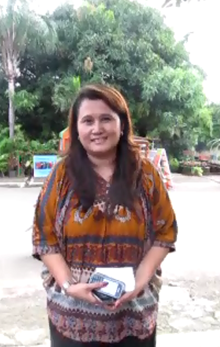
As she is expecting a baby, she found the most valuable information to be about pregnancy. She felt it important to get that information on her phone because she is able to save the messages and forward them on to her friends who may not have the service on their mobiles. She strongly feels that if her friends knew about Info Wanita they would buy it. She feels the mobile information service is useful for women because it saved them researching on the internet or buying magazines as it came to them free with the mobile phone bundle. She also said that even if they had to pay for the service, as long as it was cheap enough, they would deem it worth paying for.
Read our account of our trip to meet Ruma Pulsa entrepreneurs who are working with Indosat to become retailers of Indosat’s products in their communities.