Empowering artificial intelligence for global good
Artificial Intelligence (AI) has rapidly evolved into one of the most transformative technologies of the 21st century, offering immense promise to drive meaningful impact. Despite its potential, its role in addressing global challenges by providing solutions tailored to the needs of local populations in low- and middle-income countries (LMICs) remains under-explored.
AI can help in early disease detection, predict crop yields for smallholder farmers, offer personalised learning experiences for students, and address climate-related challenges. It does so by analysing vast datasets, identifying patterns, and generating insights at scale. When used alongside established expertise and knowledge, AI becomes even more powerful and relevant to local needs.
In January 2025, The GSMA Innovation Fund for Impactful AI was launched, with funding from the UK Foreign, Commonwealth and Development Office (FCDO), with an aim to identify and support for-profit small and growing enterprises, including startups, leveraging AI and emerging technologies (e.g. mobile big data, IoT, remote sensing, computer vision, blockchain, and drones) alongside mobile technologies to solve real-world problems.
This blog outlines some of the trends we saw from the applications submitted and provides a snapshot of organisations seeking funding to support their impactful AI solutions.
Geographic distribution and organisations profile
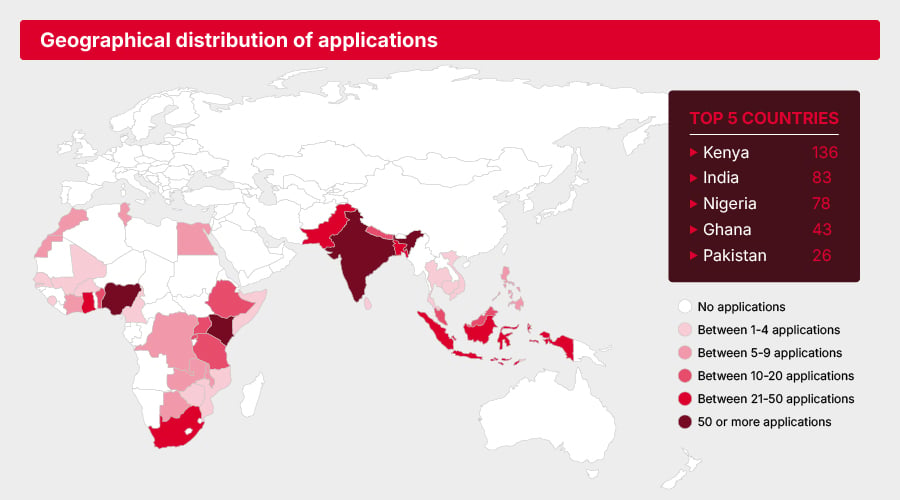
We analysed 625 applications from 40 countries across Africa, Pacific, South and Southeast Asia. Two-thirds of these came from African countries, with the highest concentration being from East Africa. Five African markets accounted for nearly half of all the applications: Kenya (22%), Nigeria (23%), Ghana (7%), South Africa (4%) and Uganda (3%). The majority of applications came from the tech hubs of the region, in line with our previous research. The remaining applications came from South and Southeast Asia, led by India (13%), Pakistan (4%), Bangladesh and Indonesia (3% each).
The GSMA encourages applications from local entrepreneurs, with a good representation of women and homegrown talent at all levels of the organisation. We know that grounding innovation in local realities not only strengthens the relevance and sustainability of interventions but also fosters a deeper sense of ownership among local communities.
Local entrepreneurs bring deep knowledge of their communities’ cultural, social, and environmental nuances, enabling them to design solutions that are aligned with local needs and more likely to be trusted and adopted. This proximity enables quicker adaptation, iterative innovation, and stronger feedback loops, critical in low-resource, complex and rapidly changing environments.
Notably, over 90% of the project applications we received were for solutions being designed and delivered in-country, and 78% came from companies founded entirely by local entrepreneurs. It was also encouraging to see strong gender representation: 58% of organisations had at least one female co-founder, and 10% were fully led by women founders.
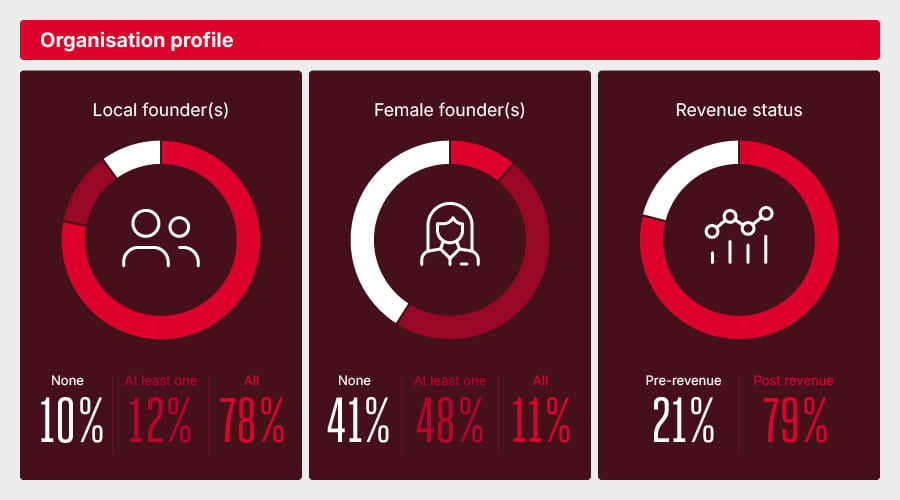
What is interesting to notice is that 79% of organisations who applied to the fund are more than two years old (average age 5.5 years). This highlights the demand for grant funding to de-risk AI and emerging tech-based innovations, even for established startups.
Although 58% of organisations have women in management, funding disparities persist. Male-led organisations receive 35% more funding than mixed-gender ones and over three times more than only female-led organisations.
Key focus areas of impact
Healthcare solutions dominated the pool of applications, with 20% of projects pitched focusing on this sector followed by agriculture at 15%. A remarkable 13% of applications were from startups focused on addressing digital inclusion challenges (i.e. local language content generation and translation, access to digital services through speech recognition and natural language processing, and accessible interfaces for people with disabilities). Another 12% of the applications focused on financial inclusion (i.e. credit scoring for the unbanked and financial education tools).
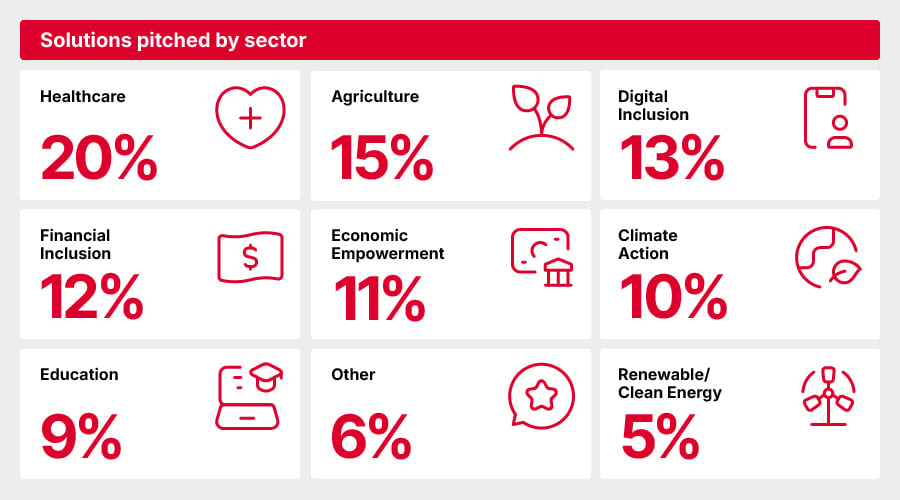

The significant focus on AI-driven healthcare and agriculture can be attributed to systemic challenges in these key sectors of the economy and society, including limited access to doctors and frontline health workers, unreliable crop yields and climate change. Financial exclusion and digital illiteracy are persistent systemic challenges that affect LMICs, especially the poorest, the most vulnerable and those living in rural areas. These challenges present opportunities for AI innovators to play a transformative role across these sectors, leveraging mobile phones and mobile technology for scalable and cost-effective interventions.
Among the proposed solutions, applicants suggested employing computer vision models to train and develop diagnostic tools, utilising natural language processing (NLP) to create voice-based conversational chatbots that provide information in local languages to underserved regions and applying machine learning for credit scoring and supply chain optimisation. These innovative approaches, coupled with the increasing accessibility of AI models, demonstrate the potential of AI to bridge critical gaps in LMICs, establishing a strong foundation for sustainable impact.
Use of AI and emerging technologies
Most applicants incorporated a mix of various technologies into their projects. Solutions included different technical components based on the focus area, the type of problem being addressed, and the end user profile.
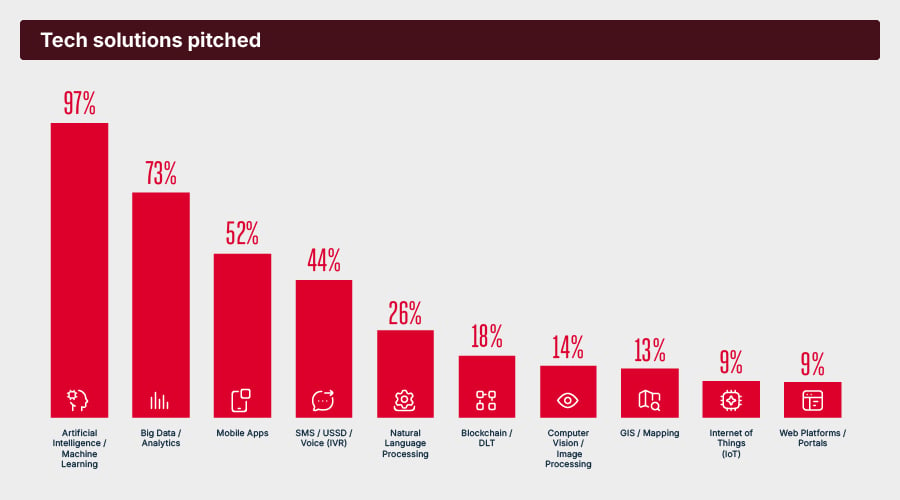
Applicants frequently proposed utilising a combination of emerging and legacy technologies within their projects. For instance, a mix of channels such as mobile applications, WhatsApp, IVR, and SMS were suggested to engage end-users with varying levels of access, budgets, and digital literacy.
Early-stage projects: Confidence in impactful AI
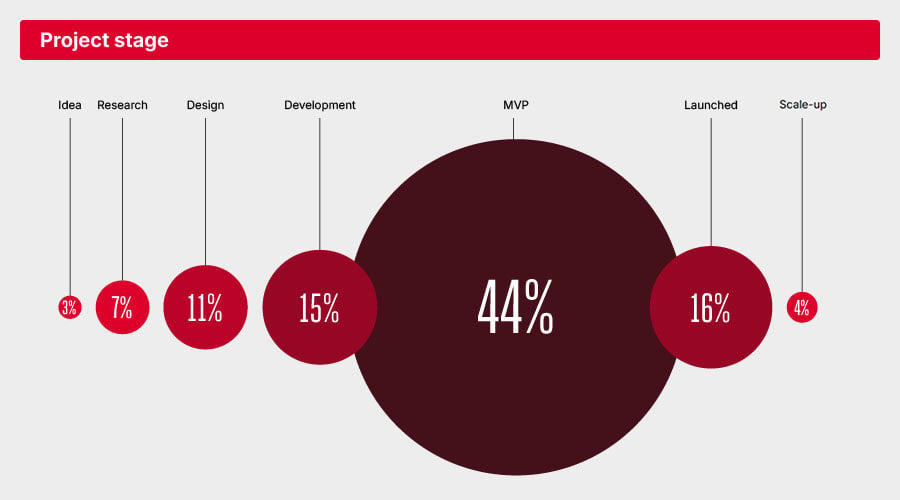
Eighty percent of all submitted projects were at the minimum viable product (MVP) stage or earlier, indicating a pipeline of early-stage innovation. Additionally, 62% of these early-stage projects were being developed by companies that have reached post-revenue status, which indicates that a notable proportion of market-validated organisations are engaging in AI and emerging tech-based product development focused on impact.
AI risk awareness: from privacy to plagiarism
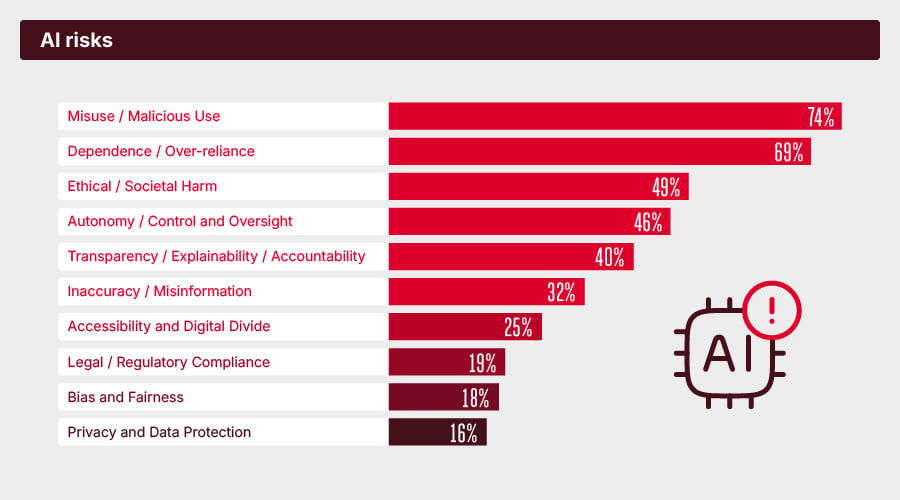
Applicants demonstrated a strong understanding of the complex risks associated with the use of AI and emerging technologies in impact-focused innovation. Among the most frequently cited concerns were issues relating to privacy and data protection, bias and fairness, and legal or regulatory compliance, indicating a clear recognition of fundamental ethical and governance challenges. Additionally, numerous applicants identified risks related to accessibility and the digital divide, inaccuracy or misinformation, and transparency, explainability, and accountability, highlighting their commitment to developing scalable, inclusive and trustworthy solutions.
Looking ahead
The GSMA Innovation Fund for Impactful AI is uniquely positioned to de-risk AI innovations by supporting startups as they test, adopt and scale innovative uses cases, partnerships and business models. A core principle of the fund is the use of AI in combination with supporting emerging technologies – such as Mobile Big Data, IoT, and remote sensing – as well as mobile technology, to create positive socioeconomic or climate-related impact for the world’s most vulnerable populations.
An announcement about the successful applicants and the solutions proposed will be made in November at the MWC Doha 2025. Before then, you can explore the full GSMA Innovation Fund portfolio of organisations here.
For more updates from Mobile for Development, please sign up to our newsletter here.