


The findings presented in this blog post are based on the recently released research report ‘Bridging the gender gap: mobile access and usage in low- and middle-income countries’. This blog was co-written with Shireen Santosham.
With a population of 250m, a unique subscriber penetr ation of 40%, and 3 mobile operators controlling over 80% of the market1, Indonesia is one of the largest and most competitive markets in the world when it comes to mobile. However, in the past few years the mobile market has experienced declining revenues that could hinder further growth of the market – a steep drop in voice usage, a decline in ARPU per connection, and consequently a decline in net profits that have affected to a certain degree all the major operators. Telkomsel, XL Axiata and Indosat, will need to diversify their consumer portfolio if they want to be competitive going forward, and focus on a market that so far has been largely overlooked and, consequently, untapped – women.
Women tend to own a mobile less than men, especially in certain segments
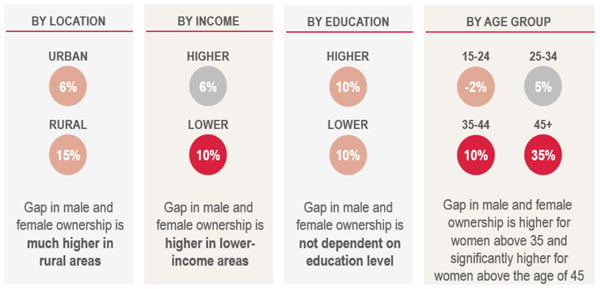
According to a recent report, women in Indonesia were found to be 10% less likely to own a mobile phone than men – this percentage difference translates into 5 million fewer women than men owning a mobile. However, this number masks a greater imbalance, which manifests itself as we focus on specific female segments. As Fig 1 shows, this imbalance is driven by factors such as income level and location, as well as age. Women in rural areas are found to be 15% less likely than men to own a mobile, and more likely to quote the poor network quality and coverage as one of the main reasons. Women coming from low-income households are also less likely than men to own a mobile, by 10%. This can be explained by the fact that women tend to be less financially independent than men, tend to ask permission before spending money, and are therefore significantly more sensitive to the price of the handset (or of the credit), which can in turn deter them from purchasing a mobile phone. Additionally, women above the age of 45 were found to be significantly less likely than men to own a mobile than their male counterparts, quoting the lack of understanding of the functionalities of the mobile phone and the fear to make a mistake as one of the main reasons explaining that. These findings speak for a large opportunity for operators to tap into these segments – for the rural women segment, for instance, operators should consider solutions to improve network quality, such as energy-efficient and renewable energy networks in off-grid regions and active and passive infrastructure sharing. To tap into the low-income female segment, operators should consider microloans and partnering with low-cost handset manufacturers to bring lower cost handsets to women, as well as creative tariff plans that appeal to women. To target women above the age of 45, operators should consider training and incentivising agents to help women getting familiar with the mobile phone and its functionalities, as well and creating services that are relevant and appealing to them. 2,
Fig. 1 – Difference between male and female mobile ownership by segment
Women’s mobile usage is less intense and less frequent than men’s…
Even when women own a phone, their usage of mobile is significantly less intense than men . This is especially true for more sophisticated services, such as mobile money, mobile internet and social media (Fig 2). Women also report needing more assistance than men. This can be explained by a lack of technical literacy and confidence by women when it comes to operate a mobile, as well as engrained social norms that make it harder for women to use mobile frequently, especially in more conservative areas of the country. Consequently, there lies a tangible opportunity for operators to accelerate the adoption of more sophisticated mobile services by women, by building a helpful and trusted agent network that can raise awareness and help build women’s digital skills, for instance by offering training on mobile services.
Fig 2 – % of women and men who reposted being able use the following mobile services without help
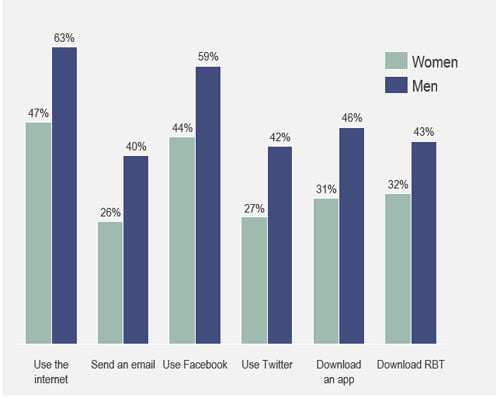
…especially for more sophisticated mobile services
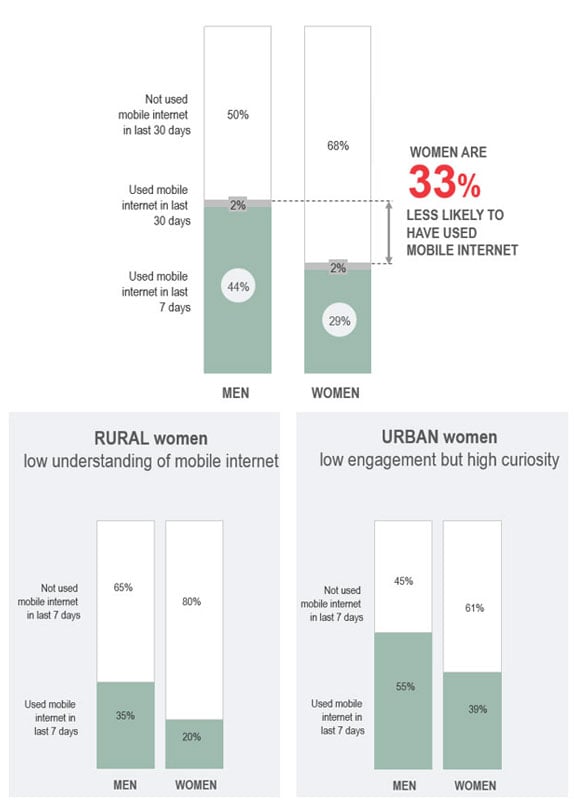
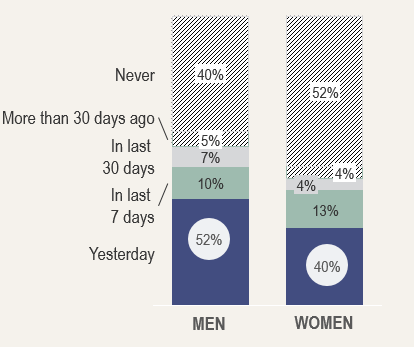
Even when women do use sophisticated mobile services, they tend to do it significantly less frequently than men. For instance, when it comes to accessing internet, women are 33% less likely to having accessed it via their mobile than their male counterparts (Fig 3). While this is true both for rural and urban women, it is worth noting that during focus group discussion women have shown a high curiosity about mobile internet and a propensity to learn how to use it, in order to better connect with friends and family, as well as to be able to monitor their children and connect with their spouses (Fig 3).
Fig 3 – Frequency of mobile internet use for women and men mobile owners (%)
When it comes to social media usage, women not only tend to be less likely than men not only to access Facebook and Twitter on their mobile, but they also tend to do it less often (Fig 4). This highlights that there is a clear opportunity for mobile operators to drive mobile data usage by supporting and encouraging women to use social media on their mobile. Interestingly, this is true both in rural and urban areas. And, highlights the need for more services with relevant content targeted at women.
Fig 4 – % of smartphone or feature phone owners who have ever used Facebook/ Twitter on a mobile
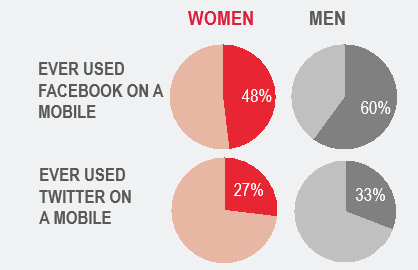
% of smartphone and feature phone owners who have used Facebook on their mobile
3 ways mobile operators can seize the opportunity
- Focus on women’s underpenetrated segments for mobile ownership – rural women, women from low-income households and women above the age of 45. These female segments tend to perceive, respectively, poor network quality and coverage, cost of handset and credit, and technical literacy and confidence, as key factors hindering them from owning a mobile phone, more so than men. To tap into these segments, operators should address these barriers, by considering energy-efficient and renewable energy networks in off-grid regions and active and passive infrastructure sharing; by bringing lower cost handsets to women through microloans solutions and creative tariff plans; and by training and incentivising agents to help women getting familiar with the mobile phone and its functionalities.
- Develop a helpful agent network to raise awareness of more sophisticated mobile services and develop women’s digital skills. This will help increase women’s technical literacy and confidence when operating a mobile, which will in turn lead to a more sophisticated and frequent usage of mobile services.
- Leverage women’s interest in social media to support mobile data usage. While women tend to use social media less frequently than men, they have shown a high curiosity and propensity to use social media such as Facebook and Twitter more often, in order to better connect with their children and spouse. Mobile operators should capitalise on that as it has a clear potential to drive mobile data usage
1. Source: GSMA intelligence
2. For more information please see ‘Bridging the gender gap: mobile access and usage in low- and middle-income countries’. The Indonesia country profile can be found at page 82.
Image Courtesy of Qualcomm® Wireless Reach™