


Green Power for Mobile’s fourth Asia Working Group took place in the hospitability of Indonesia’s capital on September 25th-26th, in partnership with the IFC (World Bank Group) and IBS Towers. The 66 participants represented 38 different companies, including Mobile Operators such as Axis and Smartfren (Indonesia), Ncell (Nepal), Robi (Bangladesh); as well as Energy Service Providers (ESCOs) such as Fluidic Energy, Narada or Heliocentris and government bodies from the regulatory and ICT Ministry of Indonesia. It was a successful event and a clear progress in terms of growing the green power for mobile industry since last year’s Asia Regional Working Group in Cambodia.
Below is a highlight of what was discussed during the two-day event.
DAY 1
Opening Session – The State of the Industry
As co-host of the Working Group, the CEO of IBS Tower, Andrie Tjioe, , opened the first session on the region’s green power market. Mr. Tjioe highlighted the opportunity for this event to bring forward the best practices of the sector and confirmed IBS Tower’s support of the country’s effort to green the industry. In the same tone, Mr. Bunyamin Sura, from the Ministry of ICT, stressed the need for green telecoms initiatives to scale up and move away from the sector’s traditional power usage of diesel in remote areas.
GPM’s Asia Project Manager, Ali Imron, presented the position of Indonesia, explaining that in the last 4 years there has been a focus on Bangladesh, Pakistan, Afghanistan and Indonesia. Indonesia holds a great opportunity for green power as the leader in terms of unique mobile subscribers and number of towers (155,000 across the country). Also, when combined, these four countries have 213 million people with no access to electricity.
Currently, to power the 3,500 off-grid towers installed in these four countries, MNOs need to spend a total of US$79 million. In Indonesia alone, its 874 off grid towers require an investment of US$19 million. MNOs also need to add the cost of powering unreliable sites [1]. Indeed, powering the four countries’ 14,500 unreliable grid sites amounts to US$209.5 million a year. As the number of off grid and unreliable grid towers continues to grow, the costs of powering those sites will only increase. Therefore, there is a real opportunity for MNOs to capture savings by converting to green power solutions.
On this note, Dr Riant Nugroho, Commissioner of the Indonesian Telecommunications Regulatory Authority, highlighted Indonesian President Yudhoyono ’s 2009 decree to reduce C02 emissions from 40% to 26% by 2020. However, since then no green regulations have been put in place. Dr. Nugroho affirmed the need for action and presented the regulatory roadmap to be put in place for the next 3 years.
Challenges of Going Green – Experience Sharing
The afternoon session focussed on operators’ Smartfren, Axis and Robi experiences in the green sector and energy efficiency. The MNOs agreed that they are open and even in need of new technology and green solutions – highlighting they’re being agnostic about the technology – only the problem remains high capital expenditure. The vendors are asked to do an effort and create “a middle ground”,i.e. a reasonable price, in order for MNOs to delegate the responsibility of energy management to them. The market is still nascent and needs to make more business sense for it to pick up, and for this to happen both operators and vendors will have to work together.
Mr. Mohuiddin Babar, VP CSR for Robi ,broadened the topic by highlighting the social and economic impacts of green power. Robi increasingly promotes a tower sharing model in Bangladesh and is currently implementing a project that uses solar powered home systems for communities.
Battery companies have transitioned as the market matures, and are now looking at the needs of the end-user and identifying right prices as well as identifying new variants to power batteries, from fuel cells to lead or wind to solar power. Vendors are also looking for partnership and collaboration with operators as well as battery manufacturers to find the best technology given the local context. Again, there is no one-fits-all technology solution.
DAY 2
Reality Check and Business Innovation – How to Scale Up Green Power
After identifying some of the main challenges, the second day of the Working Group focused on ways to scale up the green power telecom industry – as Fluidic Energy explained, the Diesel Genset is still the most “universal” and versatile Power-Backup solution. In line with this need to scale up, Soleq Private Equity fund highlighted their aim to invest up to US$200 million into telecom green power solutions, in Asia in the coming years, offering an interesting OPEX model for operators. Solution provider Alta Energy brought up the need for remote monitoring and data collection to identify battery and power needs (which battery performs best, which tower requires maintenance) at the sites.
The question around the role of each of the industry’s actors was raised. Speakers agreed that operators should focus on revenue generation and leave the power management to third party service providers (the OPEX model) which would make for better ROI. The role of the community was also discussed as it is seen as both the biggest supporter and threat to power management. To answer this dilemma the best solution is to involve the community in the projects, which will considerably lower risks of theft and maintenance. Dr. Idris Sulaiman from Meaningful Broadband confirmed the importance of community power empowerment and highlighted the World Bank’s initiative on Smart Green Projects. However, the audience was not receptive to those initiatives, showing a certain disconnect.
Green Deployments – 2009 to 2013
The deployment of green power in the region has significantly increased in the last four years, as the figure below shows:
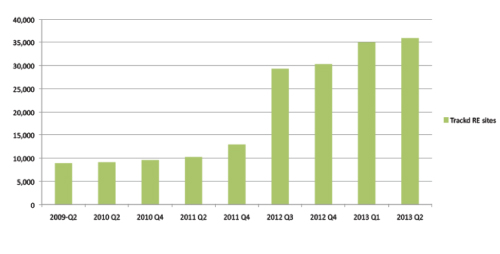
Most of the current 35,908 green sites are solar-powered and approximately 4,500 of them use an OPEX based ESCO model. The majority of green sites are in Asia, with China leading the way (20,000 green sites) followed by Indonesia (4,600), India (+3,000), Cambodia (1,500) and Nepal (+150).
Break –out Session – Next Steps
The Working Group split into two smaller groups to discuss the next steps needed for green power to scale up. The need to raise awareness and educate the industry was stressed a few times by the participants: it is essential to understand really what “green is about” and move away from what Narada called “green poisoning”, referring to the negative impact of green company policies which risk to slow the business.
Also, despite the disconnect mentioned earlier, participants agreed that there was a need for government action in order to help green power to grow while still making good business sense. Partnerships remain one of the most important requirements for the industry to develop, between government, Vendors/ ESCOs, mobile operators and tower companies. The OPEX model is encouraged as a good economic option for MNOs, but then again, as it is for technology, there is a need to identify the right local solution – different customers have different needs: context is key.
[1] GSMA defines an unreliable site, one that is subject to power outage of more than 8 hours a day.