


This blog post was co-written with Gunnar Camner.
Pakistan’s branchless banking market has become one of the most competitive in the world. With more than 17m transactions per month[1], there are no less than 8 active players in the market, five of which are mobile operators and three that are banks.
The market is strongly OTC (Over-the-counter) driven and 81% of transactions[2] are completed in this manner, according to the State Bank of Pakistan (excluding Agent Transactions for Liquidity Purposes). The take-off of mobile wallets in Pakistan remains a challenge mainly due to a combination of constraining KYC (Know Your Customer) and transaction limits.
18 months ago, Mobilink launched its mobile money service Mobicash, jumping in the game against Easypaisa, U Paisa, UBL Omni and others, making the market even more competitive. In this blog post, I want to highlight what has made Mobilink achieve their successful results since the launch. There’s no secret recipe, and Mobicash’s success came from leveraging market best practices and improving and focusing on operational efficiency and excellence:
- To ensure liquidity at the agent level, Mobicash extended credit to its channel, demanding commitment on a minimum level of investment from agents in return. This is being tracked through a credit monitoring system.
- Mobicash set up dedicated helplines for both the agents and end-consumers to provide industry-best customer service.
- Dedicated MFS Business Development Officers were integrated with the selling channel to engage agents and consumers on Mobicash.
- An extensive visibility drive was carried out for Mobicash to ensure better customer recall and brand presence. Both ATL and BTL communication channels were utilised.
Rapid agent onboarding is ongoing to increase the financial network across Pakistan. With over 35,000 agents onboard, Mobicash has become the fastest-growing MFS deployment in Pakistan.
Some number given below for reference:
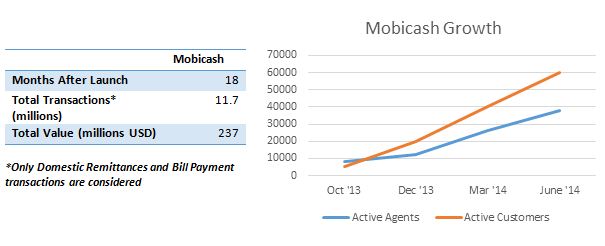
Rapid growth, increasing competition
However, Mobicash’s rapid growth has increased the level of competition on OTC transactions. Even though the number of agents is growing, many were agents for other deployments previously. This means that agents are working with a number of mobile money providers, who in turn start to use increased agent commissions as a means to drive transactions and take market share. This has led the market to an agents commissioning war, putting the agents in a position where they can choose which service they want to use for the customer and leaving the operator without any direct link to their end-user.
In addition, the ability to effectively manage agents through commissions and KPIs becomes more difficult, as some of the agents have relationships with multiple providers, and can then play them out against each other for the best deal – this is the effect of OTC where the agent-customer relationship becomes stronger than the customer-service provider relationship.
Going forward, the challenge for Mobilink and other mobile operators in Pakistan will be to grow the number of mobile wallets, which would give the customer more choices and uses for the mobile money services, making them less dependent on agents to do basic transactions.
[1] Branchless Banking Newsletter – Jan – Mar 2014
[2] Branchless Banking Newsletter – Jan – Mar 2014