


(Lessons learned from over 2,000 small-scale farm households in Ghana)
This is a guest blog written by Alloysius Attah, the Co-founder/CEO of Farmerline, and Michele Messina, a Consultant at International Development & Humanitarian Action.
It’s no secret that mobile phone penetration is on the rise and nearly half of the world’s population now uses mobile communication. Close to 1billion mobile subscribers were added just in the last 4 years alone. As Jeffery Sachs rightly stated, “the mobile phone is the single most transformative tool for development”. It has led to a significant increase in the number of Mobile for Development services being launched in emerging markets. Whiles these mobile services have achieved great strides in recent years; they are still primarily delivered through SMS. Despite the wide spread of SMS used as a delivery channel for mobile-enabled services in emerging markets, native voice and IVR services over the mobile phone also provide compelling opportunities for scale and profitability. You can read more about the unsung opportunities that voice brings to both social entrepreneurs and mobile network operators here.
Farmerline is one of the few ICT4Ag companies born out of native voice and IVR over the mobile phone. For the past year, we delivered voice services to over 2,000 small-scale farmers across Ghana. Farmerline is a technology product company that builds supply chain and value chain solutions to integrate agricultural outputs of rural farmers in Africa/emerging markets. As a service specifically focused on smallholder farmers and organizations that need more access to them, we are able to use our voice technology to link farmers to markets, finance, weather forecast, new farming tips, inputs dealers and equipment services. You can learn more about Farmerline in this video.
Whilst deploying our voice technology and developing content for farmers in various local languages in Ghana, we made some great progress and some learnt lessons that I want to highlight in this blog post.
KEY FINDINGS AND LESSONS LEARNED
1. Farmers don’t just use dumb phones
The Farmerline voice system works with all categories of mobile phones in the market and this was witnessed during some of our field visits/sensitization workshops. There are basically three (3) categories of mobile devices in the market. These are:
i) Smart phones
ii) Feature phones and
iii) Dumb phones
All these categories of phones were used by our farmers and so offered us the opportunity to see how comfortable each farmer felt with using the various features of our voice system.
Please find below snapshot of mobile phones used by some of farmers;
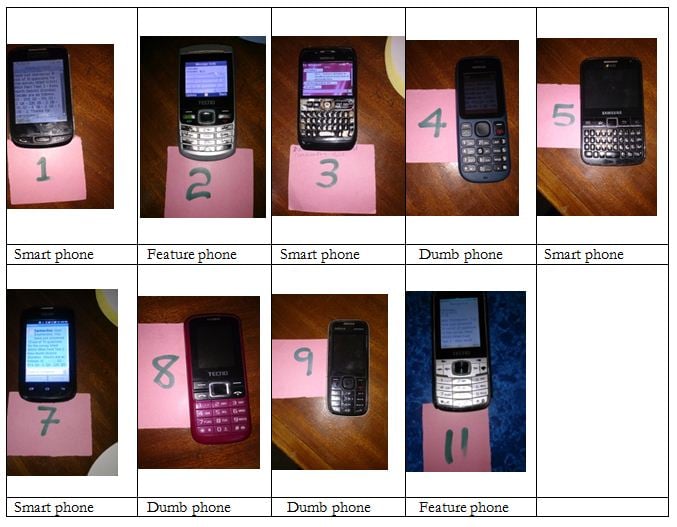
Fig 1: Snapshot of mobile phones used by most farmers
2. Mobile voice surveys cut costs but need careful design and training
For mobile voice surveys, we conduct immediate surveys with thousands of farmers at a fraction of the cost of in person surveys. This allows us to solicit feedback from various farmers and also to measure the impact of our services. We learnt the following:
- We noticed however that, phones with the “qwerty” keypads found it challenging initially to respond accurately to the questions administered via voice recordings. This is because, most farmers mistakenly press the alphabets instead of the numeric keypads and the system does not recognize alphabets as a data format.
- Questions on population size and numbers presented small ‘tricks’ and were answered wrongly by farmers without prior training. They were answered correctly in communities after training and sensitization.
- The system sends confirmation SMS messages to each farmer with the answers provided to each survey question. This proved to be useful as far as instructions on how to interpret this messages are provided during sensitization workshop and training.
3. Tips for voice messages & notifications
For outgoing messages or voice notifications, native voice is recorded and played for famers over their mobile phone. We noticed that farmers were able to absorb the content of the messages more easily because it’s in their local language of choice. To improve the farmers’ experience, organizations using voice notifications must observe the following:
- Introduce your organization and state the purpose of the call at the beginning of each message. This is because farmers tend to drop anonymous messages. They also drop calls that are too fast and are without any break at the beginning. It’s advisable to leave at least 3 seconds break at the beginning of each message.
- The average listening rate of most messages is between 2-3 minutes. Messages longer than this suffer a low response rate.
4. Challenges and opportunities for the Farmer Helpline/IVR
The Farmer Helpline/IVR service has not been widely adopted by most farmers yet. The feedback we received from farmers is that it’s more expensive for them to access information by calling a helpline as compared to receiving specific and timely voice messages customized to their location and crop types. They don’t want to stay online for a long time or navigate through a series of menus to access information.
Case Study: Using IVR and voice surveys for emergency assessment
We however experimented the use of IVR and voice surveys in a completely new area, rapid needs assessment in the area of water and sanitation in case of a disaster. This might be the first time ever that someone tests IVR and voice surveys for emergency assessment.
In this case, we learnt the following:
There is good potential for the use of the IVR systems for rapid assessment in emergencies. The system:
- Can work with ‘dumb’ phones
- Can produce information in a few days
- Is easy to use (compared to systems based on SMS)
- Is inexpensive and free for field staff using their own mobile phones
- Agency’s field staff can “flash” or buzz the system every time they have new data to report
- Summary of the data received can be sent via SMS to supervisors and decision-makers in real time.
- The system can send instructional messages to field staff via SMS based on the data that they reported compared to national emergency standards.
Training on IVR and needs assessment to agency’s field staff is essential. By comparing the results of two IVR Field Test (one with no training and the 2nd with training), the reliability of the information captured increased from around 40% to 90%.
The confirmation SMS message that the IVR system sends to each participant with the answers provided to each question proved to be useful and increases accuracy. Motivational messages are welcome by participants.