


The post is written by Kenny Ewan, the Programme Manager at Cafédirect Producers’ Foundation.
WeFarm is a worldwide peer-to-peer knowledge sharing network from the Cafédirect Producers’ Foundation (CPF). It has been designed by and for smallholder farmers. The content is created by the users; sharing their knowledge and ideas from farmer to farmer across continents and languages, and enabling people with no access to the internet to harness its power, through even the most basic mobile phone.
Over the last 2 years we have been designing and building the WeFarm platform, and piloting it with farmers in Peru, Kenya and Tanzania. Here are some of the key things we have learned in the process:
The reality of the context on the ground…
During the project planning phase we carried out baseline surveys with smallholder farmers in our pilot communities. We found:
- Average education levels greatly vary between Africa and Latin America. While 35% of Peruvian coffee farmers received a secondary school education, this drops to just 11% in Kenya.
- A typical coffee farmer in Peru earns around 77p per day, but for a rural tea farmer in Tanzania, this falls to just 11p a day.
- Access to mobile phones is growing quickly, but availability of internet remains low. ~90% of our smallholder farmers had regular access to a mobile, but only 7% regularly used the internet.
- Of the 199 people surveyed, there was an amazing 11 different languages spoken!
Peer to peer knowledge sharing works.
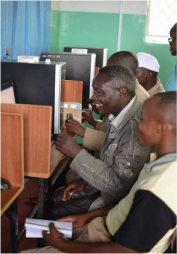 One of the fundamental ideas behind WeFarm is that rural, small-scale farmers around the world have plenty of innovative ideas, as well as generations’ worth of farming knowledge. However, with 90% lacking internet, they have limited ability to share or access this information. The developed world has become accustomed to using tools such as Google and Wikipedia to ‘crowdsource’ knowledge from the other side of the planet – WeFarm uses ‘text to web to text’ technology to bring this same ‘crowdsourcing’ philosophy to isolated farming communities.
The advice which has been shared through WeFarm to date highlights the vast potential of this, for example Jacob Gituma, a WeFarm pilot member in Kenya, was supported during the setup of a rabbit keeping micro-enterprise on his farm. WeFarm members in Peru and Tanzania helped him to calculate how much the rabbits would cost to keep, and predict his profit margins.
Useful information on topics such as pests and diseases, fertilization, income diversification, and soil management has also been shared across languages and cultures.
International communication is important…
A good example of potential collaboration between farmers in different countries is on information relating to climate change in tea and coffee growing areas. Pests and diseases which were once only found in certain parts of the world, are now becoming more commonplace as the climate changes in Africa and Latin America. Farmers who have dealt with these ‘new’ diseases for many years, such as pests that attack coffee, are ideally placed to provide advice when these diseases reach different parts of the world.
To find out more about WeFarm visit www.wefarm.info and follow us @we_farm