


This blog post was written by Rahul Shah with inputs from Quijano Flores, COO, NextDrop.
Earlier this year, the Mobile for Development Impact team delivered a study of NextDrop, an M4D Utilities grantee. The purpose of the DFID-funded study was to analyse NextDrop’s engagement with two key stakeholders – end-users and valvemen – and propose recommendations to increase overall engagement and improve quality of service. The study used advanced data analytics on NextDrop’s existing transactional data, as well as qualitative and quantitative research. Three paths forward were envisioned for NextDrop and recommendations were developed for each. The full report and executive summary are available for download.
NextDrop leverages mobile technology to provide critical information by SMS on water supply so that:
- End-users can save time because they don’t spend it waiting for water
- The Bangalore Water Supply and Sewerage Board (BWSSB) can leverage the aggregate network-wide data to improve water delivery
The accuracy of the information depends on the data shared by two categories of individuals:
- Valvemen: to accurately provide the supply times
- End-users: to ensure the mapping of the water network is accurate
You can visit our previous blog for details on how the NextDrop service works and the advantages and challenges of deploying a mobile app for valvemen reporting.
Removing bottlenecks
Before the study could be initiated, NextDrop needed to explain its processes to the research team. It is a natural tendency in all organizations for white spaces and assumptions to build over time. This tendency is exacerbated in start-up organisations who are perpetually under-resourced and constantly playing catch-up. As NextDrop documented its processes, a few holes began to surface.
For example, there was a large fallout (nearly 30%) between the Registration and Consent stages in NextDrop’s customer journey (Figure One). To be on the safe side, NextDrop was operating under the assumption that the Do Not Disturb (DND) regulation in India requires even registered users to provide explicit consent to receive informational messages. Once the scale of the fallout became evident, NextDrop sought legal opinion on the matter and are close to finding a solution that ensures compliance with the law, while being able to solicit feedback from all registered customers.
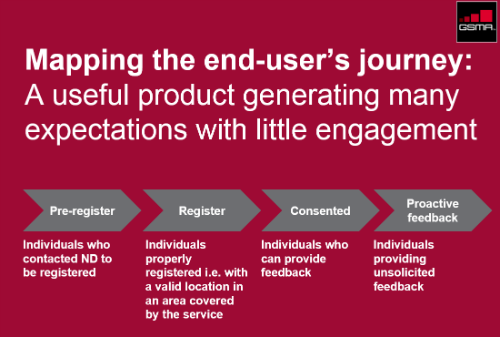
Figure One: the end user customer journey (slides 14-25 of the full report)
Finding alternate sources of information
By design, NextDrop is totally dependent on valvemen (Figure Two) for information on water supply timings. While about 47% of valvemen in the NextDrop service areas are frequent users, NextDrop needs the rest to also report as often as possible. At the same time, even valvemen who report often tend to do so in batches rather than for each valve. Batch reporting makes the water alerts moot in most cases as the accuracy of the timing of the water is lost. NextDrop has been trialling a variety of approaches including incentive plans for valvemen and making reporting less intrusive for them to avoid this issue.
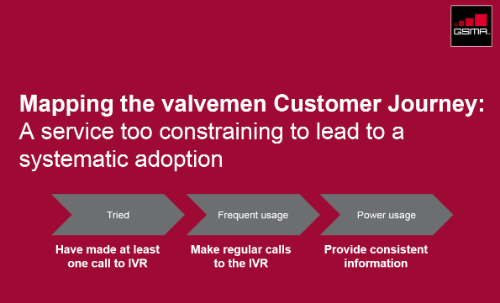
Figure Two: the valvemen customer journey (slides 26-40 of the full report)
One of the potential paths forward (Figure Three) for NextDrop is to use automation to gather information. This would require significant investment of time and money but would entrench NextDrop into its customers’ operations thus creating a defensible position against competition. In the near term, NextDrop has begun to experiment with an alternate strategy of crowdsourcing information from end-users. Users can now give missed calls to one of two numbers to indicate that their water supply is on, or that they are waiting for water. In the first four weeks, NextDrop has logged 2,000 calls on these two lines. It remains to be seen whether this spurt is temporary or whether end-users will stay engaged because water is a necessity.
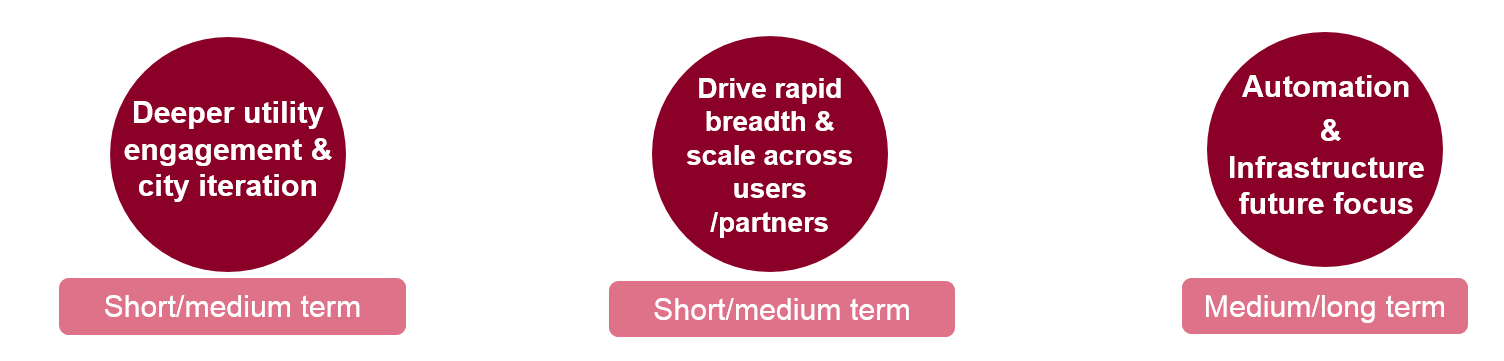
Figure Three: Potential pathways forward (slides 41-55 of the full report)
Revenue streams
The GSMA grant has funded a successful trial in a large part of Bangalore that has helped NextDrop prove the value of its service to the BWSSB who have recently issued a tender to expand the service to the rest of Bangalore. Thus, NextDrop (if it wins the bid) will begin to realise revenue from its Business to Government (B2G) service stream. NextDrop views its service to utilities as its core offering through which end-users’ problems are solved and consequently NextDrop’s brand is built. However, this revenue stream will grow slowly as NextDrop convinces each utility individually.
An alternate and complementary Business to Business (B2B) revenue stream has recently emerged that allows NextDrop to monetise its brand equity. Corporates like fast moving consumer goods (FMCG) companies want to leverage NextDrop’s user base for advertising and promotions. Such B2B contracts are fixed term but renewable and provide NextDrop financing for new trials, much like the GSMA grant did.
There is an inherent assumption that NextDrop will be able to build its brand equity by being the communication channel between utilities and end-users. As the surveys showed, users have a positive view of NextDrop even though the majority of them say that water alerts are only sometimes accurate. Will NextDrop’s brand suffer if people have the misconception that NextDrop will solve their water problems when NextDrop gathers, analyses and presents information to the BWSSB but exercises no direct control on the water network?
In your opinion:
1) Should NextDrop work actively to position itself as the communication channel rather than the problem solver in the end-user’s mind?
2) By doing so, will NextDrop undermine its own brand and therefore its B2B revenue stream?