


Photo source: Business Daily, Kenya Power eyes sh1bn in County Fibre Optic Expansion http://goo.gl/i2mVqx
Kenya Power and Lighting Company (KPLC), Kenya’s national energy utility, has unlocked an innovative business model through the installation of fibre optic cables alongside its grid infrastructure to improve monitoring and management, while also leveraging this for new partnerships with mobile operators and internet service providers (ISPs).1 Aside from generating increased revenue for themselves, KPLC’s new model benefits mobile operators and ISPs, ultimately increasing access to internet, energy and other essential services to bottom of the pyramid consumers.
Armed with new data capabilities, KPLC uses the fibre optic connection for remote management of their grid while leasing out additional capacity to businesses with large data demands.2 Through this business model, KPLC is able to leverage existing infrastructure to generate additional revenue, while staying focused on their core service of balancing the grid and delivering electricity to consumers.
So what is the addressable market that utility companies like KPLC can tap into?
In developing markets internet penetration and access to energy remains low. For instance, in Sub-Saharan Africa alone some 580 million people (~32% of the population) had no access to electricity in 2013.3 In the same year, only 30% of people in the developing world were reported to use the internet.4 However, GSMA predicts that rapid adoption of mobile internet services will lead to a doubling of unique mobile internet users in the developing world from 1.5 billion in 2013 to 3 billion in 2020.5
Figure 1: Growth in Unique Mobile Internet Subscribers
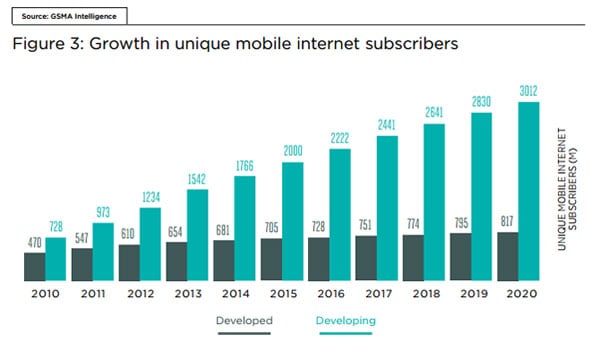
Source: GSMA, Digital Inclusion Report 2014
These forecasts present an attractive proposition for energy providers to increase their revenue streams. By bundling data with electricity services, energy utilities can generate income from leasing that can ultimately help finance grid expansion. KPLC is already leasing their extra data capacity to companies such as Safaricom, Airtel, Liquid Telecom, Jamii Telecommunications and Wananchi Group. They anticipate this new revenue stream will generate KES 1 billion (US$ 10.8 million) by the end of 2017.6 At the same time, investment in grid expansion is costly, and new connections to underserved areas may be slower to recoup the capital expenditure. KPLC can therefore reduce the risk of capital expenditure on these grid connections paired with fibre communication, by selling bulk data capacity to ISPs and telecoms.
Simultaneously, this leasing opens up new markets for ISPs and telecoms to provide data services where cap-ex requirements are otherwise too great. For example, fibre networks are already present in the urban centre of Nairobi, yet the costs for a single ISP or telecom to expand fibre in more peri-urban and rural areas is prohibitive, and potentially restricted by lack of power. With KPLC installing both grid and fibre, then leasing data capacity, it lowers the barrier to entry for companies to grow revenues in new markets. The benefits also flow back to KPLC as internet access drives more energy consumption on devices.
Additional benefits of fibre implementation for KPLC and other utility service providers include smart metering at the consumer level, beyond main line management. Energy and water utilities alike can decrease losses and improve operations through real-time information about household consumption. Pre-payments via mobile money can be sent remotely to smart meters, replacing tokens or codes for transferring credit to meters. Indeed, Safaricom already advertises utility metering as one of the benefits to customers from connecting buildings to the fibre network.7
Sharing and leveraging infrastructure between utility service providers and communication providers can unlock new revenue streams for both partners, whilst creating more affordable models of providing bottom of the pyramid customers with basic services. The mobile industry is well-aware of these gains demonstrated by the growing trend toward sharing tower infrastructure to reduce costs. Therefore, we expect to see more mobile operators and energy companies in other markets follow this innovative partnership in Kenya, to provide the underserved with access to basic services.
1. [Business Daily, Kenya Power eyes sh1bn in County Fibre Optic Expansion, http://goo.gl/i2mVqx]↩
2. [Kenya Power Website, http://goo.gl/7FrX2e]↩
3. [GSMA, Sizing the Opportunity of Mobile to Support Energy and Water Access https://www.gsma.com/solutions-and-impact/connectivity-for-good/mobile-for-development/wp-content/uploads/2013/12/Sizing-the-Opportunity-of-Mobile_Nov-2013.pdf]↩
4. [ITU, World Telecommunication/ICT Indicators database 2014]↩
5. [GSMA, Digital Inclusion Report 2014, http://goo.gl/ud5zIS]↩
6. [See 1]↩
7. [http://www.safaricom.co.ke/business/connectivity-solutions/fibre-to-buildings]↩