


Islands of Connectivity
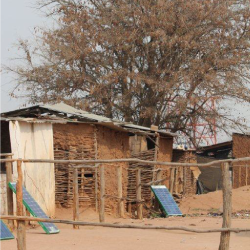 From Muxuenge in the province of Sofala, the sandy road west heads 80 km to the town of Chitobe, soon leaving behind a power line and any evidence of easily accessible water supplies. It is a dedicated task to receive an SMS on your mobile phone along a route with unreliable mobile coverage and no electricity!
Arriving just before dusk in Chitobe, there is hope that the isolated diesel-powered mini-grid will light the streets, but without funding for fuel we instead see a few indoor lights and the occasional noise of a TV or radio and proof of the free enterprise required to attain and provide services using solar power and car batteries. During the day the market streets, alleys and roofs are scattered with solar panels brought in from Harare and Johannesburg, vastly overpaid for by earnest shopkeepers and bar owners.
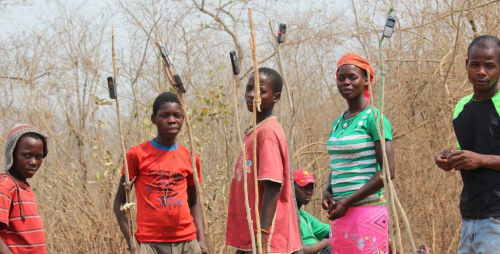
Sticks used to help get better mobile connectivity in underserved Sofala
“Bem Vindo a Carga de Telefones”: Welcome to Charge Phones
All three mobile service operators have towers in in the town, but while there is no grid-power (like 97% of other rural households in Mozambique), kiosks and barbers make good business at about US$0.30 per phone charge. This was the same price as one large torch battery and one large candle on sale. Some businesses provided a large variety of phone model charging plugs, as well as universal battery chargers (preferred by customers so they can keep the handset to avoid theft) and if they had more sockets and power, they would charge more phones.
Under the Grid but un-Powered
There was clear evidence of an unmet demand for electricity services in communities living across areas without power grid distribution, and this was the case even for those living directly under power lines (and fibre lines) because households cannot always afford connection and service without prepaid facilities.
With Power comes Water
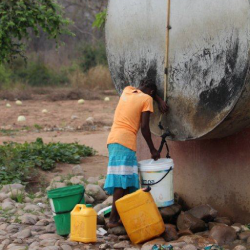 Medical centres were in places provided with solar-powered water pumps with the ability for storage, but not always offered as a community-wide service. This did provide opportunity for a keen enterprise to earn a living from a diesel-powered water pump where free hand-pumped taps are on the other end of the village.
We look forward to the next opportunity to return to Mozambique and sharing news on the horizon of funding opportunities for off-grid energy services.